“A heavy legacy”… What challenges does the Iraqi prime minister-designate face?
“A heavy legacy”… What challenges does the Iraqi prime minister-designate face?
2026-04-30
 Shafaq News – Baghdad
Since 2003, Iraq has witnessed profound political transformations that have directly affected the nature of the transfer of executive power, with a number of figures succeeding each other as Prime Minister within different internal and external contexts.
This path began with Iyad Allawi, who led the interim government after the fall of the previous regime, then Ibrahim al-Jaafari in a transitional phase characterized by institution-building, followed by Nouri al-Maliki, who ruled for two terms and whose term witnessed the consolidation of a system of governance based on political balances.
Then came Haider al-Abadi in a complex security situation during the war on ISIS, then Adel Abdul Mahdi, who ended his term under pressure from the October protests, then Mustafa al-Kadhimi, who took over managing a sensitive transitional phase, and finally Mohammed Shia al-Sudani, who came as a result of the 2021 elections.
This sequence reflects a political pattern based on compromises and settlements, where governments were often formed as interim solutions for managing crises rather than as long-term reform projects.
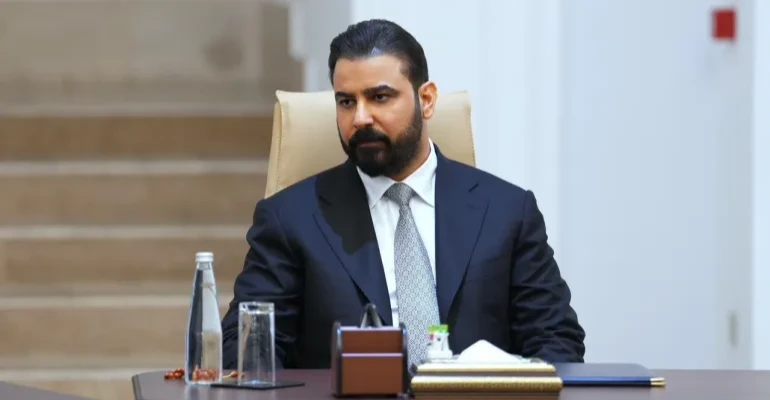
Within this context, the nomination of Ali al-Zaidi comes as an extension of this path, burdened with a heavy political legacy that requires him to deal with an intricate system of interests and balances.
Al-Zaydi’s nomination
The nomination of Ali al-Zaidi is presented in political discourse as a step that bears different features from the pattern that has governed the political process since 2003, as the focus is on him being outside the traditional framework of some of the forces that have run the government during the past years.
In this context, Fahd al-Jubouri, a leader in the Wisdom Movement led by Ammar al-Hakim, told Shafaq News Agency that the issue of choosing the new prime minister-designate is outside the general context, as it is far removed from the political system that has ruled since 2003, and it is considered the beginning of a new political phase away from the traditional forces, and thus it will be the beginning of a new kind of political work in Iraq with a new prime minister.
This proposal reflects an attempt to give a new character to the selection process, but the general context in which the nomination took place, and the forces that supported it, indicate the continuation of the same mechanisms of political consensus.
Thus, the discourse of change becomes linked to the ability to implement it actually, not merely to a political description, especially in light of the continued use of the same tools that governed the formation of previous governments.
political support
Al-Zaydi’s nomination also enjoys the support of influential political forces, but this support is accompanied by clear expectations regarding the nature of the upcoming government performance.
In this regard, Ali Al-Ahmad, a member of the Progress Party headed by Mohammed Rikan Al-Halbousi, affirms that the party, as the largest Sunni component on both the political and social levels, supports the option that emerged from the coordination framework in choosing the Prime Minister.
Al-Ahmad told Shafaq News Agency that this agreement came after challenges and a long period of discussions, noting that the proposed figure is characterized by being non-sectarian and capable of managing the next stage.
In a related context, Al-Ahmad stressed the importance of addressing key issues related to achieving political balance, addressing the issue of displaced persons, and returning residents of areas such as Al-Awja, Jurf Al-Nasr (formerly Jurf Al-Sakhr), in addition to building balanced relations with neighboring countries.
This perception represents the nature of conditional support, where political endorsement becomes a framework that sets the government’s priorities and restricts its room for maneuver, leaving any prime minister facing a web of overlapping obligations.
Factions equation
Armed factions are among the most prominent actors in the Iraqi political scene, as their role goes beyond the security dimension to include influencing political decisions.
In this context, Kazem Habib Al-Fartousi, spokesman for the Sayyid Al-Shuhada Brigades (one of the most prominent armed factions in the country), says that “the premiership in Iraq is a constitutional entitlement that represents the Shiite component.”
Al-Fartousi adds to Shafaq News Agency that the coordinating framework is the one that chose the Prime Minister, as he is a representative of the voters, noting that this choice reflects the political will of the current stage.
He continues, saying that the resistance factions emphasize the need for a genuine investment in the political process, and that the basic objectives of the government program should include achieving full Iraqi sovereignty.
These statements reveal the position of the factions as part of the governing system, as they present the concept of sovereignty from their own perspective, which puts the Prime Minister in front of a complex balance between the requirements of state-building and the positions of the influential forces on the ground, in light of a clear overlap between the political and the security.
economic challenge
The economic file represents one of the most pressing challenges, as Iraq suffers from a heavy dependence on oil revenues, with limited diversification of income sources, high unemployment rates, and continued administrative and financial corruption.
The crises that Fahd al-Jabouri referred to as “existing and undeniable” reflect a pressing reality that forces any government to operate within a narrow margin.
This reality necessitates deep structural reforms that include reorganizing the economy, activating productive sectors, and strengthening control over resources. However, these steps often clash with the entanglement of political and economic interests within the state, making the reform process slow and complex.
Relationship with the Kurdistan Region
The relationship between the federal government and the Kurdistan Region remains one of the most complex issues in the Iraqi landscape, as constitutional, political and economic dimensions are intertwined.
In this context, former member of the Kurdistan Region Parliament, Abdul Salam Barwari, says that “the tense relationship between the region and the federal government is not due to personal differences, as Kurdish leader Masoud Barzani has indicated on more than one occasion, but rather to the vision of the state.”
Barwari explained to Shafaq News Agency that the Kurdistan Region believes in the constitution and the Iraqi cause, which was founded on its principles, but there are those in Baghdad who still adopt the idea of a centralized state, which leads to a continuous misunderstanding between the two sides.
This vision reveals the depth of the disagreement related to the nature of the political system itself, as the problem goes beyond the limits of current disagreements to reach a difference in understanding the form of the state and its powers, which makes this issue one of the ongoing tests for any government.
Phase Management
Any Iraqi government faces a set of overlapping challenges related to the nature of the political system itself, where internal division is evident through the multiplicity of decision-making centers within the alliances, and the overlap between security and politics is embodied in the role of the factions.
The economic crisis continues as a constant source of pressure, along with the complexities of foreign relations and the need for a balance between international powers, as well as ongoing disputes with the Kurdistan Region.
These factors combined create a complex environment that makes governance more of a continuous crisis management process than a stable path to reform.
Dealing with these challenges requires a high degree of political maneuvering and understanding-building, as the success of any prime minister is linked to his ability to reconcile the different political forces and gradually strengthen the authority of the state, while avoiding direct clashes that could hinder stability.
Government performance is also linked to the leadership’s ability to put forward a realistic economic program, manage foreign relations in a balanced way, and open effective channels of dialogue with the Kurdistan Region, in accordance with the constitution and to reduce ongoing tensions.
shafaq.com
