An economy on the brink of collapse: The role of the parallel market in draining Iraqi dollars
An economy on the brink of collapse: The role of the parallel market in draining Iraqi dollars
4-1-2026
 Researcher Shatha Khalil
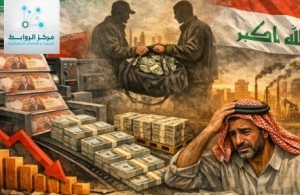
The Iraqi economy is currently experiencing increasing pressure on its monetary stability due to a combination of internal and external factors, most notably the repercussions of US sanctions on Iran. Official restrictions on dollar transactions with Tehran have led to the emergence of unofficial channels for obtaining hard currency from the Iraqi market, which has directly impacted the dinar’s exchange rate and caused its depreciation.
From an economic perspective, this phenomenon can be interpreted as a form of unregulated capital flight, where dollars are withdrawn from the economy without any corresponding increase in production. This behavior leads to an imbalance in the supply and demand for foreign currency, with demand for dollars rising in the parallel market while supply remains limited through official channels regulated by the central bank. Consequently, the dinar comes under continuous pressure, leading to its depreciation.
The impact extends beyond the exchange rate to the effectiveness of monetary policy itself. A thriving parallel market diminishes the central bank’s ability to control liquidity and manage monetary stability. As these informal channels expand, a significant portion of financial activity falls outside the purview of regulation, weakening economic policy tools and increasing uncertainty.
Furthermore, this phenomenon fuels the growth of the so-called shadow economy, an economy operating outside the legal and regulatory framework. This type of economy does not contribute to government revenue and is not subject to oversight, leading to decreased financial transparency and increased potential for corruption and smuggling. Moreover, the circulation of dollars outside the banking system creates a risky environment that may include illicit activities such as counterfeiting or money laundering.
One of the most immediate consequences of this crisis is the rise in imported inflation. Iraq relies heavily on imports to meet its basic needs, and with the devaluation of the dinar, the cost of imported goods increases, leading to higher prices in the domestic market. This impact is felt most acutely by low-income groups, exacerbating existing social and economic challenges.
At the regional level, the Iraqi economy appears as a weak link in the network of economic interactions, as it can be significantly affected by political pressures and sanctions imposed on neighboring countries. This reality highlights Iraq’s dependence on the dollar and its unbalanced trade relations, making it vulnerable to external shocks.
Given these circumstances, it becomes essential to adopt stricter and more comprehensive economic policies. This requires strengthening oversight of the exchange market, regulating dollar sales, and combating informal channels. Furthermore, a long-term solution lies in diversifying the Iraqi economy and reducing dependence on imports and the dollar by supporting domestic production and stimulating non-oil sectors.
In conclusion, the dinar’s depreciation is not merely a temporary monetary problem, but rather a reflection of deeper structural imbalances in the Iraqi economy. With regional pressures persisting, achieving stability requires fundamental reforms that balance monetary stability with sustainable economic development.
Economic Studies Unit / North America Office,
Links Center for Research and Strategic Studies
rawabetcenter.com
