The Federal Court will rule on Wednesday on the appeal against the decision to increase customs tariffs and on parliamentary demands to discuss the strikes.
The Federal Court will rule on Wednesday on the appeal against the decision to increase customs tariffs and on parliamentary demands to discuss the strikes.
2026-02-08 01:08
 Shafaq News – Baghdad
Member of Parliament Mohammed al-Khafaji announced on Sunday that the Federal Court (the highest judicial authority in Iraq) has decided to set February 11 as the date for ruling on the appeal filed against the decision of the caretaker federal government to increase customs tariffs.
This came in a statement he made via video recording in front of the Federal Court building in the capital, Baghdad.
Meanwhile, MP Ibtisam Al-Hilali, from the State of Law Coalition, called on the Speaker of Parliament to include the issue of taxes and customs tariffs and their impact on the economic and living conditions of Iraqis due to the rise in prices of imported goods and commodities in local markets on the agenda of the parliamentary session scheduled to be held tomorrow, Monday.
Al-Hilali told Shafaq News Agency that members of the House of Representatives had previously submitted requests to discuss the decisions issued by the government to increase fees and customs tariffs, which affected the street and the market.
She added that members of parliament will renew their demands in tomorrow’s session to discuss the repercussions of the decisions issued by the government that caused the strike and closure of malls and shops.
Al-Hilali continued, saying that the Speaker of Parliament is required to add a clause to the agenda of Monday’s session to discuss the repercussions of the decisions and the strike of the shops, or to go and allocate a special session to discuss the matter and consider the government’s decisions.
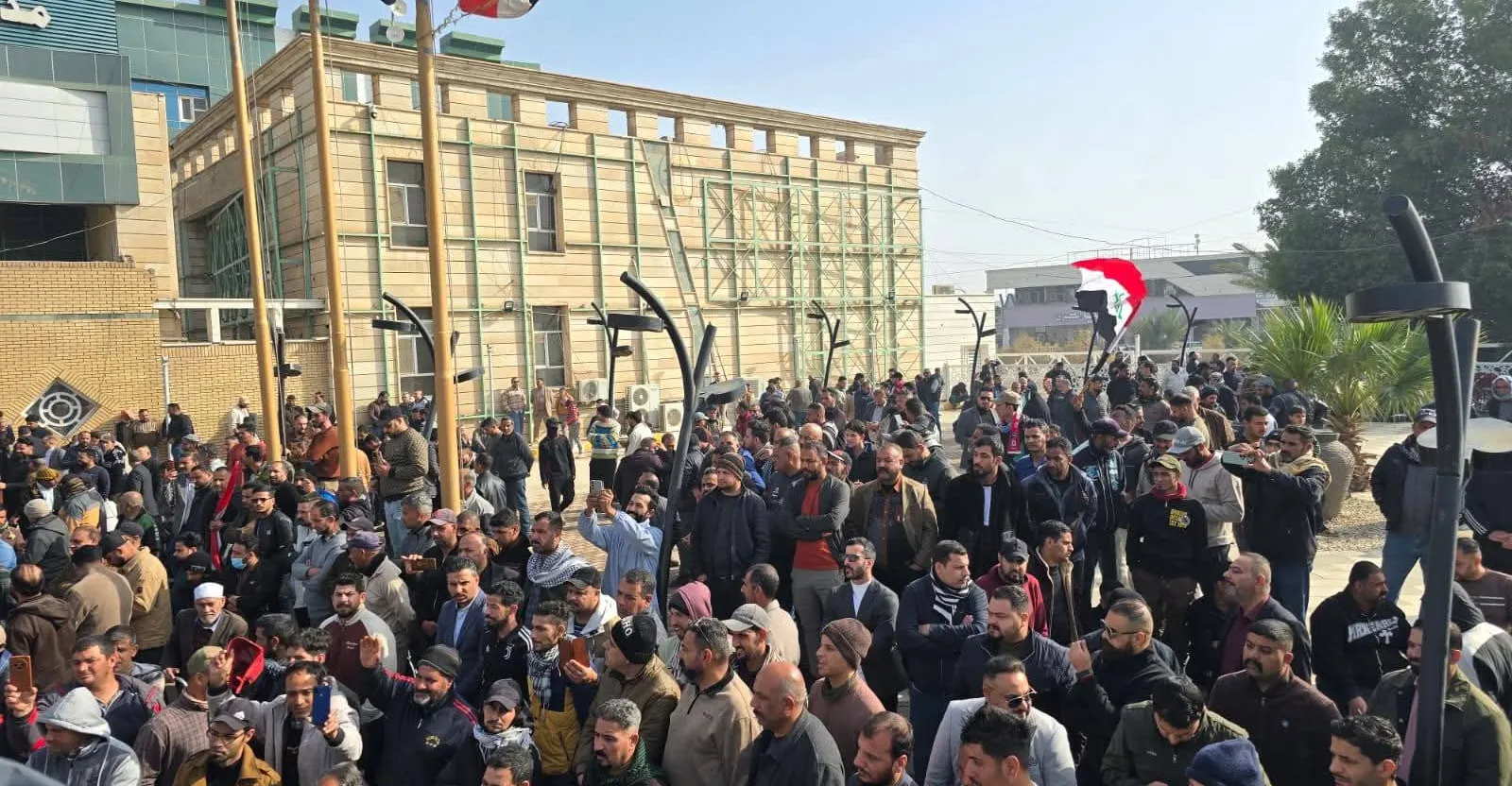
This morning, dozens of merchants and shop owners demonstrated on Al-Nidal Street in front of the Customs Authority building in central Baghdad, protesting against the new customs tariff and demanding that it be canceled or amended to be in line with the reality of the local market.
The protesters raised Iraqi flags during the demonstration and chanted slogans condemning the recent measures, which they said had burdened them and caused an increase in import costs and a decline in buying and selling activity in the markets.
On Sunday morning, Iraqis woke up to closed shops and markets after traders announced a general strike in protest against the decision to raise customs tariffs in the capital, Baghdad, and a number of central and southern provinces.
Economic expert Nabil Al-Marsoumi stated yesterday, Saturday, that the “ASYCUDA” system implemented by the Iraqi government has caused a decrease in trade transactions and a decline in customs revenues in the country, calling for dialogue sessions with chambers of commerce to reach appropriate solutions after the deterioration of the economic situation as a result of the application of the customs tariff.
Al-Marsoumi said in a post today that commercial activity in Iraq is currently of utmost importance, as there are more than 350,000 commercial establishments and more than one million traders dealing in imported and local goods worth tens of billions of dollars, and employing millions of workers.
He added that this activity is currently suffering from the repercussions of the ASYCUDA system, and from the application of the customs tariff, which, according to official information, has led to a halving of Iraq’s trade transactions with the outside world, and to significant losses for traders and the government, whose customs revenues also decreased in January by 71 billion dinars compared to the months that preceded it.
The economist stressed that “there is an urgent need to hold a dialogue session with the chambers of commerce to reach suitable solutions for the government, merchants and the general public.”
The Iraqi government raised customs duties by percentages ranging between 5% and 30%, distributed across brackets starting from 5%, 10% and 15%, up to the maximum limit of 30%.
These ratios cover the entire customs tariff register consisting of 99 chapters containing approximately 16,400 customs items, which are the items adopted globally in trade.
A few days ago, the General Authority of Customs in the Ministry of Finance issued a directive to adopt a reduction rate of 25% on the average import values recorded in the ASYCUDA system.
Over the past month, Iraq has witnessed angry demonstrations in several provinces, protesting the decision to impose new taxes and fees, and to apply customs tariffs to imported goods.
shafaq.com
