Iraq is approaching financial collapse, with accusations directed at the Finance Ministry and the Central Bank.
Iraq is approaching financial collapse, with accusations directed at the Finance Ministry and the Central Bank.
2025-05-27 07:49
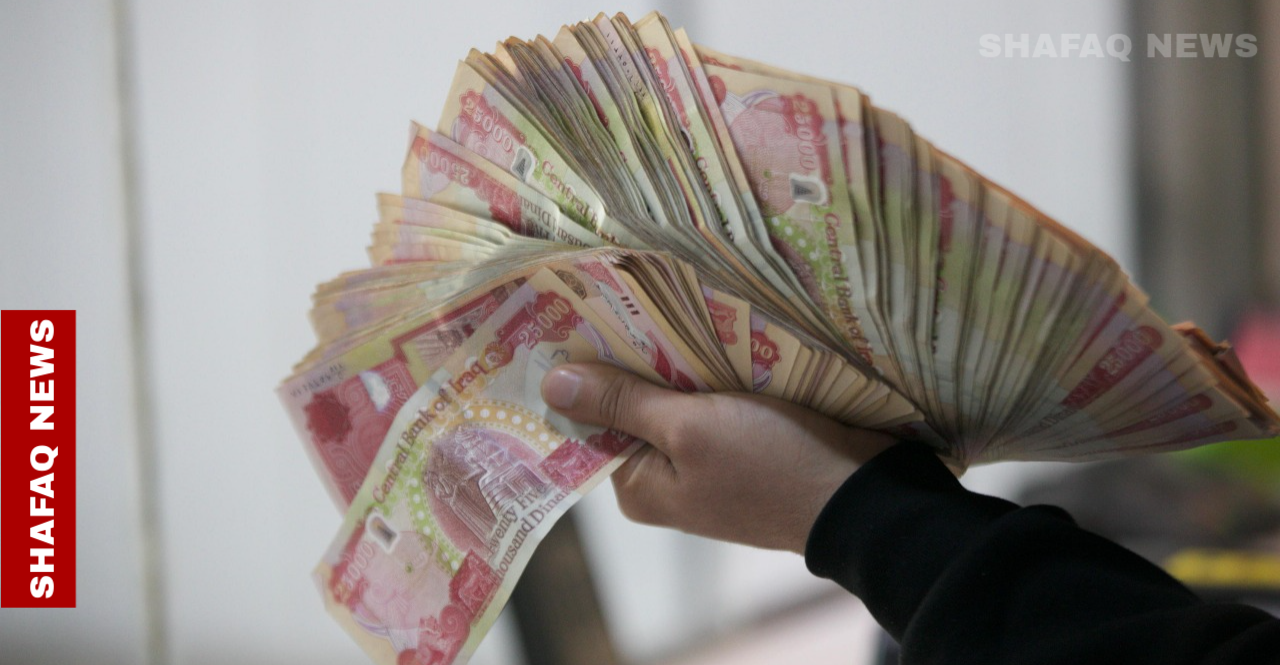 Shafaq News/ The Parliamentary Finance Committee warned that a real financial crisis is looming in Iraq in the future, amid declining oil prices and the absence of preventative and precautionary measures capable of averting an economic crisis. The committee stressed that financial and economic indicators point to a worsening deficit and declining liquidity, which portends serious challenges in the coming period. Meanwhile, economic experts hold the Ministry of Finance and the Central Bank responsible for the cash liquidity crisis.
Causes of the expected crisis
Finance Committee member MP Mohammed al-Shabaki told Shafaq News Agency, “All economic indicators confirm that the country is approaching a financial crisis, the main causes of which are the decline in oil prices and the decline in cash liquidity, in addition to the accumulating budget deficit and the government’s delay in submitting budget schedules to parliament.”
He explained that “Iraq lacks the financial tools used in most countries around the world to hedge against crises, such as futures contracts, foreign investments, and emergency funds,” adding that “the available financial hedges are only sufficient for two years.”
Al-Shabaki pointed out that “the planned budget for 2025 was approximately 200 trillion dinars, while the volume of spending is estimated at approximately 130 trillion dinars,” stressing that “what remains of it is supposed to be carried over to the next year.”
He also called for the need to develop urgent plans to increase non-oil revenues to 30% of the state’s total revenues, compared to the current figure of 3-4%.
Al-Shabaki added, “We need to activate technical and technological tools that support the Iraqi economy, and a government that makes bold decisions in the area of tax collection and fees, independent of political and electoral influences.”
Who is responsible?
For his part, economic expert Saleh Al-Hamashi blamed the Ministry of Finance and the Central Bank of Iraq for the cash liquidity crisis, pointing out that the two institutions failed to find effective mechanisms to recycle currency within the banking system, which has led citizens to hoard their money at home and lose confidence in banks despite the introduction of electronic payments.
Al-Hashemi told Shafaq News Agency, “The absence of a healthy monetary cycle in the country has forced the government to resort to domestic debt and strategic reserves,” noting that “the current circulating money supply amounts to approximately 127 trillion Iraqi dinars, 70% of which is outside the banking system and circulating among citizens, and only 30% is held by the Central Bank.”
He also pointed out that “successive governments have not developed a clear strategy for managing the monetary mass,” adding that “the Central Bank still lacks a comprehensive financial vision in this regard.”
Al-Hashemi continued, saying, “The government has begun to sense the gravity of the situation and has begun to rely on strategic reserves or issue new banknotes when the available cash supply declines.”
He also pointed out that the decline in oil prices and the production cuts under OPEC agreements have directly impacted state revenues, prompting the government to attempt to achieve financial balance by drawing from its financial reserves.
In a social media post earlier today, Tuesday, economic expert Nabil Al-Marsoumi confirmed that Iraq’s oil revenues for April were only sufficient to cover salaries and expenses of oil licensing companies.
Al-Marsoumi said, “The decline in Iraqi oil exports and the drop in crude oil prices from $72.5 in March to $66.7 per barrel last April led to a drop in oil revenues from $7.716 billion to $6.738 billion, a decrease of 15%.”
The Iraqi Ministry of Oil revealed its crude oil export and revenue statistics for April on Monday.
shafaq.com
