The Iraqi parliament enters a two-month recess: sessions are absent, and laws have been suspended for six months.
The Iraqi parliament enters a two-month recess: sessions are absent, and laws have been suspended for six months.
2025-05-09 02:59
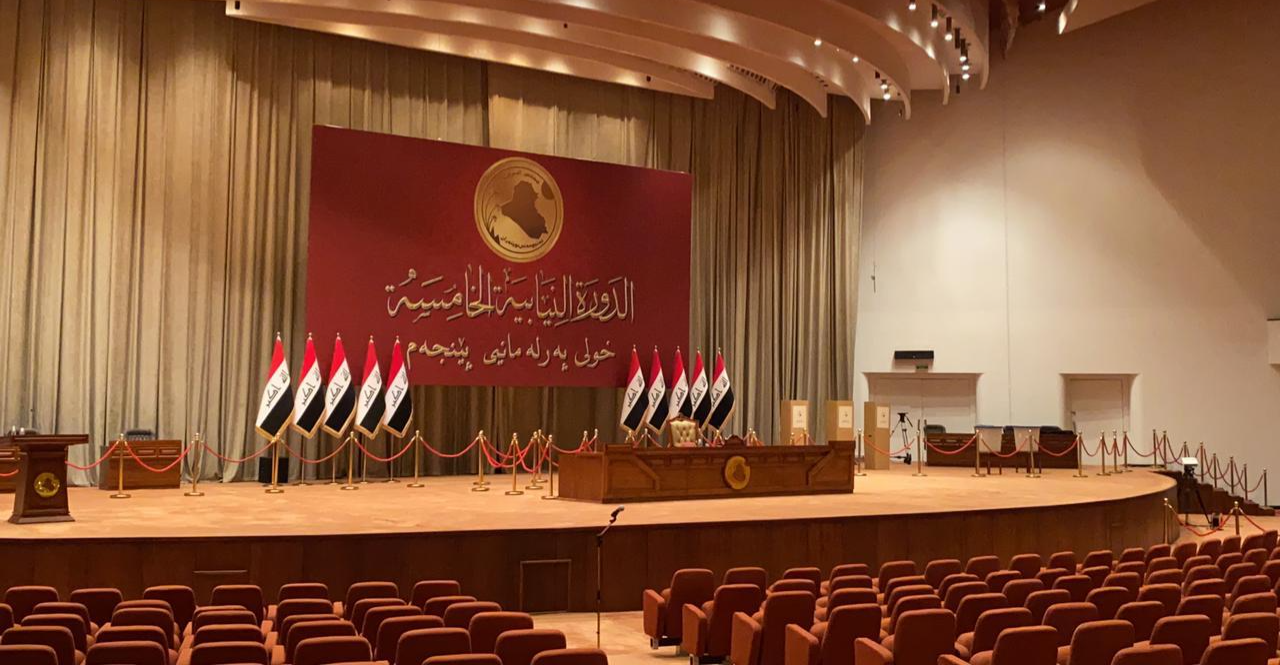 Shafaq News/ The Iraqi Parliament’s fifth session continues to be disrupted, with members absent for more than six months, according to members of parliament. This is despite numerous laws piling up in the chamber’s drawers awaiting a vote.
Although the House of Representatives announced it would hold its regular session last Tuesday, it decided to postpone it for half an hour due to a lack of quorum. It then decided to postpone it permanently for the same reason, a phenomenon that had been repeated the day before.
A few hours later, the House of Representatives decided to end the first legislative session of the fourth legislative year (the fifth electoral cycle) starting today, Friday.
The media department of the Council of Representatives stated in a statement received by Shafaq News Agency that based on Article (57) of the Constitution of the Republic of Iraq and Article (22) of the internal regulations of the Council of Representatives, the Council Presidency decided to end the first legislative session of the fourth legislative year – the fifth electoral cycle.
Speaking to Shafaq News Agency, MPs attributed the disruption of parliament’s work over the past months to a number of reasons, including an “agreement” between the government and the parliament presidency to disrupt the session, an attempt to thwart Parliament Speaker Mahmoud al-Mashhadani, the early start of the election campaign by some MPs, and the Arab Summit scheduled for May 17 in Baghdad.
MPs believe that the parliamentary session, which was not held for a few days, may be the last, given that the legislative term ends on Friday, May 9, according to parliament’s internal regulations. The two-month legislative recess will then begin.
Disabled 6 months ago
In this regard, Mukhtar al-Moussawi, a representative of the Fatah Alliance led by Hadi al-Amiri, said, “The House of Representatives has been inactive for more than six months. During last Tuesday’s session, only six members were present, despite numerous pending laws, including the budget, the Popular Mobilization Forces (PMF), and the retirement law.”
Regarding the reasons for this disruption, Al-Moussawi told Shafaq News Agency, “The problem lies with the parliament’s leadership, which has not established strict controls to ensure the attendance of parliament members.”
He points to an agreement between the government and the parliament’s presidency to suspend the parliament and not question any ministers. He also points to efforts to thwart the parliament speaker by disrupting the parliament’s work.
Amid the parliamentary attendance crisis, the First Deputy Speaker of the Iraqi Parliament, Mohsen al-Mandalawi, last Tuesday instructed the media and parliamentary departments to publish the names of the parliament members who were “absent” from the session.
According to a brief statement issued by his office and received by Shafaq News Agency, the directive included deducting the stipulated financial percentage from their salaries.
The number of MPs absent from today’s session reached 190, while 139 MPs attended the session, which did not achieve a quorum.
Two-month legislative holiday!
For his part, independent MP Hussein Al-Saabari said, “The parliament will enter a legislative recess starting today, lasting for two months, but even after that recess, sessions are not expected to resume.”
Al-Sa’bari, speaking to Shafaq News Agency, attributed this to “the Arab Summit to be held in Baghdad and the desire to maintain a positive atmosphere among political forces, which could be marred by a session that could witness tensions within Parliament. After the summit ends, there will be Hajj and Muharram, and it is unlikely that members of Parliament will attend them. After that, preparations for the elections will begin.”
Al-Saabari also points out that “there is a proposal to extend the legislative recess to one month or to hold extraordinary sessions to complete the remaining laws, including those related to teachers, programmers, the red card, certificates, industrial investment, and others. However, during regular sessions, MPs do not attend, so how about extraordinary sessions?”
With the conclusion of Iraq’s fifth parliamentary session, statistics conducted by Shafaq News Agency last month revealed that parliament held only 51% of the sessions required by the internal regulations. This has had a negative impact on the legislative and oversight roles of the council, according to MPs and observers.
Since the beginning of the parliamentary session in January 2022, the Iraqi Council of Representatives has held only 132 sessions, while the internal regulations stipulate 256 sessions annually. The internal regulations also stipulate eight sessions per month, a four-month legislative term, and 32 sessions per term.
Weakness in oversight and legislation
Based on this obstruction, Aqeel al-Rudaini, spokesman for the Victory Coalition led by former Iraqi Prime Minister Haider al-Abadi, believes that “the current session of Parliament has not met the required level of oversight and legislation, and therefore the role of Parliament has been weak.”
Speaking to Shafaq News Agency, he added, “The current session is nearing its end, and no minister, undersecretary, general manager, or head of any agency has been questioned, at a time when there are significant indications of theft of public funds and widespread corruption in ministries and agencies.”
According to al-Radini, the House of Representatives has lost its national spirit. Controversial laws have created factions within the parliament, with some members defending a portion of the people. This is not the nature of the Iraqi parliament, and this fragmentation could portend a dangerous future for Iraqi democracy in general.
Regarding the current suspension of parliamentary sessions, he ruled out the possibility of parliament’s work ending in the coming months, stressing, “There will be sessions, as the internal regulations stipulate that sessions must continue for four full legislative years. However, some MPs may have become preoccupied with their election campaigns early on. As for suspending parliament from now on, that is impermissible and there is no legal justification for it.”
shafaq.com
