Enrichment negotiating point: from 60% to agreement
Enrichment negotiating point: from 60% to agreement
10-12-2026
 Iyad Al-Anaz
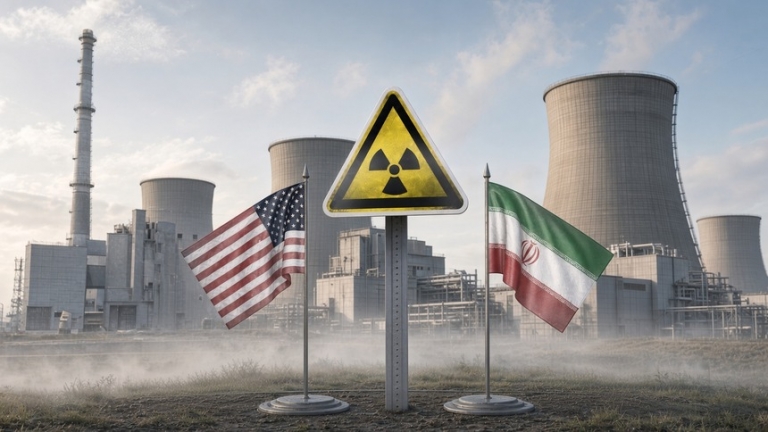
The importance of discussing Iranian nuclear activities and studying the dimensions of the nuclear program and its significance in the American-Iranian confrontation stems from the interview conducted by Iranian President Masoud Pezeshkian with Fox News on September 24, 2026, on the sidelines of his attendance at the United Nations meetings, in which he announced that Tehran was open to committing to all the provisions of the Nuclear Non-Proliferation Treaty and abandoning the 60% enrichment level. This came in response to a question about whether Tehran was prepared to give up its stockpile of uranium enriched to 60%.
Pezeshkian’s remarks aligned with an Iranian initiative presented through the Qatari-Arab Gulf mediator. This initiative, discussed during a meeting between Iranian Foreign Minister Abbas Araqchi and US envoy Steve Wittkopf in New York on the sidelines of the UN General Assembly, outlined Iran’s vision for reopening the Strait of Hormuz. This vision included ending the naval blockade, releasing frozen Iranian assets, and ending fighting on all fronts of the “resistance.” However, this initiative was rejected by US President Donald Trump, who demanded the immediate reopening of the Strait of Hormuz, the commencement of negotiations regarding the Iranian nuclear program, and a return to the conditions Washington had set before the US-Israeli confrontation on February 28, 2016.
Iranian President Masoud Pezeshkian is aware of the regime’s deep suffering due to the escalating economic and social crises plaguing Iranian society. These crises place a heavy burden on the nature of Iranian political performance and behavior, prompting the search for any attempts or initiatives to reach an effective formula for lifting US sanctions. He also understands the importance of his timing, as he seeks to reach an understanding or agreement with the US administration before the midterm elections for the US Congress and House of Representatives.
The discussion about enriching uranium to 60% brings us back to the Joint Comprehensive Plan of Action (JCPOA) signed in July 2015, under which the Iranian nuclear program was frozen in exchange for the lifting of sanctions, before President Trump decided to withdraw from it during his first term in 2018.
Iran resumed its nuclear activities after the American decision, reaching high levels of enrichment and large quantities, which the International Atomic Energy Agency (IAEA) estimated at 440.9 kg of uranium enriched to 60%, enough, according to the agency’s report, to make about 10 nuclear bombs. This was one of the main reasons for the American-Israeli attacks in June 2015, which led to the destruction and severe damage of uranium enrichment facilities at the Fordow, Natanz, and Isfahan sites. This led the Iranian authorities to prevent IAEA inspectors from carrying out their monitoring and inspection duties, and Iran refused to provide any information about the fate or location of the highly enriched uranium.
During one of his campaign stops in Alaska on October 5, 2026, US Vice President J.D. Vance sought to say that the United States was still open to reaching an agreement with Iran, but that it required tangible Iranian nuclear concessions. He referred to what Iranian President Masoud Pezeshkian had offered regarding his country’s readiness to discuss the issue of uranium enrichment ratios, but Vance reiterated the American condition: “If you don’t want a nuclear weapon, why do you need fuel enriched to 60%? And if you want to demonstrate a commitment not to manufacture a nuclear weapon, then don’t manufacture highly enriched fuel.”
Iran, due to the American strikes, the ongoing confrontation, and the continuous dialogues and negotiation sessions—despite their continuation through rounds of Arab and regional mediation—does not trust what the American administration and its officials announce or say. It views these pronouncements as a form of threat, political pressure, and the imposition of conditions that must be met. This approach is rejected by Iranian political circles, who believe that Washington is prepared to renege on any agreement after the midterm elections. This applies to the initiative announced by President Pezeshkian, in which Iran expressed its readiness to negotiate the fate of its enriched uranium stockpile within any arrangements agreed upon with the United States. If this is not a proposal to prolong and stall Iranian behavior, then it is a strategy by which Tehran seeks to lift economic sanctions and reach avenues that attempt to appease Trump’s political ambitions by achieving a political breakthrough related to Iranian nuclear activities and returning to the path of political negotiation and diplomatic dialogue that began in the Pakistani capital, Islamabad, in April 2016. The
Iranian political mindset and security doctrine, led by the Iranian Revolutionary Guard, do not seek negotiations regarding the nuclear program or the opening of the Strait of Hormuz and the allowance of freedom of navigation, international energy supplies, and global trade. Rather, they seek comprehensive deals and security arrangements. This would allow it to enjoy sufficient flexibility and capability to sit at the negotiating table from a position of strength, not weakness and preemptive concessions.
The nuclear weapon and its components, such as centrifuges and enrichment levels, are a constant topic of political debate within the Iranian regime. The conservative political faction views the enriched stockpile as a sovereign guarantee and a bargaining chip that cannot be relinquished, but rather used effectively and decisively in any future confrontations. Meanwhile, the moderate and reformist faction believes that retaining this asset should be within its political context and horizon, and should not be allowed to become a permanent burden against Iran’s political vision and its efforts to assert its regional and international role.
Hence comes the Iranian position, which always rejects any initiative or executive condition, under any specific technical arrangements, for transferring enriched uranium out of Iran. It believes that this would not be the end of the crisis with the United States, but rather the beginning of successive demands that include the ballistic missile program, drones, and Iran’s regional political influence. Therefore, the stockpile of enriched uranium is not viewed as a bargaining chip, but as a tangible guarantee against American pressure. This is confirmed by the official spokesman for the Atomic Energy Organization of Iran (Behrouz Kamalvandi), who stated that “the uranium enriched to 60% is in a secure location and is a means of guaranteeing the country, and that Iran does not accept zero or mini-enrichment.” This confirms the reality of the Iranian orientation and the political and security doctrine adhered to by the Iranian Revolutionary Guard, which sees it as a delicate equation that denies seeking to acquire nuclear weapons, but does not relinquish what makes the possibility of such weapons present in the calculations of others.
The remarks made by Iran’s representative to the Organisation for the Prohibition of Chemical Weapons (OPCW) in The Hague, Hadi Farajvand, on October 6, 2026, can be interpreted within the context of US positions and directives regarding Iran’s possession of chemical weapons. He stated that US strikes on Iranian chemical industries damaged 111 petrochemical and pharmaceutical facilities and disrupted supply chains. In his address to the 113th session of the OPCW Executive Council, he added that the US attacks damaged 60 petrochemical complexes, 44 pharmaceutical factories, and 7 pharmaceutical facilities in Iran. He was referring to the US strikes launched on the morning of February 28, 2026. It
appears that the price sought by US President Donald Trump as a prerequisite for any political settlement or agreement, or for any regional Arab mediation in his military confrontation with Iran, is that the nuclear issue be the primary focus. He aims to achieve a political and strategic victory, followed by securing all maritime routes for international energy supplies and global trade. In reducing energy prices and restoring fuel prices within the United States to their normal state before the date of the American-Israeli-Iranian confrontation.
Links Center for Research and Strategic Studies
rawabetcenter.com
