Following the rise of the dollar, political understandings are being reached to create new ministries in Iraq.
Following the rise of the dollar, political understandings are being reached to create new ministries in Iraq.
2026-10-10
 Shafaq News – Baghdad
Two days after the official exchange rate of the dollar was raised, former MP Amir Al-Maamouri revealed on Friday political understandings towards creating new ministries and separating the Ministry of Culture and Tourism, in a move that raised questions about its administrative and economic feasibility, at a time when the country is facing a financial deficit and increasing pressure on public spending.
Al-Maamouri said in a Facebook post followed by Shafaq News Agency that there is an effort to create two new ministries, one for artificial intelligence or digital investments, in addition to splitting the Ministry of Culture and Tourism into two independent ministries, one for culture and the other for tourism, distributed according to quotas, in order to satisfy the political blocs, asking: “So where is the financial crisis then?”
In addition, an informed source revealed to Shafaq News Agency on October 1 that one of the armed factions being negotiated with by the Quartet Committee for the Confinement of Weapons to the State has demanded the creation of a new ministry to support the security ministries.
On June 25, MP Mukhtar al-Moussawi told Shafaq News Agency that the creation of the Ministries of Tourism and Governance is still under discussion and study, and that resolving it requires an administrative, financial and legal evaluation, far removed from considerations of political appeasement.
These proposals come in conjunction with the implementation of the new official dollar exchange rate of 1,520 dinars for the end user, starting from Wednesday, compared to the previous 1,320 dinars, amid fears that the cost of the change will be passed on to the prices of goods and services and a decline in the purchasing power of citizens.
Reforming government inefficiency
In this context, former Iraqi Planning Minister Nouri al-Dulaimi believes that Iraq does not need to create new ministries at the present stage as much as it needs to restructure existing ministries and institutions, considering that the priority should be to address administrative imbalances and improve the efficiency of the government apparatus.
Al-Dulaimi, speaking to Shafaq News Agency, points out that the Iraqi experience has shown the dangers of the inflation of institutions and positions, citing measures taken by Haider al-Abadi’s government in 2015 to abolish the positions of Vice Presidents of the Republic and Prime Minister and reduce security details, following protests that demanded reform and combating government bloat.
He adds that expanding the establishment of bodies and institutions may exacerbate disguised unemployment and increase operational burdens, especially when new institutions are not associated with clear tasks and measurable indicators.
Public finance pressures
This discussion becomes increasingly important in light of financial indicators; according to data from the Iraqi Ministry of Finance regarding the implementation of the federal budget up to the end of last July, Iraq’s total revenues amounted to about 39.096 trillion dinars.
Oil revenues constituted about 78% of these total resources, amounting to 30.356 trillion dinars, compared to about 8.740 trillion dinars for non-oil revenues, which accounted for the remaining 22%.
In contrast, accounting data reviewed by Shafaq News Agency last Sunday showed that total expenditures jumped to about 65.424 trillion dinars, resulting in an actual deficit between revenues and spending of about 26.329 trillion dinars.
Al-Dulaimi warns that the creation of a new ministry is not limited to the minister’s salary, but extends to agents, advisors, directorates, offices, headquarters, security details, and operational budgets, which may conflict with the need to rationalize spending and maximize revenues.
These concerns coincide with the decision to amend the exchange rate, which was approved by the Cabinet in its session last Tuesday, October 6, and began to be implemented the following day.
The amendment aims to generate greater revenue in dinars compared to dollars, but in return it raises the cost of foreign currency for beneficiaries, with the possibility of this being reflected in import prices.
Government digital transformation
In contrast, former MP Hussein Arab believes that establishing a Ministry of E-Governance or Artificial Intelligence could be an important administrative step if it aims to address the weakness of electronic connectivity between state institutions, develop government services and raise the efficiency of administration.
Arab told Shafaq News Agency that Iraq still lacks an integrated electronic system linking ministries and service institutions, and that what has been achieved so far does not exceed, in many aspects, partial linking.
He adds that digital transformation is no longer an administrative luxury, given the rapid global developments in the fields of artificial intelligence and e-government, noting that the proposed ministry could rely on existing employees and expertise in government institutions, by transferring some of them to it, instead of creating a completely new agency.
Arab emphasizes that the cost of the ministerial post alone is not the core issue, but rather the extent to which there is a real need for the new institution, warning that Iraq’s delay in adopting digital governance and artificial intelligence may widen the gap between it and other countries.
Quotas and distribution of portfolios
For his part, former MP, Mahma Khalil, rules out the possibility that creating new ministries is an urgent administrative necessity, but he believes that the desire of some political blocs to participate in the government may push towards expanding the number of portfolios.
Khalil told Shafaq News Agency that such a move could increase operating expenses and put pressure on the budget, warning against forming an inflated government at a time when public finances are suffering from a shortage of resources and revenue cuts.
He adds that disagreements over the vacant ministries and their distribution among political forces may open the door to the introduction of additional ministries within understandings aimed at satisfying different parties.
However, Khalil calls for not overlooking the issue of representing Iraqi components, noting that he had previously called for the creation of a Ministry for Components that includes representatives of the Yazidi, Christian, Sabean Mandaean, Faili Kurd, and other components, with the aim of enhancing their participation in state institutions.
He says that representing these components can send a message about respecting Iraq’s historical and social diversity.
Rationalizing government spending
Political analyst Majashaa Al-Tamimi believes that Iraq does not currently need new ministries, but rather a reduction in administrative redundancy and a restructuring of state institutions, given the financial deficit, rising operating expenses, and increasing debt burdens.
Al-Tamimi told Shafaq News Agency that creating additional ministries means positions, salaries, allowances, protections, buildings, and administrative expenses, without guaranteeing tangible results, calling for prioritizing austerity, raising the efficiency of existing institutions, and rationalizing public spending.
These warnings are becoming increasingly important as Iraqi finances become heavily dependent on oil revenues, which makes the state’s ability to finance its expenditures dependent on the fluctuations of the energy market, the volume of exports, and the revenues generated.
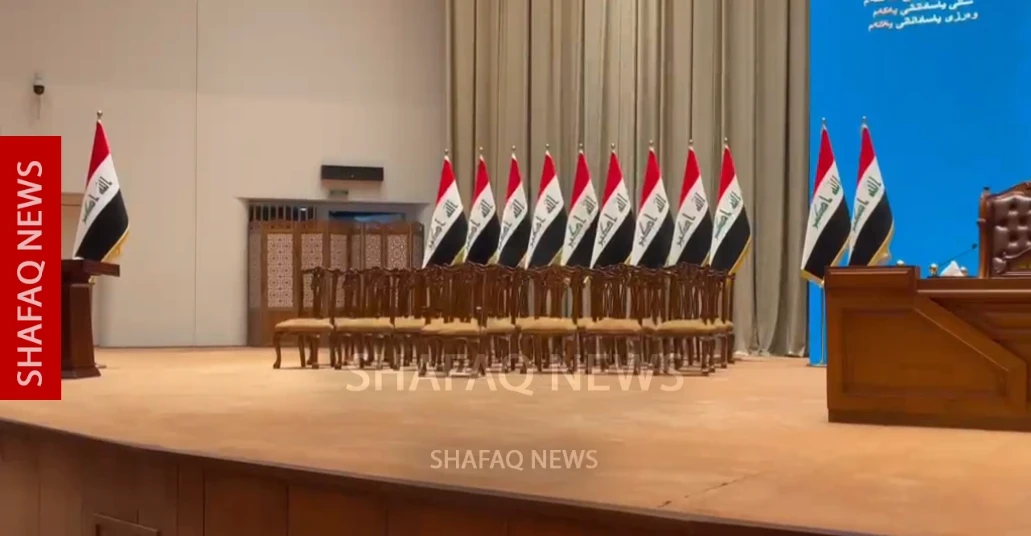
The Iraqi parliament is expected to hold a session next week to complete the cabinet formation, according to a source who spoke to Shafaq News Agency.
The source also noted the continued disagreements over the candidates for the ministries of Labor and Social Affairs, Youth and Sports, and Planning, Reconstruction and Housing.
The State of Law Coalition, led by Nouri al-Maliki, officially nominated Yasser Sakheel for the Ministry of Interior portfolio, and Haider Bahaa, who currently serves as Dean of the College of Pharmacy at Al-Nahrain University, for the Ministry of Higher Education portfolio.
Al-Zidi’s government consists of 23 ministerial portfolios. 14 ministers have currently been appointed since last May, while 9 portfolios remain vacant (most notably Defense, Interior and Planning) and are currently being run by acting ministers, pending the outcome of the anticipated parliamentary vote to resolve this issue.
shafaq.com
