“At its weakest point”… Will the coordination framework fall apart?
“At its weakest point”… Will the coordination framework fall apart?
2026-08-04
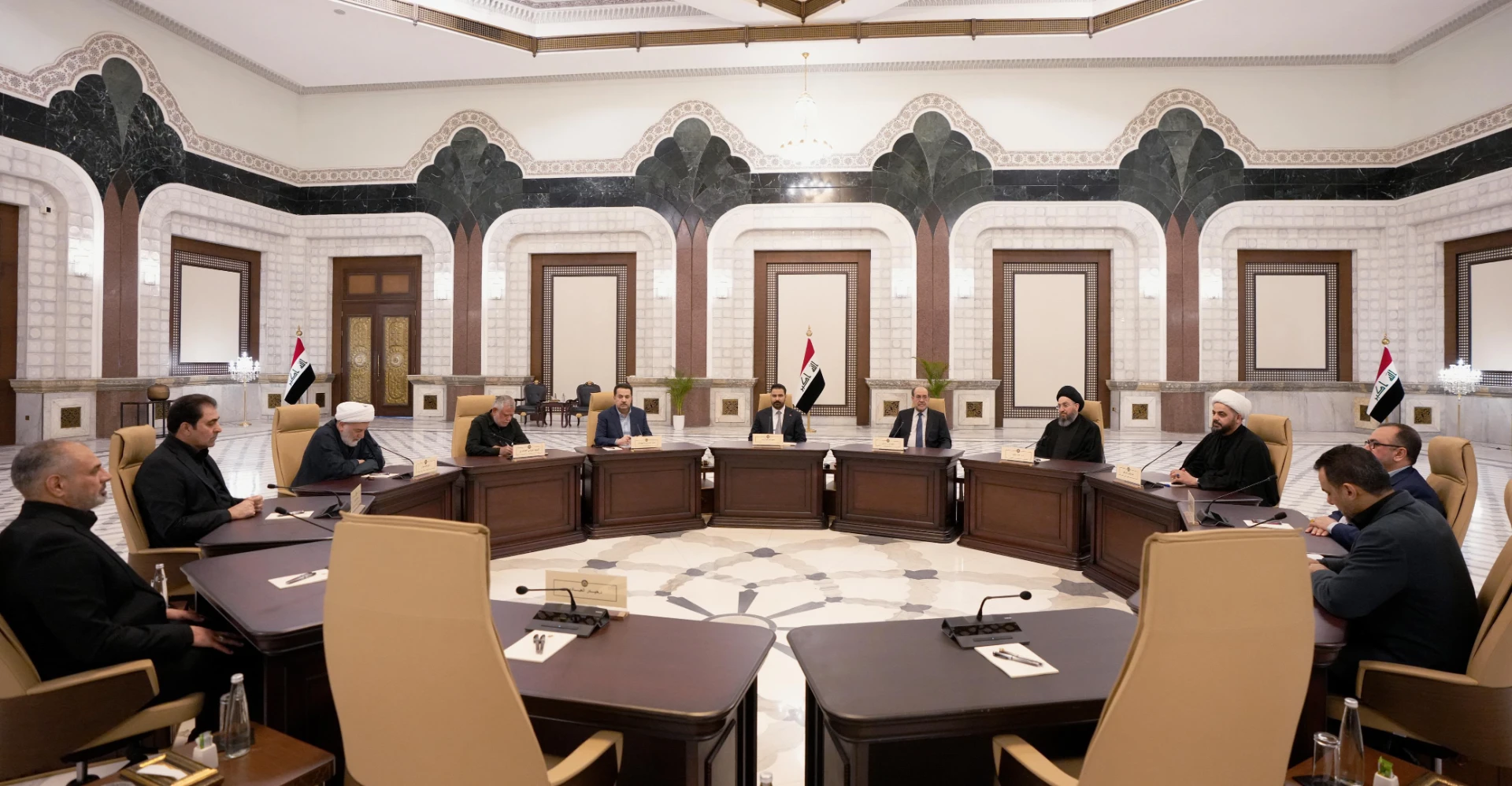 Shafaq News – Baghdad
Since the formation of the coordinating framework that brings together the ruling Shiite political forces in Iraq in 2021, with the aim of unifying their political position after the results of the early parliamentary elections and confronting the project of forming a majority government led by the Sadrist movement, the alliance is currently facing a series of challenges that threaten its ability to maintain its internal cohesion and its role in managing the major issues in the country.
Observers believe that the alliance, which arose as a unified front against a common political opponent, has gradually turned into an arena of conflict between forces that have different visions regarding the form of the state, the role of parties, and the limits of factional influence, prompting questions about whether the coordinating framework is heading towards a phase of declared disintegration, or whether it will reproduce itself in a new form.
Internal power struggle
The coordination framework includes various Shiite political forces, including the State of Law Coalition led by Nouri al-Maliki, the Fatah Alliance led by Hadi al-Amiri, the Hikma Movement led by Ammar al-Hakim, and the Victory Coalition led by Haider al-Abadi, in addition to forces linked to armed factions such as Asaib Ahl al-Haq, the Rights Movement, and other forces.
The primary objective of the alliance was to prevent the passage of the Sadrist movement’s project to form a political majority government that would exclude the forces within the framework, and to return to the consensus government model that had prevailed since 2003.
But the withdrawal of the Sadrist bloc’s representatives from parliament in June 2022 changed the balance of power, as the bloc became the largest within the House of Representatives, and moved from the position of opposition to the position of leading the government formation process.
In October 2022, the framework was able to pass the government of Mohammed Shia al-Sudani, after the formation of the “State Administration” coalition that brought together Shia, Sunni and Kurdish forces.
The emergence of disagreements
With the framework of power becoming established, the disputes that had been postponed during the confrontation with al-Sadr gradually began to emerge, as the competition shifted from protecting the alliance to the struggle for influence within state institutions.
In this context, Essam Al-Faily, a professor of political science at Al-Mustansiriya University, says that “the coordinating framework, even at the moment of its inception, took on an incomprehensible title. It did not take the form of a bloc, coalition, or alliance in the traditional sense, but rather certain circumstances came about that prompted the forces to form a framework that brings them together.”
Al-Faily adds to Shafaq News Agency, “The objective reason for its formation was to oppose what the Sadrist movement adopted, so it was originally an opposition coalition, but it was keen to keep its name symbolic, while in reality it represents a group of different forces that do not agree on many issues.”
He points out that “disagreements emerged even at the moment of forming the Sudanese government, as conflicts arose between the leaders of the framework, and the selection of the current Prime Minister, Ali Falih al-Zaidi, was not a matter of complete agreement before it was agreed upon.”
Sudanese and the framework
During the government of Mohammed Shia al-Sudani, the Prime Minister tried to build his own political space away from the complete dominance of the coordination framework, according to political readings, but this led to tensions with some of the forces that brought him to power.
In this regard, Haitham Al-Hiti, a professor of political science at the University of Exeter in Britain, says that “Al-Sudani tried to form his own alliance to gradually break free from the framework, but he failed, and later became a political target through corruption files and accusations related to his government.”
Al-Hiti adds to Shafaq News Agency, “The framework produced several political figures and prime ministers, the latest of whom was Ali al-Zaidi, and none of them were far from the effects of the framework.”
He believes that the relationship between the government and the framework was not one of separation, but rather one of mutual influence, noting that “Al-Zaydi came with the support of figures within the framework, including Hadi Al-Amiri, Ammar Al-Hakim and Nouri Al-Maliki, and was not a candidate outside the will of the coalition.”
Division over weapons
The issue of armed factions and the future of the Popular Mobilization Forces is one of the most sensitive issues within the coordination framework, as positions differ between the political forces linked to the state and the forces closest to the armed factions.
In this regard, Al-Faily says that “part of the factions under the framework did not move towards handing over or reorganizing weapons, and therefore the negotiations related to limiting weapons are not a collective decision of the framework, but are being conducted individually.”
He points out that this issue “represents one of the main challenges to the cohesion of the alliance, especially with the differing views on the relationship with the international community and the United States.”
With the transfer of power to Ali al-Zaidi’s government, disagreements escalated within the coordination framework regarding the distribution of positions and the mechanism for managing the next phase.
The session to grant confidence to the government revealed differences between the components of the framework, after a number of candidates from some forces were not approved for ministerial portfolios, which sparked mutual accusations of violating understandings and trying to impose wills.
Political readings indicate that the dispute is no longer limited to the distribution of positions, but has extended to a broader question concerning who holds the decision-making power within the Shiite political establishment, and how to manage security, economic, and foreign affairs.
“Weakness” without alternative
Haitham al-Hiti believes that “the coordination framework is at its weakest point today, but it is still the ruling power in Iraq.”
This is attributed to several factors, including “the difficult regional situation, the decline in Iran’s position, the American conditions on Iraq, in addition to the Arab stance that has become clearer towards Baghdad.”
He adds that “the main problem is that the framework does not have a political figure today who is capable of being a unifying leader, and therefore a centrist figure like Al-Zaydi was found to manage the stage.”
But Al-Hiti points out at the same time that “the absence of a political alternative has put Iraq in a state of suffocation, as the framework no longer provides real political cover, but rather protocol cover.”
Despite the growing talk about the disintegration of the coordination framework, some researchers believe that the alliance has not completely lost its role.
In this context, political researcher Abbas Ghadeer Al-Jubouri says: “I do not believe that what is happening represents a decline in the coordination framework, as it is the political sponsor of the Iraqi government, and Al-Zaidi is a product of the framework’s selection and support.”
Al-Jubouri adds to Shafaq News Agency, “The files that the government is dealing with today are inseparable from the will and support of the framework forces, and what is happening is a political repositioning imposed by the variables of the stage and the complexity of the files, and not a withdrawal or retreat.”
shafaq.com
