Conditions and obstacles… Will Baghdad succeed in controlling weapons within 90 days?
Conditions and obstacles… Will Baghdad succeed in controlling weapons within 90 days?
2026-07-01
 Shafaq News – Baghdad
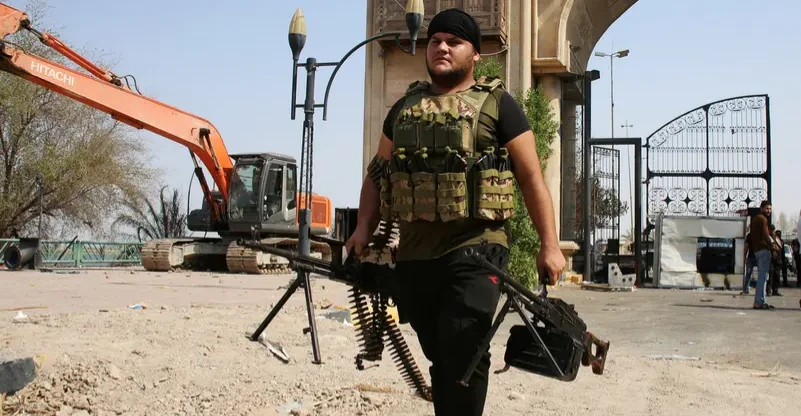
The Iraqi government has announced that September 30, 2026 will be the deadline for handing over weapons not under the control of state institutions, in a move it says aims to end the duality of armed forces and consolidate state sovereignty, coinciding with the end of the international coalition’s mission to fight ISIS in the country.
Government spokesman Haider al-Aboudi said that all armed groups had been notified of the deadline, stressing that “any weapon that remains outside the framework of the state after this date will be considered an unregulated weapon and will be subject to legal action.”
The decision comes amid escalating internal and external political and security pressures, and amid preparations for a planned visit by Prime Minister Ali al-Zaidi to Washington in July, where the issue of armed factions is expected to be at the top of the agenda.
Weapons and corruption
In parallel with the arms issue, the government intensified its rhetoric on combating corruption, stressing that the ongoing campaigns that began at dawn last Sunday “have no exceptions,” and that they include lifting the immunity of officials and prosecuting figures inside and outside the country, along with establishing a mechanism to recover public funds.
Iraqi Prime Minister Ali al-Zaidi says his government is moving towards a “new phase” based on the state’s monopoly on weapons and ending the system of corruption, announcing a national sovereignty conference at the end of the year to enshrine this direction.
When Al-Zaidi officially took office on May 14, he pledged to proceed with “restricting weapons to the state” and to consider the monopoly of armed force as “an exclusive function of official institutions,” which brought the issue back to the forefront of the political scene after years of setbacks.
For its part, the Coordination Framework (which brings together the ruling Shiite political forces in Iraq) authorized the Prime Minister to take whatever measures are necessary to preserve the higher interests, while supporting the project of restricting weapons to the state and severing the Popular Mobilization Forces’ ties from political, partisan, and social frameworks.
This path was reinforced by the announcement by the Sadrist movement, led by Muqtada al-Sadr, on May 27, 2026, of the disassociation of the “Peace Brigades” from it and their integration into the state, with calls for the factions to join under the authority of the government away from party affiliations.
Factional divisions
However, this step does not seem to have the consensus of all armed factions, as their positions differ regarding the government’s approach to limiting weapons to the state, between parties that announced their readiness to integrate within the official frameworks, and others that clung to the option of keeping their weapons and linked any step in this direction to political and security conditions.
On the side of the factions that showed flexibility, forces such as Saraya al-Salam, Asaib Ahl al-Haq and Kataib al-Imam Ali announced steps towards handing over the management of some brigades within the Popular Mobilization Forces to the government, within the framework of arrangements described as preliminary to reorganizing the relationship with the state, and separating the political dimension from the military one.
A discourse has also emerged within some wings supporting the government’s approach, which considers that restricting weapons does not necessarily mean dismantling the factions, but rather readjusting the decision to use force within official state institutions.
In contrast, other more hardline factions, most notably Kataib Hezbollah, Harakat al-Nujaba, and Kataib Sayyid al-Shuhada, refuse to include their weapons in this process, and insist on adhering to what they call “the weapons of the resistance,” considering that their existence is linked to regional and security contexts, most notably the continuation of external threats and the presence of foreign forces.
Explanation of the decision
Alongside this division, the divergence is not limited to the armed factions, but extends to the political forces in their interpretation of the content and limits of the government decision, as readings differ on whether it means “handing over weapons” in reality or reorganizing the decision to use them within state institutions.
In this context, Ahmed Adnan, a member of the General Authority of the Sadiqun Movement, the political wing of the Asaib Ahl al-Haq movement led by Qais al-Khazali, says that what is happening is not a “handover of weapons” but rather “restricting the decision to use them to the state.”
Adnan explained to Shafaq News Agency that the factions’ weapons will remain within the Popular Mobilization Forces system, while the focus is on “disengaging the political decision from the military decision.”
He adds that the implementation of the decision must include all factions without exception, as it is a “national, religious and political decision,” noting that the end of the presence of the international coalition forces next September opens the door to a comprehensive discussion about the future of weapons.
In contrast, security and political expert Adnan al-Kinani believes that the current stage represents a turning point, considering that the end of the presence of the “occupier” means that “armed resistance must end,” and that the factions must either fully integrate into the state or turn to political action.
Al-Kinani, speaking to Shafaq News Agency, points to a division within the factions themselves between supporters and opponents of the government’s course, which reflects “an internal problem that requires addressing from the roots.”
Origin of the factions
Most of the current armed factions trace their roots back to after 2003, when armed formations emerged in connection with the security vacuum that followed the American invasion of Iraq, and then expanded significantly after ISIS invaded large Iraqi cities in 2014.
At that stage, the Peace Brigades were formed as a military force in response to al-Sadr’s call to protect holy sites, in parallel with the integration of other factions into the Popular Mobilization Forces, which later became an official umbrella for a large number of armed formations.
But this merger did not end the multiplicity of power centers, but rather established a complex scene that combines the state, factions, and political and partisan authorities, which made the “weapons control” file one of the most problematic files in Iraq.
American withdrawal
For his part, Mu’in al-Kadhimi, a leader in the Badr Organization headed by Hadi al-Amiri, links the future of the “resistance” to the presence of American forces, saying that the factions’ commitment to handing over weapons is linked to a “complete and effective withdrawal” of American forces and the end of their air and military operations in Iraq.
Al-Kadhimi explained to Shafaq News Agency that factions such as Kataib Hezbollah and Kataib Sayyid al-Shuhada require clear guarantees that there will be no return of American military intervention, adding that “the government is capable of managing the security file, but it needs a decisive political decision.”
He points out that any final arms agreement requires a “balance of commitments” between Baghdad and Washington, while ensuring Iraq’s full sovereignty over its territory and airspace.
In a related context, security researcher Mustafa Ajil told Shafaq News Agency that setting September 30 as the deadline for restricting weapons coincides with the plan for the withdrawal of US forces, making this a “pivotal” stage for ending the justifications for weapons outside the state.
But experts warn that the success of the plan depends on the implementation mechanisms, especially with regard to restructuring the Popular Mobilization Forces and determining which entity will receive the weapons, given the absence of detailed arrangements announced so far.
International support and agreement
The government’s approach enjoys international and regional support, as a joint ministerial meeting between the United States and the Gulf Cooperation Council announced its support for Baghdad’s efforts to control weapons, while simultaneously condemning attacks attributed to pro-Iranian groups inside and outside Iraq.
Washington also links its continued aid to Iraq to “concrete measures” to remove armed factions from state institutions, while threatening economic and political pressure if these measures are not implemented.
The US withdrawal from Iraq is based on a bilateral agreement between Baghdad and Washington concluded in 2024, which stipulated the end of the international coalition’s mission to fight ISIS inside the country in two phases.
Under this understanding, the first phase was completed in early 2026, and included ending combat missions, withdrawing part of the forces and repositioning them within the framework of bilateral security partnerships with the Iraqi government.
The second phase extends until September 2026, and includes completing the withdrawal of the remaining forces and ending the use of bases inside Iraq to support operations in Syria, with the relationship between the two sides turning into limited security and advisory coordination.
This agreement is seen as the governing framework for the process of ending the American military presence, setting a clear time limit for reorganizing the security relationship between Baghdad and Washington.
shafaq.com
