What’s going on behind the scenes? Iraq has 22 days until the deadline for restricting weapons.
What’s going on behind the scenes? Iraq has 22 days until the deadline for restricting weapons.
2026-09-09
 Shafaq News – Baghdad/London
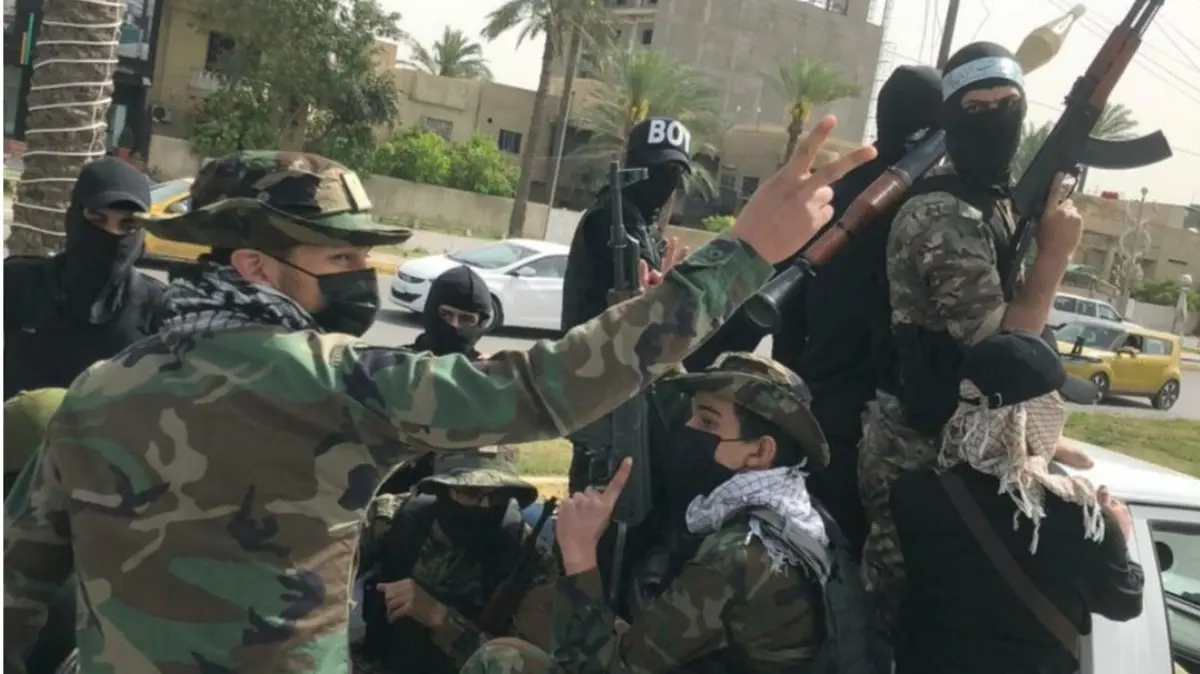
Iraq is only 22 days away from September 30, the date set by the government to end the military presence of the international coalition, at a time when the issue of restricting weapons to the state remains stuck between the positions and conditions of the armed factions, and between increasing political pressure to implement the principle of the state’s monopoly on force.
In its latest statement, the Sayyid al-Shuhada Brigades, one of the armed factions in Iraq led by Abu Ala al-Walai, affirmed that the issue of restricting weapons cannot be separated from achieving what it described as “full sovereignty” for Iraq.
The brigades, through their spokesman Kazem Al-Fartousi, stressed to Shafaq News Agency that the principle put forward by the factions is based on the equation of “weapons in exchange for sovereignty,” and that giving up weapons will not be on the table before guaranteeing the protection of the land, airspace, political decision and economic independence of Iraq.
Deadline extension
In contrast to the hardline positions of some factions, Fahd al-Jubouri, a leader in the Wisdom Movement, which is part of the coordination framework, believes that restricting weapons to the state is a politically settled principle, but its implementation requires a longer period than the specified deadline.
Al-Jubouri told Shafaq News Agency that the file is “complex and multifaceted” and needs more time, revealing the existence of a document expected to be signed in the coming period that includes a mechanism to draw up a practical path to restrict weapons to the hands of the state, describing this as a quasi-political agreement between the government, the factions and the coordination framework.
According to Al-Jabouri, the implementation will not end on September 30, but may extend until the end of the year, with September 30 being the starting point for this process.
He believes that the tense statements issued by some parties do not necessarily reflect the nature of the ongoing understandings, saying that there is a committee within the coordination framework that has reached understandings with the forces and factions regarding some guarantees, including the foreign presence and the organization of the Iraqi air defense system.
Mobilization Law First
For his part, Essam Al-Faily, a professor of political science at Al-Mustansiriya University, believes that the available indicators do not suggest that the factions are ready to hand over their weapons even after September 30, considering that some of them may move to obstruct the government’s procedures by linking the issue to other legislation.
Al-Faily told Shafaq News Agency that one of the most prominent new proposals is the requirement to dissolve or reorganize the factions after the Popular Mobilization Forces Law is passed, a law that is still a subject of political controversy, while its legislation or amendment of its controversial articles will take a long time.
According to Al-Faily, this path may lead to the integration of the factions into the structure of the Popular Mobilization Forces in a way that guarantees them greater influence and power, instead of directly ending their military presence.
On the other hand, Al-Faily believes that September 30 will hold great symbolic sovereignty for Iraqis with the completion of the withdrawal of American forces, but at the same time it will be a serious test for Al-Zaidi in how he translates his positions into practical steps.
He points out that some forces within the “State Administration” coalition have begun to lean towards proposing negotiations instead of confrontation, which may mean that the support within the coordination framework for Prime Minister Ali al-Zaidi is not full practical support as much as it is political and media support, with a change in positions.
Mounting American pressure
Al-Faily believes that the United States has made September 30th a crucial turning point, and that it may move, if the file falters, through two paths; the first is imposing economic sanctions on Iraq, which may open the way for internal pressure on the political system, which part of the public opinion holds responsible for the continuation of corruption and the spread of weapons outside state institutions.
But he warns that the crisis may not stop at economic sanctions, as Washington or other parties could take military action if the confrontation between Iran’s proxies and countries in the region escalates, noting that developments related to the Houthis may give indications of a broader trend toward escalation.
Al-Faily concludes that Iraq may be facing a real crisis if the equation of weapons and sovereignty is not resolved through negotiation, especially with the approaching date that has become linked in Iraqi political discourse to the future of the relationship with the United States.
Limits of Zaidi movement
But Haitham al-Hiti, a professor of political science at the University of Exeter in Britain, offers a more skeptical reading of the prime minister’s ability to bring about radical change in this matter.
Al-Hiti tells Shafaq News Agency that the general image of Al-Zaidi is based on the fact that he came to confront armed forces outside the framework of the state and corruption, but that does not mean that he is able to get out of the political system that brought him to power.
He adds that the prime minister can take limited steps, and that having a positive image as someone who is not a traditional part of the political system gives him some room to maneuver, but that does not mean that he is able to implement a radical change in the structure of the armed forces.
According to Al-Hiti, Al-Zaidi came with the approval of the existing political system, and therefore it is difficult for him to enter into a direct confrontation with factions organically linked to influential political forces. He believes that what has happened so far can be described as “political maneuvers” to convince the United States that there is a change coming, while he does not see any indications of a real change in the structure of the system.
Al-Hiti warns that Iraq could become part of a wider confrontation between the United States and Iran, whether through economic pressures or security developments, concluding that the paths ahead look difficult, and there are no realistic government measures that would allow for the dissolution or effective dismantling of the factions.
shafaq.com
