Oil Minister from Kirkuk: We are negotiating with OPEC to increase Iraq’s production and attract American companies.
Oil Minister from Kirkuk: We are negotiating with OPEC to increase Iraq’s production and attract American companies.
2026-11-27
 Shafaq News – Kirkuk
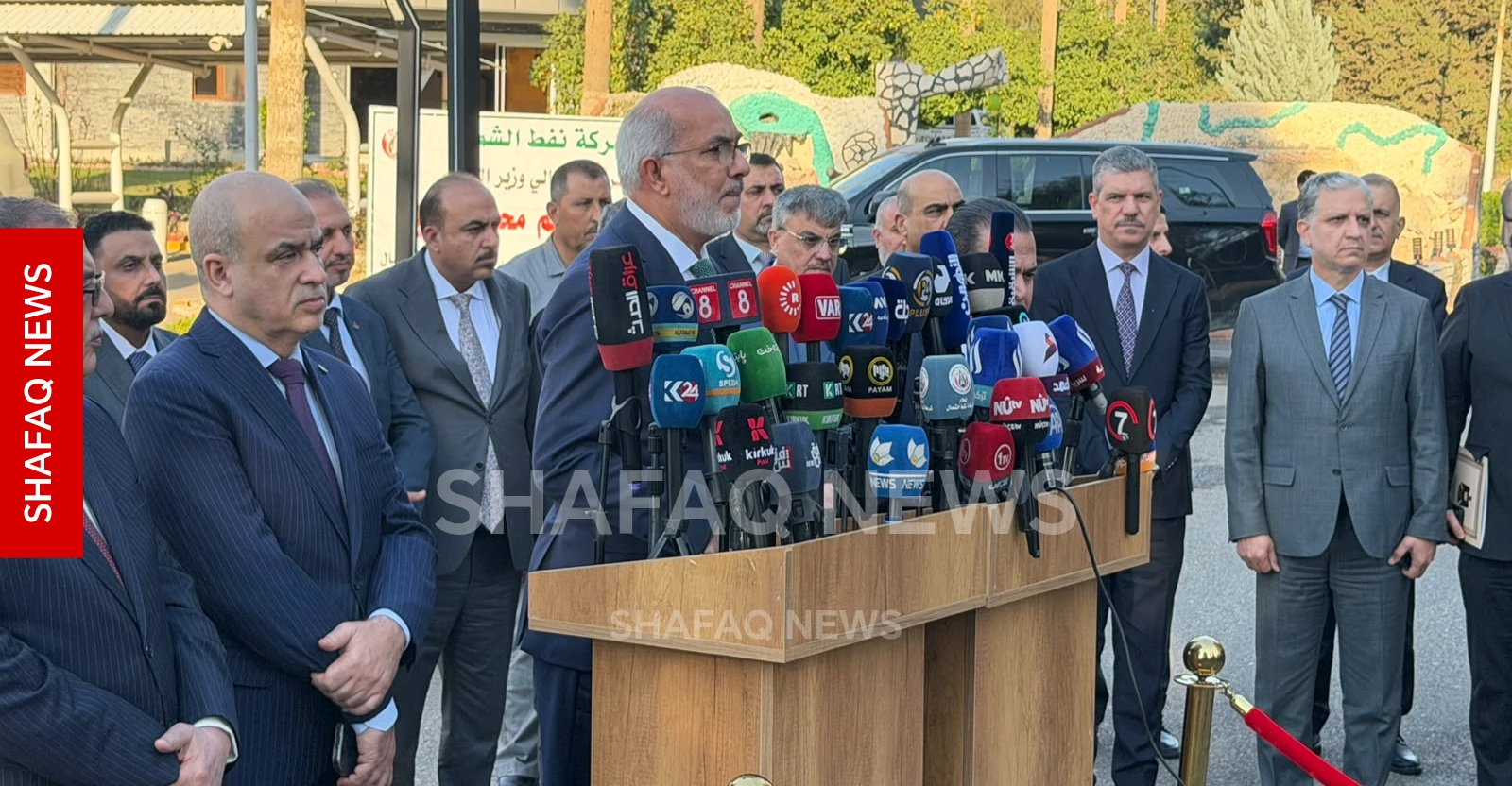
Iraqi Oil Minister Bassem Mohammed Khudair Al-Abadi confirmed on Friday that the ministry is working to develop the oil and gas sector and maximize the state’s financial resources, noting that Iraq is negotiating with OPEC to increase its production, while announcing that American companies will have an important contribution in oil and gas investment and the development of the sector’s infrastructure.
Al-Abadi said in a press conference during his visit to Kirkuk Governorate, which was attended by a correspondent from Shafaq News Agency, that “my visit included holding a meeting of the Ministry’s Advisory Board,” indicating that “other meetings will be held in a number of governorates based on the directives of the Prime Minister, to follow up on oil files and work on developing the sector.”
He added that “oil represents one of the most important baskets of financial resources for Iraq, and therefore the ministry is working to maximize the benefit from oil and gas wealth and increase the revenues generated from it,” noting that “the meeting discussed the file of associated gas and ways to invest in it, in addition to discussing the possibility of attracting specialized international companies to work in the sector.”
He explained that “the ministry is working to bring American companies to invest in oil and gas, given their expertise and capabilities that can be utilized in developing the energy sector and infrastructure,” stressing that “American companies have an important role in the next stage in the field of oil and gas investment.”
Regarding the rehabilitation of the Iraqi-Turkish pipeline, Al-Abadi said, “The ministry inaugurated the pipeline rehabilitation project today,” considering it an achievement for the Ministry of Oil and the North Oil Company, and appreciating the national effort that contributed to the pipeline’s rehabilitation, especially the projects, pipelines, and drilling companies.
He pointed out that “the pipeline will pump in the first phase at a capacity of 300,000 barrels per day, and that within two days the capacity will be raised to 500,000 barrels per day,” stressing that “restarting the pipeline represents an important step in enhancing Iraq’s export capabilities and benefiting from oil infrastructure.”
He added that the ministry is working according to clear figures, and that Iraq’s exports last May were around 200,000 barrels per day, while today they have reached about 3.6 million barrels per day,” stressing that “the ministry is fulfilling its responsibilities and working day and night to develop production and exports and maximize revenues.”
The Minister of Oil pointed out that there are “negotiations with OPEC regarding raising Iraq’s production,” explaining that “Iraq has been exposed to exceptional circumstances during the past five decades, and therefore we hope that OPEC countries will take into account Iraq’s special status as a founding member of the organization, which will allow it to increase its production and invest its oil capacities.”
In the fight against corruption, the minister stressed that “the directives of the Prime Minister focus on confronting corruption of both kinds, whether related to the theft of public funds or administrative corruption,” emphasizing that “the ministry will not tolerate anyone proven to be involved in tampering with public funds.”
Al-Abadi added that “the files and issues raised concerning pipelines and other matters are subject to legal procedures, and the ministry is awaiting the results of the judiciary,” stressing that “any person proven to be involved or negligent will face the necessary legal measures.”
He explained that “my presence in Kirkuk also comes to review the meters and work mechanisms in the North Oil Company, and to ensure the integrity of the procedures related to production, measurement and export,” stressing “the need to preserve public funds and protect oil wealth.”
He noted the continued communication with the Kurdistan Region regarding the oil fields, stressing the need to preserve them and work to invest in them in the best way possible in a way that serves Iraq and enhances its financial resources.
The Minister of Oil revealed that there is cooperation with BP to conclude new contracts related to the Ajil gas field, the Hamrin field and the Qayyarah oil field, with the aim of developing these fields, increasing their production and providing the required financial returns for Iraq.
He affirmed that the ministry is proceeding with the development of the oil and gas sector and attracting international companies, which will contribute to increasing production and exports and maximizing revenues, stressing that the goal is to achieve the best possible investment of oil and gas wealth and transform it into resources that support the Iraqi economy.
It is noted that Prime Minister Ali Faleh al-Zaidi issued a package of decisions last Tuesday in light of the investigations into the oil smuggling case at the North Oil Company, which included the Federal Border Ports Authority taking over all ports in the Kurdistan Region, and restricting approval for the export of oil and its derivatives to the Federal Ministry of Oil.
The decisions also included the Federal Ministry of Oil taking over the management of its fields in the governorates of Kirkuk, Nineveh, Salah al-Din and Diyala, which are outside the security control of the federal government.
The Federal Supreme Court, the highest judicial authority in Iraq, issued a ruling last Wednesday declaring the measures taken by Prime Minister Ali al-Zaidi towards the Kurdistan Region to be constitutional.
The decisions sparked negative reactions in the Kurdistan Region, as its leaders stressed the need to resort to the constitution in addressing disputes, and rejected taking unilateral measures that affect the region’s powers and constitutional gains.
shafaq.com
