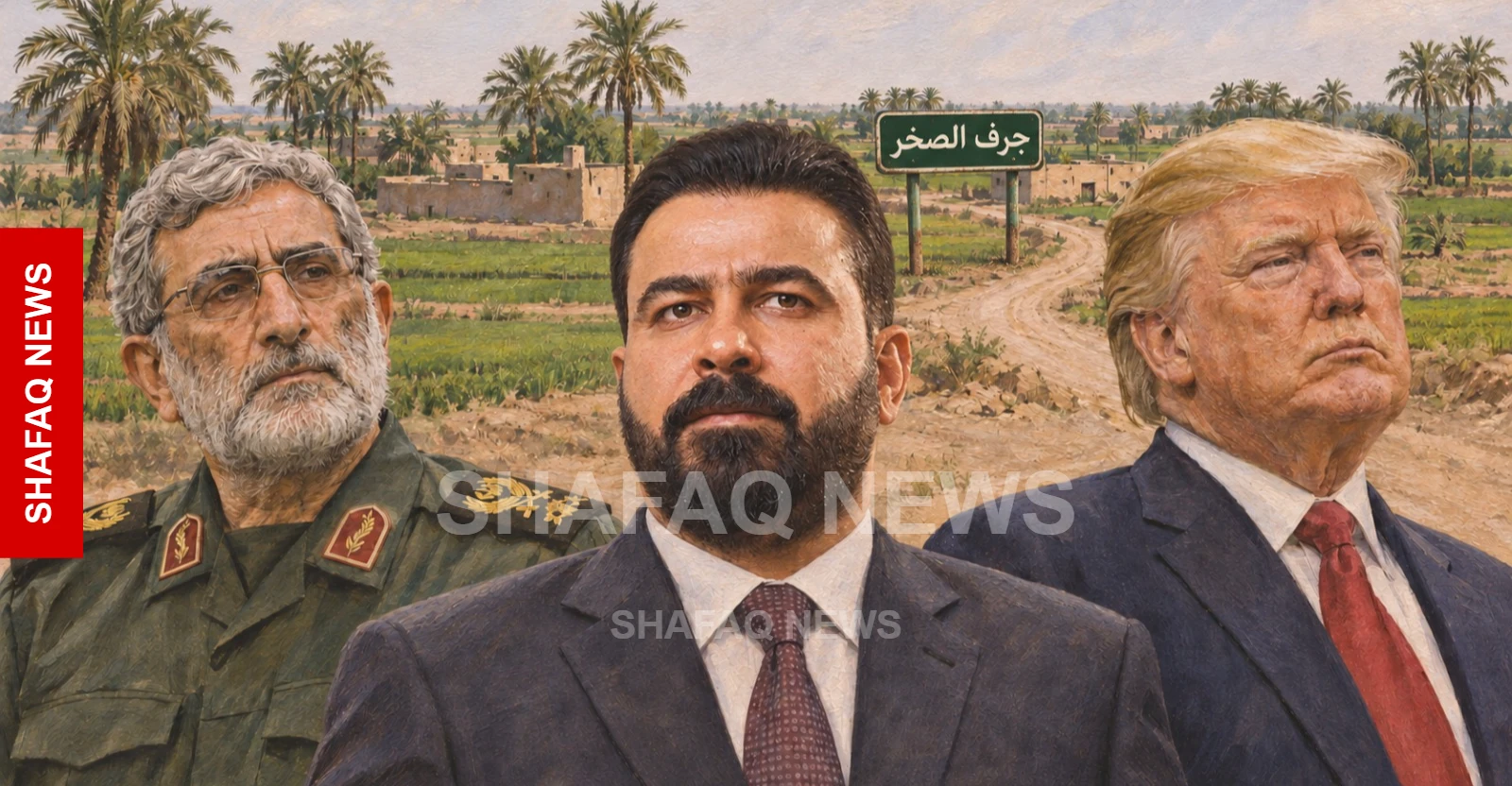
The rocky cliff enters the calculations of Washington and Tehran… Al-Zaidi bets on state authority, and Qaani seeks a settlement
The rocky cliff enters the calculations of Washington and Tehran… Al-Zaidi bets on state authority, and Qaani seeks a settlement
2026-11-19
 Shafaq News – Baghdad/Washington
Hours before the deadline set by Iraqi Prime Minister Ali al-Zaidi for Kataib Hezbollah to withdraw from Jurf al-Sakhr, the armed group announced on Thursday that a meeting between its leader, Iranian Quds Force commander Ismail Qaani, and a number of Iraqi leaders had ended with “good” results, in the latest attempt to avoid a confrontation between government forces and one of the most prominent factions allied with Tehran.
The brigades did not reveal details of what was agreed upon, or whether they were prepared to relinquish control of the area north of Babil Governorate, while al-Zaydi continues to push for the complete handover of the security file to government forces, supported by an American position demanding accountability for armed factions linked to Iran.
Al-Zaydi had ordered the security forces to prepare to enter Jurf al-Sakhr, following government investigations into suspicions of smuggling oil and its derivatives from the area, which ended with the dismissal of nine security and administrative officials and the referral of those involved to the judiciary.
Kataib Hezbollah denies the accusations, describes the results of the investigations as fabricated, and refuses to withdraw from the area, large parts of which it has controlled since recapturing it from ISIS in 2014.
Jurf al-Sakhr, also known as Jurf al-Nasr, lies about 60 kilometers southwest of Baghdad, and its location connects important roads between the capital and the central and southern provinces. Many of its residents have been unable to return to their homes since the fighting that took place in the area more than 12 years ago.
But al-Zaydi’s decision to end the brigades’ control put him in front of a possible confrontation with an armed faction that enjoys political and security influence, and sparked a division within the coordinating framework that brought him to the premiership about six months ago.
A meeting held by the framework last Monday witnessed verbal clashes between al-Zaydi and the leader of the Badr Organization, Hadi al-Amiri, after the Prime Minister refused to extend the deadline or back down from his decision, despite warnings from political leaders that the use of force could lead to security disturbances in other Iraqi cities.
Al-Zaydi left the meeting without reaching an agreement, while security reinforcements arrived in the vicinity of Jurf al-Sakhr, coinciding with the government forces’ preparations to take over responsibility for the area, according to a political source for Shafaq News.
Washington supports al-Zaidi
The prime minister’s moves have received support from Washington, which accuses armed factions allied with Iran of undermining Iraq’s sovereignty and seizing its resources.
A spokesperson for the US State Department told Shafaq News Agency that the United States expects the al-Zaidi government to “hold Iranian-backed militias accountable for their involvement in violent and destabilizing activities throughout Iraq and the entire region.”
He added that these groups weaken the Iraqi economy and seize the country’s resources through corruption and illicit gain for personal profit and for the benefit of the Iranian regime.
Washington has long pressured successive Iraqi governments to curb the influence of Tehran-linked factions, some of which have carried out attacks on US interests and forces, but the current prime minister has gone beyond political warnings, giving his forces a specific deadline to prepare to take control of an area that is considered one of the most prominent strongholds of Kataib Hezbollah.
Thomas Warrick, a former official at the U.S. Departments of State and Homeland Security, says the United States wants al-Zaidi to succeed in bringing all armed factions under his authority as commander-in-chief of the armed forces.
Warrick told Shafaq News that “Washington wants to see the Prime Minister succeed in his efforts to bring all militia forces under his command as Commander-in-Chief of the Armed Forces.”
Warwick linked the decision to impose government control to the investigations related to oil revenues, considering that the legal violations in this case are “perfectly clear, and not a matter open to debate or doubt.”
He said the prime minister has the constitutional and legal authority to prosecute those who have made illicit profits from controlling resources that are supposed to belong to the Iraqi people.
But American support does not eliminate the risks facing al-Zaidi. Kataib Hezbollah possesses military capabilities and has a presence within the network of armed factions that have gained widespread influence since the war against ISIS, in addition to its relations with political forces involved in running the state.
Qaani’s mission
In Tehran, political analyst Saeed Shahroudi denies that Iran is behind the Iraqi factions’ clinging to their weapons, and says that his country respects the decisions of the Iraqi government and does not interfere in its internal affairs.
Shahroudi told Shafaq News Agency that “Iran has officially clarified its position on the relationship with Iraq on several occasions, and has emphasized that it respects Iraqi sovereignty and the Iraqi decision, and does not interfere in the country’s internal affairs.”
He accused the United States of interfering in Iraqi decision-making, citing Trump’s opposition to Maliki assuming the premiership, and the accompanying threats of taking action against Baghdad.
Shahroudi says that the armed factions fear threats from the United States, Israel and other regional parties, and see a need to retain some of their weapons to support government forces if Iraq is attacked.
He added that Iran does not support the existence of uncontrolled weapons, and that the issue of factions keeping their weapons concerns those groups themselves, and is not an Iranian demand, stressing that Tehran will support any decision that enjoys Iraqi national consensus.
But Quds Force commander Ismail Qaani arrived in Iraq on Monday evening as an envoy from the Iranian Supreme Leader, after the efforts of the Coordination Framework leaders to persuade al-Zaidi to reverse his decision faltered.
Qaani held a series of meetings with political leaders and armed factions, and Iraqi sources told Shafaq News that he informed his interlocutors that he came on a mission to end the crisis and prevent a confrontation, and that he does not want to return to Tehran without reaching a solution.
For Iran, an outbreak of fighting between government forces and Kataib Hezbollah could threaten one of its most important Iraqi allies, while the faction’s withdrawal from Jurf could reduce its influence in an area it has controlled for more than a decade.
Any clash could also affect relations between Shiite forces, with which Tehran has close ties, after meetings of the coordination framework revealed disagreements over how to deal with al-Zaidi’s decision.
During the talks that followed Qaani’s arrival, the mediators put forward proposals to transfer brigades belonging to Kataib Hezbollah from Al-Jurf to the Iraqi-Syrian border, and replace them with three brigades from the Popular Mobilization Forces, while keeping a number of Kataib members and their leaders in specific locations, and involving the Third Division of the Federal Police in maintaining security.
A committee comprising al-Amiri, the head of the Popular Mobilization Forces, Faleh al-Fayyad, and the chief of staff of the organization, Abdul Aziz al-Muhammadawi “Abu Fadak”, took over the task of conveying the proposals to the brigades.
However, the meetings did not result in an agreement, as the brigades rejected some proposals, while al-Zaydi rejected other proposals, according to political sources who spoke to Shafaq News Agency.
According to the sources, al-Zaydi insisted that the deadline end on Friday evening without extension, while mediators warned that the entry of government forces by force could prompt the factions to respond.
In an attempt to overcome the dispute, the Secretary-General of Kataib Hezbollah, Abu Hussein al-Hamidawi, held a meeting with Qaani, al-Amiri and al-Fayyad, which the group announced on Thursday, describing its results as “good,” without disclosing its details.
This came a day after a security meeting chaired by the Director of the Office of the Commander-in-Chief of the Armed Forces, Abdul Amir al-Shammari, at the direction of al-Zaydi, which discussed proposals for redeploying forces, organizing command and control, and distributing security responsibilities in Jurf al-Sakhr.
The meeting was attended by the head of the Counter-Terrorism Service and officials from the Ministries of Defense and Interior and the Popular Mobilization Forces. The recommendations included strengthening the protection of vital facilities and intensifying intelligence work.
The Badr bloc also announced that it does not oppose the entry of security forces into Al-Jurf, but stipulated that the process of replacing forces must be carried out in a well-thought-out manner and with the participation of formations from the Popular Mobilization Forces.
The position of Kataib Hezbollah regarding a complete withdrawal remains undecided, after its leader, Abu Talib al-Saidi, announced during a press conference he held on Tuesday inside Jurf al-Sakhr, his refusal to leave the area, while confirming that the group does not wish to confront the security services.
As Friday evening approached, the Iraqi government had not announced an extension of the deadline, nor had the Kataib Hezbollah revealed its acceptance of handing over its positions. The meeting, which the group described as having concluded with “good” results, did not clarify whether it had altered either of these positions.
shafaq.com
