The Islamic Cooperation Council session kicks off in Baghdad, and Al-Zaidi calls for the protection of international trade (Update)
The Islamic Cooperation Council session kicks off in Baghdad, and Al-Zaidi calls for the protection of international trade (Update)
2026-10-17
 Shafaq News – Baghdad
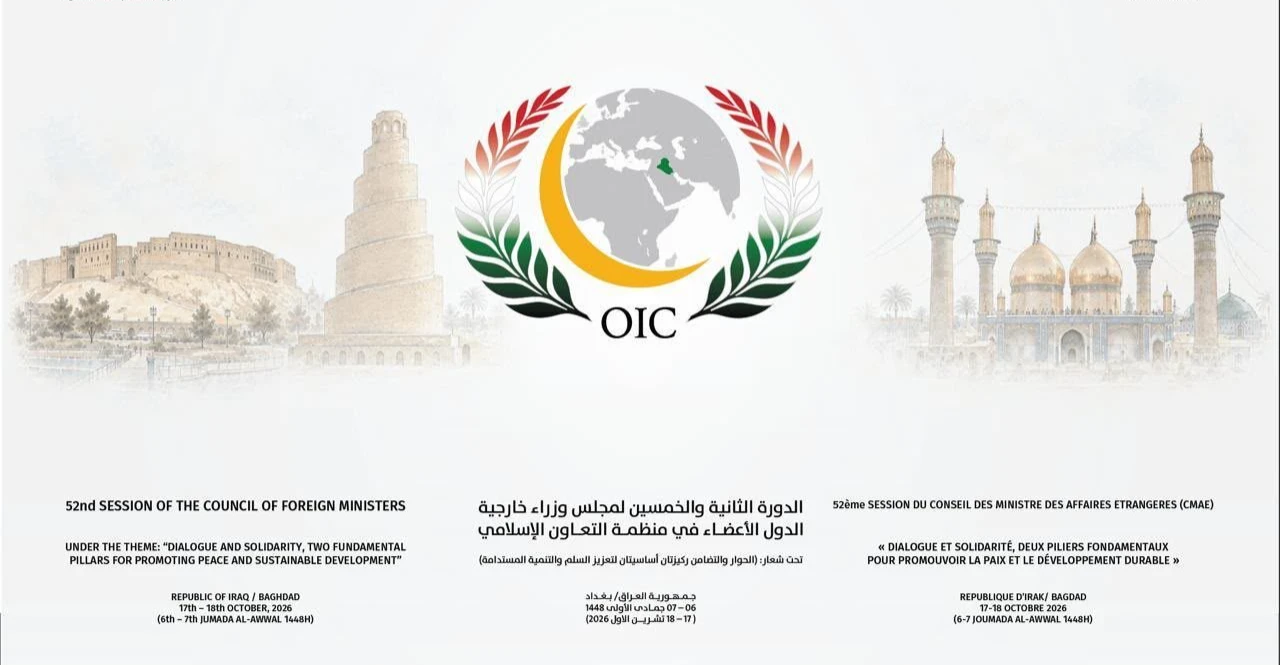
On Saturday, Prime Minister Ali Faleh al-Zaidi inaugurated the 52nd session of the Council of Foreign Ministers of the Organization of Islamic Cooperation, hosted by the capital, Baghdad.
The official spokesperson for the 52nd session of the Council of Foreign Ministers of the Organization of Islamic Cooperation, Ambassador Hassanein Kamel, said in a statement received by Shafaq News Agency that the session began with the participation of official delegations from member states and guests, under the slogan: “Dialogue and solidarity are two essential pillars for promoting peace and sustainable development.”
He added that Al-Zaidi delivered a welcoming speech during the opening session, in the presence of delegations from member states and a number of distinguished guests, including Amina J. Mohammed, Deputy Secretary-General of the United Nations and Chair of the United Nations Sustainable Development Group, along with representatives of a number of non-governmental organizations.
In his opening remarks, Al-Zaydi called for “free trade, protection of its routes, and ensuring the smooth flow of transport in international corridors,” explaining that “Iraq is advancing an initiative for integrated linking of energy networks, railways, transportation, and digital communications, developing digital payment systems and commercial platforms, and achieving integration between industrial zones.”
He explained that “the Islamic world is facing increasing challenges that test its ability to coexist and keep pace with economic, cultural and media transformations, and what we are witnessing in terms of crises in the regional and international arenas calls on us to do more joint work to protect the interests of our peoples, serve the causes of our nation and ensure the future of our generations.”
He stressed that “the Organization of Islamic Cooperation represents a pillar for strengthening the bonds of brotherhood and integration among our peoples, who are united by Islam as a religion, culture, and civilization,” affirming Iraq’s principled position on the Palestinian issue as the core of the conflict in the region, and that doing justice to the Palestinian people and guaranteeing their rights is fundamental to the region’s security and stability.
He pointed out that Iraq has suffered, and continues to suffer, from the effects of conflicts in the region and their economic repercussions, stressing that “Baghdad, the city of civilization, will remain a meeting place for cultures and peoples, and a home for coexistence and fraternity.”
He continued, saying that “cooperation and acceptance of differences are the key to understanding, reducing disputes, and the unity of the Islamic nation,” adding that the Iraqi initiative aims to “establish security, stability, and prosperity, and enhance the ability to confront crises and challenges.”
Al-Zaidi concluded his remarks by saying: “We reiterate our support for the Organization of Islamic Cooperation and its efforts to achieve development goals and the pillars of stability and common security. I thank the Islamic Republic of Pakistan for its efforts in seeking to defuse the crisis,” calling on the member states of the Organization of Islamic Cooperation to “exert more efforts to achieve stability and peace in the region.”
Ambassador Kamel explained that Al-Zaidi’s speech was followed by speeches by Foreign Minister Fuad Hussein, the Foreign Minister of the Republic of Turkey, in his capacity as the chair of the previous session, the Secretary-General of the Organization of Islamic Cooperation, as well as speeches by the heads of delegations of the participating member states.
He explained that the session witnessed the transfer of the presidency of the Council of Foreign Ministers of the Organization of Islamic Cooperation from the Republic of Turkey to the Republic of Iraq, to assume the presidency of the 52nd session of the Council.
Kamel added that the session will discuss a number of issues of common interest, foremost among them the Palestinian issue and developments in the Gaza Strip, as well as current regional and international developments, and will consider and approve draft resolutions that address political, economic, social, humanitarian and developmental issues for the next stage.
He pointed out that these discussions come within the framework of the session’s slogan, which promotes dialogue and solidarity among member states, and supports efforts to consolidate peace, expand areas of cooperation and joint action, and contribute to achieving sustainable development and serving the peoples of the Islamic world.
He noted that working sessions would continue throughout the day to discuss the topics on the agenda, and that the session would resume the following day to complete discussions and consider draft resolutions and documents submitted to the Council.
shafaq.com
