The Guardian: Has the end of the “empire of corruption” in Iraq begun with American support?
The Guardian: Has the end of the “empire of corruption” in Iraq begun with American support?
2026-09-13
 Shafaq News – Special Translation
The British newspaper ” The Guardian ” questioned whether the arrests and confiscation of financial assets carried out by the government of Prime Minister Ali al-Zaidi would lead to the dismantling of the “empire” of corruption and the weakening of the looting power structures within Iraq, while Washington supports al-Zaidi’s move alongside the judiciary.
The newspaper reported, in a report translated by Shafaq News Agency, that the arrests of corrupt individuals were met with great gloating by Iraqis, who, if they agree on anything, from different sects, ethnicities and social backgrounds, it is the extent of corruption and decay of political parties and the greed of a group of party leaders, businessmen and militia leaders.
The report also recalled al-Zaydi’s assertion, on the day of his inauguration, that the two most pressing issues were the disarmament of the factions and the fight against corruption without red lines, indicating that with the state treasury almost empty after the major disruption in oil exports due to the war on Iran, these two issues, namely the militias and corruption, are interconnected, and in the context of the war, they threaten the state itself.
He pointed out that al-Zaidi, like the prime minister who preceded him, and the person before him, announced the exposure of extensive corruption networks, but they ended their terms mired in their own corruption charges, while the country’s public services remained in ruins.
The report quoted a source familiar with the government as saying, “This is not just something every prime minister does; this is unprecedented, and it is a real earthquake within political circles because it is a signal to all politicians about what can happen to them… and to everyone, without exception,” explaining that what is happening is that a prime minister is trying to dismantle the financial empires of political parties.
He added that these are empires built on corruption and are obvious, and that every politician is involved without exception, explaining that when you choose four or five of them and strike, you are sending a message to everyone that what happened to these people can happen to all of you.
The report pointed to the quota system and power-sharing in place in Iraq since the 2003 invasion, quoting an international banker, appointed by a previous government to help clean up the system, who asserted that parties have built mini-states within the state… and we probably have seven or eight small mini-states that capture between 5% and 10% of every government contract.
Regarding how power and positions are shared in Iraq, the report stated that in January 2025, Adnan al-Jumaili was appointed Deputy Minister of Oil in charge of refineries, and that his career advancement and competence were celebrated. He appeared in several video clips alongside then-Prime Minister Mohammed Shia al-Sudani, who was cutting ribbons to inaugurate projects and showcasing his government’s achievements, while al-Jumaili stood beside him smiling and briefing him on the details. In one clip, al-Jumaili appeared receiving the “Ideal Employee” award from al-Sudani.
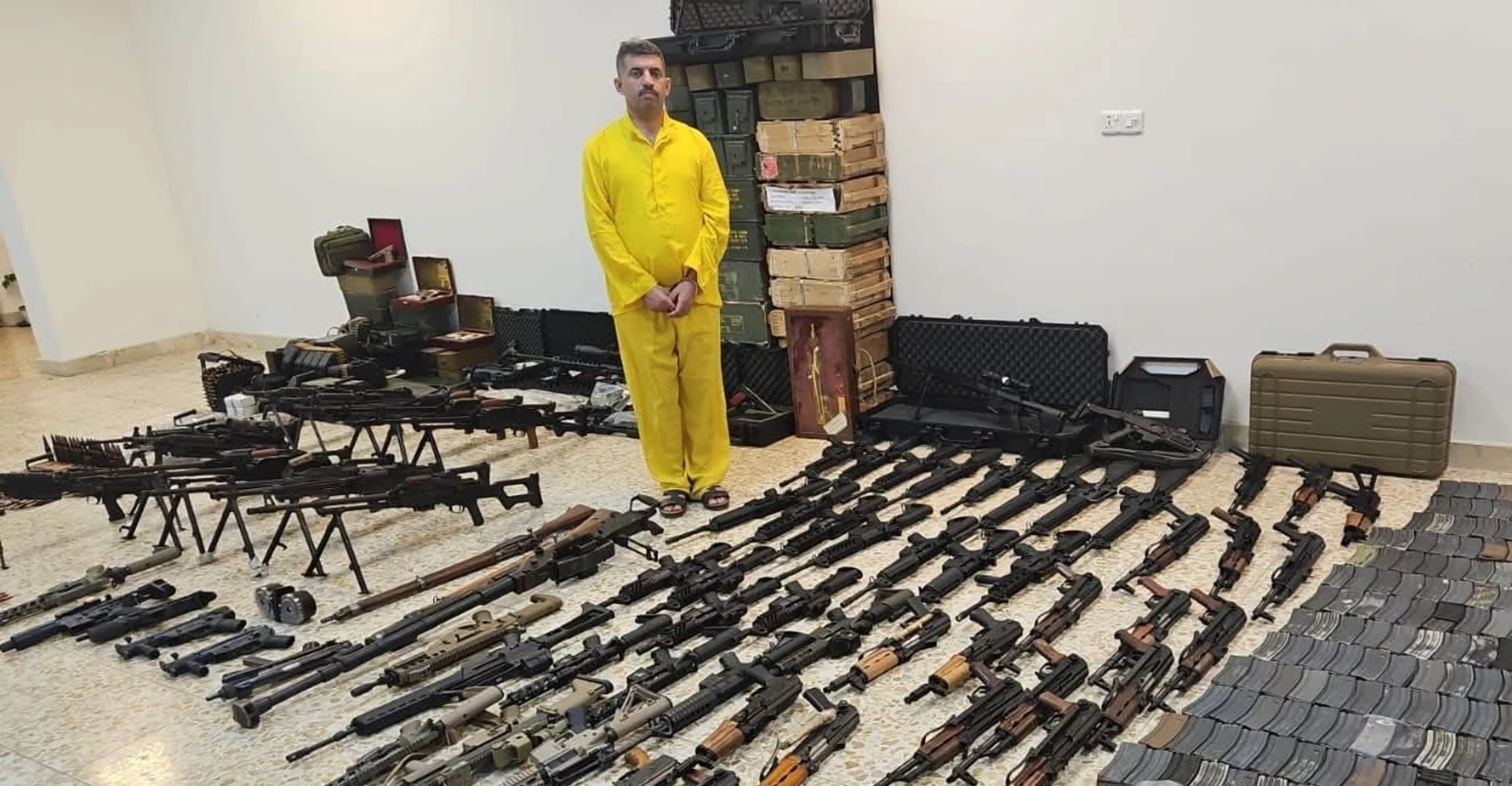
He continued: “Shortly after al-Sudani lost his bid for a second term and al-Zaidi became prime minister, everything collapsed. Al-Jumaili was the first to be detained, and a picture of him wearing a yellow suit, surrounded by dozens of machine guns and ammunition boxes, was distributed. Investigators noted that they also recovered $10 million in cash, 3 billion dinars (about $2 million), and 1.5 kilograms of gold, in addition to about 40 properties across Baghdad and other provinces.”
According to the report, investigations showed that Al-Jumaili ran a scheme that generated hundreds of millions of dollars. Al-Zaydi said during a meeting with journalists that Al-Jumaili tried to bribe him with $200 million before his arrest to keep his position. Reports spoke of a bribe offer of $600 million. He added that it is unknown whether Al-Jumaili was the mastermind behind all the corruption, or whether he fell victim to a scheme that had been set for him beforehand. However, he added that since Al-Jumaili arrived at the Ministry of Oil, he began collecting huge commissions from contracts and awards that were given to companies and contractors, and from diverted fuel shipments. As last year’s elections approached, Al-Jumaili became a conduit for providing millions of dollars to candidates, many of whom were on the Prime Minister’s list, though not all of them.
The report quoted a politician as saying that “many parties came and benefited from working with al-Jumaili, and that all of this was to protect himself,” noting the expansion of his relationships with political parties, not only with the Sunni bloc that nominated him, but also with his superiors in the Ministry of Oil and in the Prime Minister’s office, and that he felt untouchable.
According to the same politician, Al-Jumaili, with the increasing political cover he enjoyed, began to make disastrous mistakes, as he told himself that it was impossible for anyone to touch him, and so he began to make mistakes, including falsifying warehouse deliveries, diverting fuel to create a fictitious stockpile that did not exist, and he also started talking about thousands of fictitious day laborers who were paid, even though they did not exist in the first place.
The report quoted the same source as saying that the Adnan al-Jumaili case is a model of how things are run, and how the process of placing people in certain positions works, positions that are responsible for generating large revenues, illegally, for a party or several parties.
According to government insiders, members of parliament, and a source close to the judiciary, the Americans, tired of dealing with politicians who fail to deliver any reforms, have instead built a relationship with the Iraqi judiciary, with U.S. envoy Tom Barrack playing an active role, encouraged by increasingly firm statements from the judiciary regarding the state’s monopoly on weapons, according to the report.
The report added that for months, investigators had been looking for a corruption case that could be publicly disclosed. The challenge was to find a figure who, when exposed, would make headlines locally and internationally, while ensuring that the repercussions of the case would not bring down the entire political system. The Al-Jumaili case was ideal, as it showed the involvement of a number of prominent politicians, but did not name the heads of the major parties.
One official said: “You don’t know, in the end, if you continue to put pressure on these parties, what the armed factions might do? And what Iran might do?” He pointed out that “the issue touched a sensitive nerve for the Americans, specifically, which is the aspect related to oil smuggling.”
The government source emphasized: “The idea that parties live off the shares they receive from the state and through projects, committees, and so on, must end, and this chapter must be closed. I believe this is the most important thing that can happen in the history of modern Iraq,” explaining that bringing in al-Zaidi, or at least the support he receives from the United States and the judiciary, was specifically calculated for this moment. He is someone with sufficient experience and knowledge of the mechanisms involved in directing funds outside the state, and he knows how money is smuggled, directed, and extracted through contracts, projects, commissions, and so on.
The newspaper quoted informed sources as saying: “There are no guarantees that corruption will end, and that the parties will stop looting the state… But what we hear is that there is a real governmental and judicial desire to end a certain phase and start a new one, in which things will be normal, meaning that our country will become like any other country in the world, with its successes and failures.”
The report concluded with the following questions: “Will this anti-corruption campaign achieve any serious results? Or will it, at best, appear as just another cosmetic operation, if not a political compromise? How can Iraq become a normal state capable of reform while sitting on a regional fault line, caught in the middle of a multi-faceted war that has raged across its land and skies? And can this reform be achieved without holding accountable the leaders of the parties and the mini-states they have established?”
shafaq.com
