Iraq: More than 11,000 government employees are illiterate
Iraq: More than 11,000 government employees are illiterate
2026-09-08
 Shafaq News – Baghdad
The Iraqi Ministry of Education revealed on Tuesday that more than 11,000 employees in state institutions, both civilian and military, are illiterate.
The Ministry of Education spokesman, Karim Al-Sayed, said in a statement on the occasion of International Literacy Day, as reported by Shafaq News Agency, that surveys related to the recent population census showed that the percentage of Iraqis who cannot read and write is 15.3%, estimating their number at about 6.5 million to 6.9 million Iraqis.
He added that surveys showed that the governorates of Nineveh, Muthanna and Maysan had the highest illiteracy rates, while Erbil and Salah al-Din were among the governorates with the lowest rates, while Baghdad recorded the lowest rate at 10%.
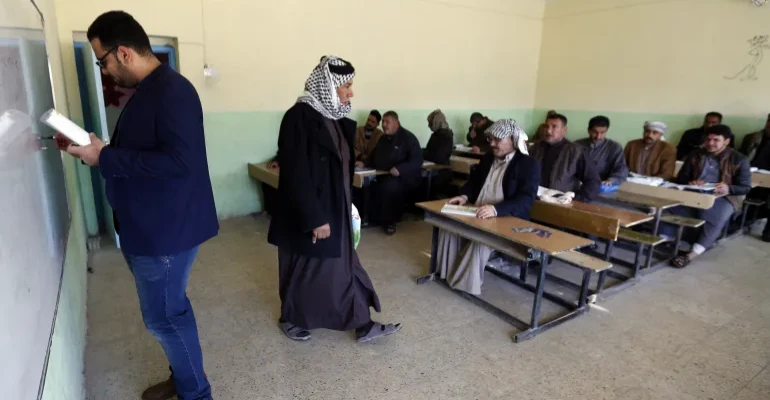
He explained that the executive body for literacy has specialized centers in all the general directorates of education, and this file is supervised by a specialized body, noting that there are more than 1,200 centers in Iraq whose programs have benefited more than two and a half million people.
He explained that the uneducated are distributed among citizens and employees, while the employees are divided between civilians and military personnel, noting that the number of students from civilian and military employees reached about 57,512 students throughout Iraq.
He noted that the number of civilian employees studying was 5,832, while the number of military personnel studying was about 10,366.
Mr. pointed out that there are more than 11,000 employees in state institutions who are illiterate, including employees in ministries and civil institutions, most notably oil and electricity, as well as military and security institutions, including the Ministries of Defense, Interior and the Popular Mobilization Forces.
Mr. Al-Sayed confirmed that the executive body for literacy has developed, with the start of the academic year, an integrated program to accommodate the largest possible number of learners and reach the furthest possible point, including villages and rural areas.
He explained that the ministry is working with international organizations and governmental institutions to reduce the severity of illiteracy, indicating that the reasons for the phenomenon are multiple, most notably the security conditions that the country went through and the security fragility that contributed to leaving a number of children or those who missed educational opportunities, which led to the accumulation of years without catching up with education.
For his part, the First Deputy Speaker of Parliament, Adnan Faihan, called on the Ministry of Education to activate and implement the provisions of the Literacy Law No. (23) of 2011, and to develop its programs in a way that ensures access to the targeted groups, in continuous coordination with the Parliamentary Education Committee.
It is worth noting that the Iraqi Ministry of Education revealed in mid-August that there were about 20,000 employees in the Ministry of Electricity who did not have an educational certificate, while the capital, Baghdad, recorded the highest percentage of them with 5,768 employees.
Last April, the Iraqi Ministry of Planning announced that the illiteracy rate among the population aged 10 and above would decrease to about 15% in 2024, after it had exceeded 20% in previous years, registering a remarkable improvement in a short period.
shafaq.com
