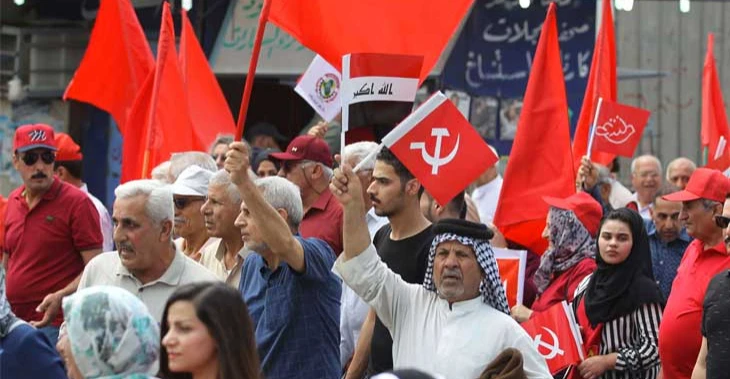
Following the completion of the cabinet, the Iraqi Communist Party calls for a popular movement against sectarian power-sharing.
Following the completion of the cabinet, the Iraqi Communist Party calls for a popular movement against sectarian power-sharing.
2026-10-16
 Shafaq News – Baghdad
On Friday, the Iraqi Communist Party called on national and democratic political forces, popular forces, unions, federations and protest movements to unite and build the broadest peaceful popular movement for change, and to confront the monopoly of power and wealth.
The Political Bureau of the Iraqi Communist Party stated in a statement received by Shafaq News Agency that “after more than five months of disruption and conflict over quotas and positions, the quota-based forces have returned to share power again, and for that purpose they have seized newly created sovereign positions and new ministries, as if what they have inflicted on the country in terms of destruction, corruption, poverty and deterioration of services was not enough.”
He added that “the vote to complete the government formation, in the closed session of the House of Representatives yesterday, Thursday, came to confirm the insistence of the influential forces on seizing the state for their interests, and turning its institutions and positions into tools to expand influence and share the spoils, disregarding the suffering of millions of Iraqis, their rights and their aspirations for a decent life.”
The Iraqi Communist Party announced its “categorical rejection of this government formation,” holding the forces that agreed to pass it fully politically responsible for entrenching sectarian quotas and perpetuating the failed approach that corrupted state institutions, squandered the country’s wealth, and plunged it into successive crises.
He pointed out that “the completion of the formation of the government cabinet, after more than five months of disruption, bargaining and tensions, did not come as a result of an agreement on a national program that puts the interests of Iraqis first, but rather it was the result of understandings between the quota forces that were preoccupied with distributing positions and obtaining gains, while the accumulated crises and the urgent demands of citizens were left without serious solutions, as the suffering from unemployment, poverty, deteriorating services, corruption and mismanagement continues.”
He explained that “experience has proven that power-sharing is the basis for crises and the perpetuation of failure, and that the forces dominating power still prioritize their partisan and factional interests over the interests of Iraqis, disregarding their demands for reform, change, and building a state of citizenship, justice, and law.”
The party held the influential forces supporting the power-sharing government responsible for the continuation of the crises, noting that the parliamentary majority that granted it confidence through power-sharing does not exempt it from popular accountability, nor does it give it an open check at the expense of citizens’ rights.
He pointed out that getting rid of the crises is not achieved by reproducing the failed approach, but rather by ending the quota system and corruption, and building a state that respects its citizens and guarantees them justice, dignity and a decent life.
The Iraqi parliament voted on Thursday evening to appoint three deputy prime ministers, including Ali al-Zaidi, and 11 candidates for vacant ministerial posts, including a minister of state, with the exception of the Ministry of Immigration.
