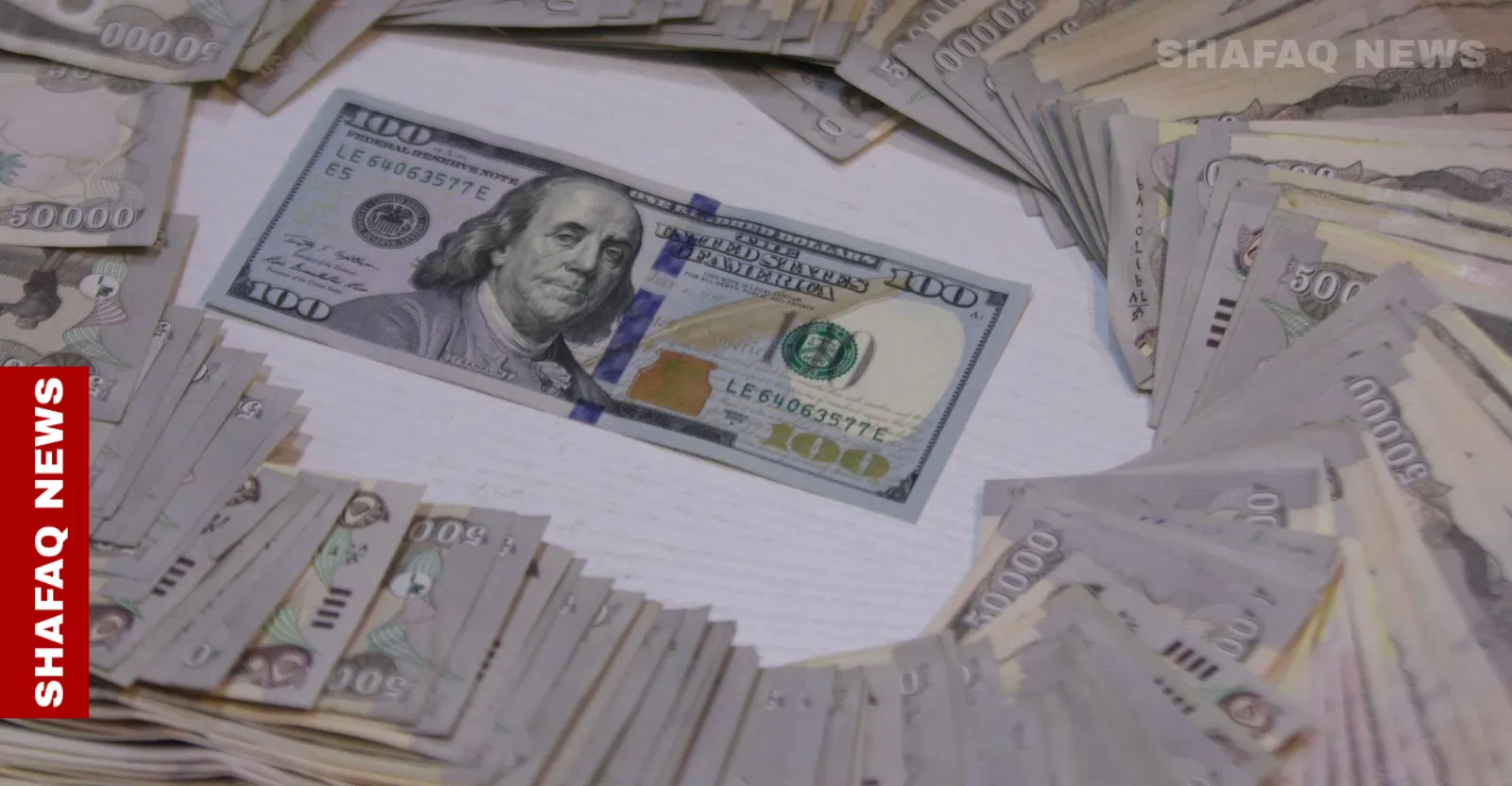
An economic institution submits a proposal to the Iraqi government to stop the rise of the dollar in the parallel market.
An economic institution submits a proposal to the Iraqi government to stop the rise of the dollar in the parallel market.
2026-02-21 02:28
 Shafaq News – Baghdad
The “Iraq Future” Economic Foundation attributed the rise in the dollar exchange rate against the dinar in the parallel market to the increased demand for hard US currency by small traders who import goods and services other than food items, while suggesting that these commercial segments be accommodated by selling dollars to them at the official rate.
The head of the institution, Manar Al-Obaidi, said in a post on social media that “the past few days have witnessed a remarkable rise in the exchange rate of the dollar against the Iraqi dinar, reaching unprecedented levels in the parallel market, which has brought back to the forefront legitimate questions about the reasons for this rise, its limits, and the extent of its actual impact on the daily life of the citizen.”
He explained that “the fundamental reason for this increase is not related to the shortage of dollars as much as it is related to the inability of large commercial sectors to enter into the formal channels for financial transfer. At the forefront of these sectors are the trade in clothes, shoes, furniture and used cars.”
Al-Obaidi also pointed out that “the problem lies in the absence of a clear institutional structure for the supply chains of these activities. The majority of importers are at the same time small shop owners or distributors, lacking legal and regulatory entities capable of meeting the requirements of official transfer and direct import,” adding that “as a result, they still rely on the parallel market to provide hard currency, which generates continuous pressure that raises the exchange rate outside the official framework.”
Given this reality, three possible paths for future developments can be envisioned.”
He went on to say that “the first possibility: continued high demand in the parallel market, which leads to a further rise in the exchange rate there. However, experience has proven that this rise is not significantly reflected in the prices of basic commodities, especially food and medicine, as more than 95% of traders in these two sectors are now able to transfer through the official system at a rate close to 1320 dinars per dollar, which limits the transmission of the shocks of the parallel market to the citizen’s livelihood.”
Al-Ubaidi added that “the second possibility is that the government will move towards establishing a special platform for small traders to purchase goods from specific countries, provided that official bodies – such as the Central Bank or some government banks such as the Trade Bank of Iraq – handle the direct financial settlement operations with those countries, without the trader himself carrying out the transfer process.”
He continued, saying that “the third possibility (which is closest to reality): shipping and customs clearance companies will become actual importers, carrying out import, transfer and clearance operations, and will transform from a logistics partner to an integrated commercial partner, a scenario that is likely to expand rapidly if the necessary regulatory and banking facilities are available to it.”
The head of the institution pointed out that “the bet on small traders entering the official financial platform individually remains unlikely in the near term, for reasons related to their lack of legal and regulatory readiness, as well as the banks’ focus on large importers due to the high operational costs required to deal with large numbers of small clients.”
Al-Ubaidi concluded that “from here, the state appears to be facing two clear options: either to take the initiative to find structural solutions that accommodate these commercial segments within the formal financial system, or to accept the continued rise in the exchange rate in the parallel market and bear its media and social consequences, before they become economic,” considering that “the file is no longer purely technical, but has become a test of the ability of economic policies to move from managing the crisis to addressing its roots.”
shafaq.com
