An American institute calls for Kurdistan’s inclusion in the energy corridor project: it enhances the security of oil exports.
An American institute calls for Kurdistan’s inclusion in the energy corridor project: it enhances the security of oil exports.
2026-11-17
 Shafaq News – Special Translation
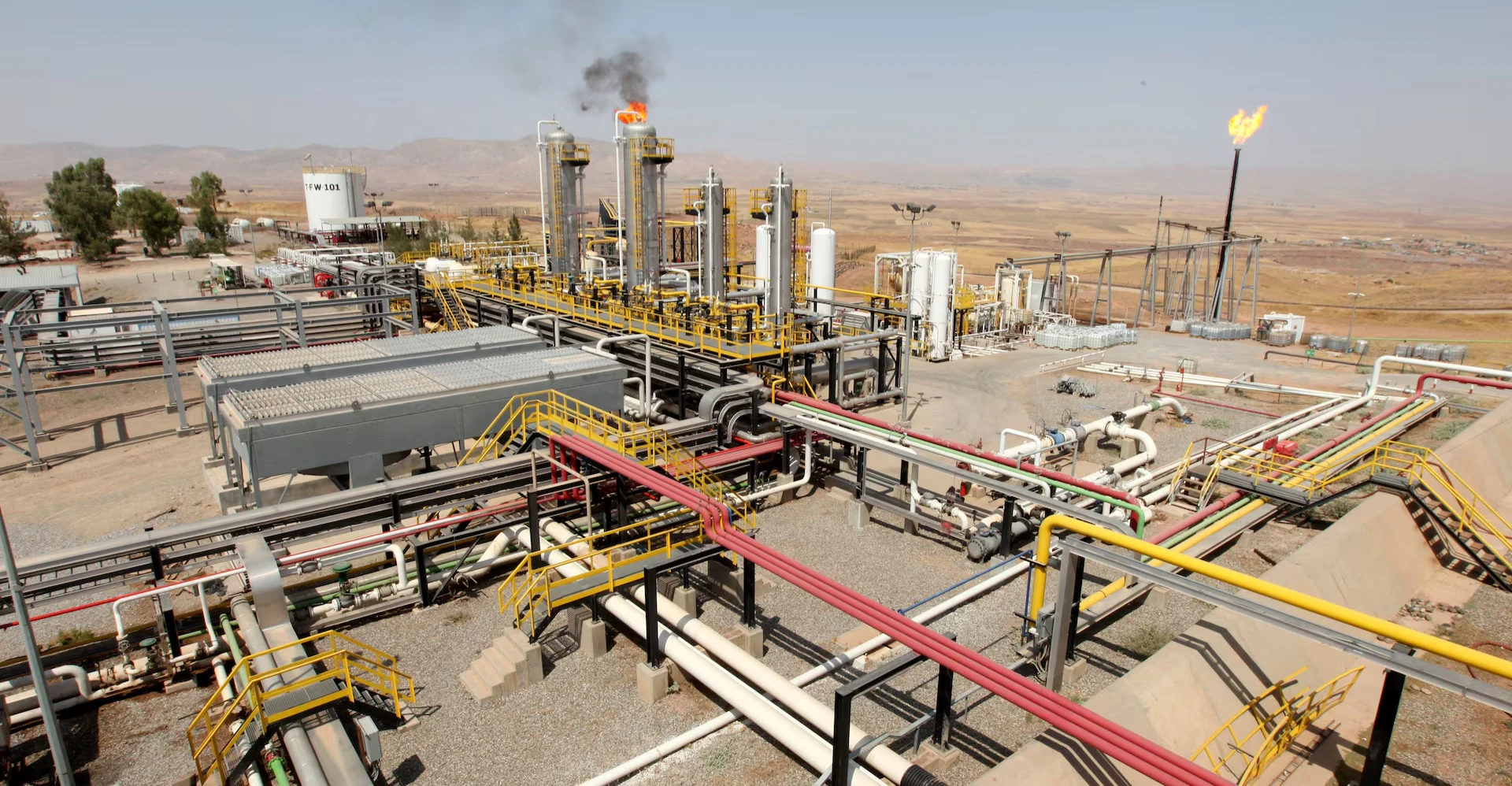
The Kurdistan Region could contribute to enhancing the security and economic value of the northern corridor of the Basra-Haditha pipeline, rather than excluding the region’s territory from its route. This calls for US support to integrate the region into the future of Iraq’s energy sector, providing an opportunity to conclude a new political and economic deal between Baghdad and Erbil, according to the US-based New Lines Institute .
The American Institute explained, in a report translated by Shafaq News Agency, that Iraq is proceeding with one of its most ambitious energy infrastructure projects in decades, by creating a new network of pipelines linking the southern oil fields to alternative export outlets on the Mediterranean Sea.
He pointed out that the project, which is about 1,000 kilometers long and is the cornerstone of Iraq’s efforts to diversify its energy export routes, focuses on establishing a pipeline between Basra in the south of the country and Haditha in Anbar province, from where it branches westward towards Banias in Syria, and northward towards Fishkhabur on the border with Turkey, where it connects to the Turkish pipeline network and the port of Ceyhan on the Mediterranean Sea, with the possibility of implementing an additional route that reaches the Jordanian port of Aqaba.
He pointed out that the project, which began in May with funding of $1.5 billion out of a total expected cost of $15 billion, is estimated to take between one and four years to complete, noting that Baghdad signed preliminary agreements with the American companies Chevron and TE Capital and the Qatari company UCC Holding, to form a consortium to participate in the development of the new pipeline network.
However, the report considered that the importance of the project goes beyond energy infrastructure and export diversification, as it provides an opportunity to reach a new political and economic deal between Baghdad, Erbil and Iraq’s neighbors, indicating that the new pipeline network is gaining greater strategic importance, as it aims to significantly reduce Iraq’s dependence on exports through the Strait of Hormuz, which has emerged as a weak point during the ongoing conflict involving Iran, the United States and Israel.
After noting that Iraq had lost a large part of its export capacity due to the recent war, the report explained that the new pipeline network would add between 2 million and 2.25 million barrels per day to export capacity.
A senior Iraqi oil official recently said that the Fishkhabur-Ceyhan and Haditha-Banias pipelines will each have an export rate of about one million barrels per day.
This is in line with Iraq’s ambitions to significantly expand oil production, after Prime Minister Ali al-Zubaidi set a target of increasing production to 10 million barrels per day by 2030.
While the report added that the proposed lines pass through some of the most politically and security-wise sensitive areas of the country, which could complicate the implementation of the project, it noted that these plans come amid a regional war and a great deal of geopolitical uncertainty, which makes the security challenges surrounding them worthy of special attention.
In this context, the report addressed Iran’s objections to alternative trade routes that would bypass the Strait of Hormuz, which Tehran might view as part of broader US efforts to weaken one of its main sources of geopolitical influence.
The report did not rule out the possibility of sabotage operations carried out by Iranian-backed factions if regional tensions continue, and it also pointed to the risks posed by the continued presence of ISIS, including its potential attacks on energy infrastructure in Iraq and Syria.
Based on these risks, he considered that the Kurdistan Region could provide a relatively safer passage for the northern station of the project, noting that the region has remained largely isolated from ISIS-related violence since 2017, while Iranian-backed factions do not have the same field presence or operational capabilities as they do in other parts of Iraq.
He added that despite this, the current plans for the project appear designed to largely bypass the region’s territory before reaching Fishkhabur, rather than integrating it into the new pipeline network, considering that the relatively stable security environment in the region represents an asset that Baghdad should take into account when planning the energy sector.
The report also clarified that “if political sensitivities can be put aside, the Kurdistan Region is well-positioned to host a longer extension of the northern export corridor towards Turkey, and therefore Baghdad needs to view Kurdistan as a partner whose energy resources can enhance the northern export corridor.”
The report argued that at a time when regional efforts are increasing to enhance connectivity through new trade routes and energy infrastructure, the Iraqi pipeline network should be viewed as more than just an infrastructure project, as it provides an opportunity to strike a new political and economic deal between Baghdad and the Kurdistan Region.
The report called on the federal government to “integrate the Kurdish oil industry into the economic logic of the corridor,” adding that expanding Kurdish production within an agreed national framework would enhance the strategic importance of the Fishkhabur-Ceyhan route, as well as deepen political cooperation and economic integration between Baghdad and Erbil.
He said that the long-term security of the network will not depend solely on protection from armed threats, but also requires creating common economic incentives for key stakeholders, ensuring the project’s continuity and viability. He stressed that the Kurdistan Region’s contribution would enhance the security and economic value of the northern corridor, giving Baghdad and Erbil a shared interest in its success.
According to the report, the Iraqi and Kurdish authorities should use this corridor as an opportunity to negotiate a permanent framework that regulates the oil and revenue file, instead of allowing it to become a new source of conflict and competition.
He went on to say that Kurdish oil production should be treated as an asset that enhances Iraq’s overall export capacity, particularly if security or other challenges delay the completion or operation of the Haditha-Fishkhabur pipeline.
According to the report, increasing oil production capacity in Kurdistan would be an important asset for Iraq in the event of a future crisis, noting that production in the region could rise, given a favorable political environment and investment incentives, from its current low levels to higher levels, compared to its total production capacity of a few hundred thousand barrels per day.
The report noted that Iraq’s pipeline ambitions would be more successful if diversifying export routes were treated not just as a matter of building alternative routes, but as an opportunity to build lasting political, economic and security partnerships around them as well.
The report put forward a number of policy recommendations, stressing that turning the northern corridor into a source of cooperation rather than a new point of contention requires well-thought-out policy choices from Baghdad and Erbil, as well as support from Washington.
Foremost among these recommendations, he called for the establishment of permanent coordination mechanisms between Baghdad and Erbil, through specialized committees in the fields of energy, trade and security, with the clear objective of integrating the Kurdistan Region into Iraq’s plans to expand energy production, as well as regional pipeline and commercial transport projects in which Iraq participates.
The report also called for a “change of mindset,” particularly in Baghdad, which exercises sovereign powers in this relationship, explaining that viewing bilateral relations as a zero-sum game has been a major obstacle to realizing the full benefits of cooperation in various fields for both sides.
Secondly, the report called for the integration of the region into Iraq’s national energy production strategy, and for encouraging foreign energy companies to continue developing existing fields and exploring new reserves, noting that increasing Kurdish production within a transparent national framework would enhance Iraq’s overall production and export capacity.
Third, the report stated that the federal government must ensure that armed factions do not threaten energy projects throughout the country, particularly in the Kurdistan Region.
Fourth, he called for the United States to provide diplomatic support for reaching an energy agreement between Baghdad and Erbil, and to actively encourage these efforts, adding that strengthening cooperation between the two sides in the fields of energy and regional trade would improve the chances of achieving long-term stability in Iraq, and help establish a permanent framework for coordination between the Kurdistan Regional Government and the Federal Government.
shafaq.com
