A contraction threatens Iraq with its “most severe” financial crisis in years.
A contraction threatens Iraq with its “most severe” financial crisis in years.
2025-04-26 06:14
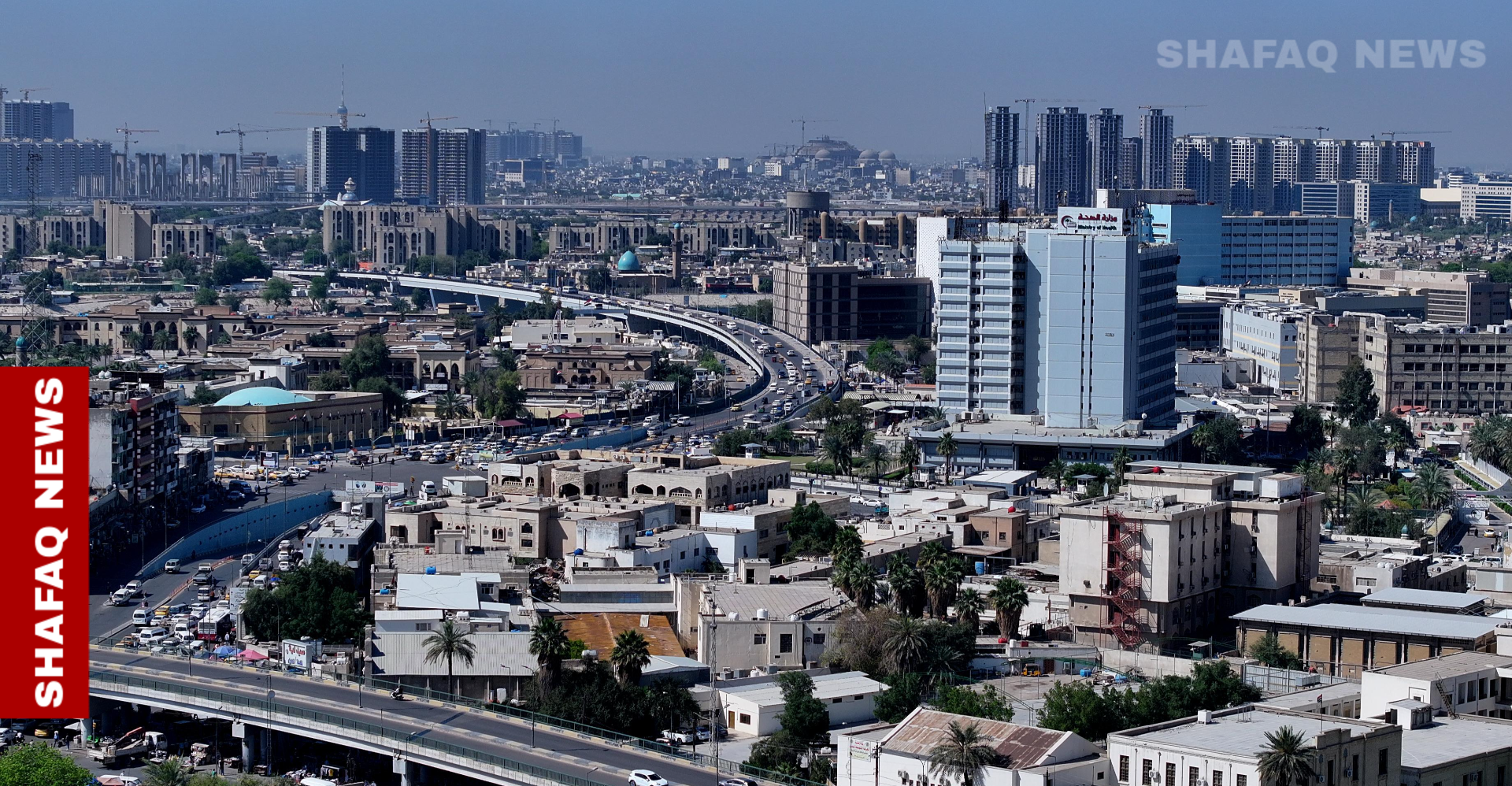 Shafaq News/ The International Monetary Fund’s forecast of a 1.5% contraction in the Iraqi economy this year reflects the complex economic reality Iraq is currently experiencing, linked to several intertwined factors, most notably the volatility of oil prices and their decline to levels insufficient to achieve the required financial balance. This poses Iraq with real financial challenges, most notably the widening fiscal deficit and the declining ability to finance projects, according to financial experts.
Experts’ concerns come at a time when a government financial advisor finds the International Monetary Fund’s indicators surprising, being overly pessimistic, without any justification for this impression. He believes the Fund’s view is out of touch with reality and may be the result of reliance on outdated data or an incorrect idea.
Last Tuesday, the International Monetary Fund predicted that the Iraqi economy would contract by 1.5% this year, before returning to growth in 2026 at a rate of 1.4%. This is due to declining oil prices and expectations of slowing demand due to a potential global economic recession resulting from the trade war.
The International Monetary Fund estimates that Iraq needs an oil price of $92 per barrel to cover government spending this year, while Brent crude futures are trading near $65.
In this regard, Kazem Al-Tawki, a member of the Parliamentary Oil Committee, emphasized that “Iraq relies on oil for its budget, and any drop in prices will have an impact on the Iraqi economy. However, this is only if the decline continues. However, if the decline is temporary, Iraq can take measures in line with the economic situation to bridge the gap by resorting to its gold and cash reserves to cover the deficit.”
Speaking to Shafaq News Agency, Al-Tawki pointed out that “oil prices are linked to the Russian-Ukrainian war, US President Donald Trump’s reversal of his policy of releasing reserves into the markets and reducing production, as well as to the relationship between America and Russia, given that the latter is a major oil producer. If the relationship between the two countries develops, Russia may push larger quantities into the oil markets.”
shrinkage
Given the International Monetary Fund’s “pessimistic” forecasts that Iraq will be the country with the most contractionary economy in the Middle East and Central Asia this year, the Prime Minister’s financial advisor, Mazhar Mohammed Salih, expressed his surprise at this indicator, considering it “the opposite of the truth.”
Speaking to Shafaq News Agency, Saleh explained that “Iraq is considered the third largest Arab economy in terms of GDP strength, after Saudi Arabia and the UAE. Non-oil GDP growth in 2024 reached 4 percent, which is due to a renaissance in development, economic activity and diversity, and political stability for the first time in twenty years.”
Saleh therefore considered this negative growth indicator to be “strange and unjustified. It is overly pessimistic and exaggerated, and perhaps this impression is based on outdated data or a misconception about the progress and economic reform taking place in Iraq, as well as regional and international cooperation in this area.”
He suggested that “the current global trade tariff war between China and the US is short-term and on the way to resolution, as is the Russian-Ukrainian war. The entire world is on the way to resolution to usher in a new era of development and growth, which will consequently increase demand for oil.”
“Not surprising”
However, unlike the government advisor who expressed surprise at the “shrinkage,” international economics professor Nawar al-Saadi said the IMF’s latest report “is not surprising, but rather reflects the complex economic reality Iraq is experiencing at this stage.”
Al-Saadi explained, during his interview with the agency, that “this contraction is linked to several intertwined factors, most notably the volatility of oil prices and their decline to levels insufficient to achieve the required financial balance, especially since Iraq remains almost entirely dependent on oil revenues to finance its public expenditures.”
“When these prices drop below $70 per barrel, as is currently happening, the state faces real financial challenges, most notably a widening fiscal deficit and a declining ability to finance investment and service projects,” according to Al-Saadi.
Al-Saadi attributed this to the fact that “Iraq has not yet succeeded in building a diversified economy capable of absorbing oil shocks, which keeps Iraq dependent on foreign markets and government support. Therefore, any change in oil revenues or fluctuations in exchange rates immediately translates into an economic slowdown that could develop into a recession.”
He believed that “what makes this year more difficult economically than the previous ones is the accumulation of crises. In addition to the oil price crisis, there is turmoil in the dollar exchange market inside Iraq, where prices have begun to decline, but in a manner that does not necessarily reflect true monetary stability. Rather, it is the result of administrative interventions rather than a result of a strong money supply or commercial stability.”
“The hardest” in years
Nawar Al-Saadi’s concerns align with the warnings of economic researcher Ahmed Eid, who says, “This year, 2025, is one of the most difficult economic years for Iraq compared to the years following the end of the COVID-19 pandemic, due to several factors, most notably the fluctuations in global oil prices and their decline to levels insufficient to cover the Iraqi state’s expenditures.”
Eid explained to Shafaq News Agency, “The International Monetary Fund’s latest estimates showed that Iraq needs an oil price of $90 to $92 per barrel to achieve financial balance, while current prices are still hovering between $65 and $72, which puts Iraq in financial distress and widens the deficit gap.”
In light of these challenges, he stressed the need to “implement radical economic reforms and a clear strategy to diversify sources of national income and empower the private sector to lead a significant portion of economic activity, moving away from the rentier model currently affecting Iraq, which has proven its economic fragility.”
Eid pointed out that “the decline in the value of the dollar against the Iraqi dinar in the markets is not sustainable. It is temporary and relative, as it does not stem from the actual strength of the state’s fiscal and monetary policies. Rather, it is affected by external factors and exceptional circumstances, some of which are political and others related to temporary technical measures.”
According to Eid, this requires building a strong economic system based on local production and diversifying sources of income. This is the basis for the Iraqi economy to achieve relative independence in monetary decision-making, free from the political, regional, and international pressures surrounding Iraq.
shafaq.com
