An American perspective on resolving the crisis surrounding al-Maliki’s nomination and Trump’s objection
An American perspective on resolving the crisis surrounding al-Maliki’s nomination and Trump’s objection
2026-02-05 02:04
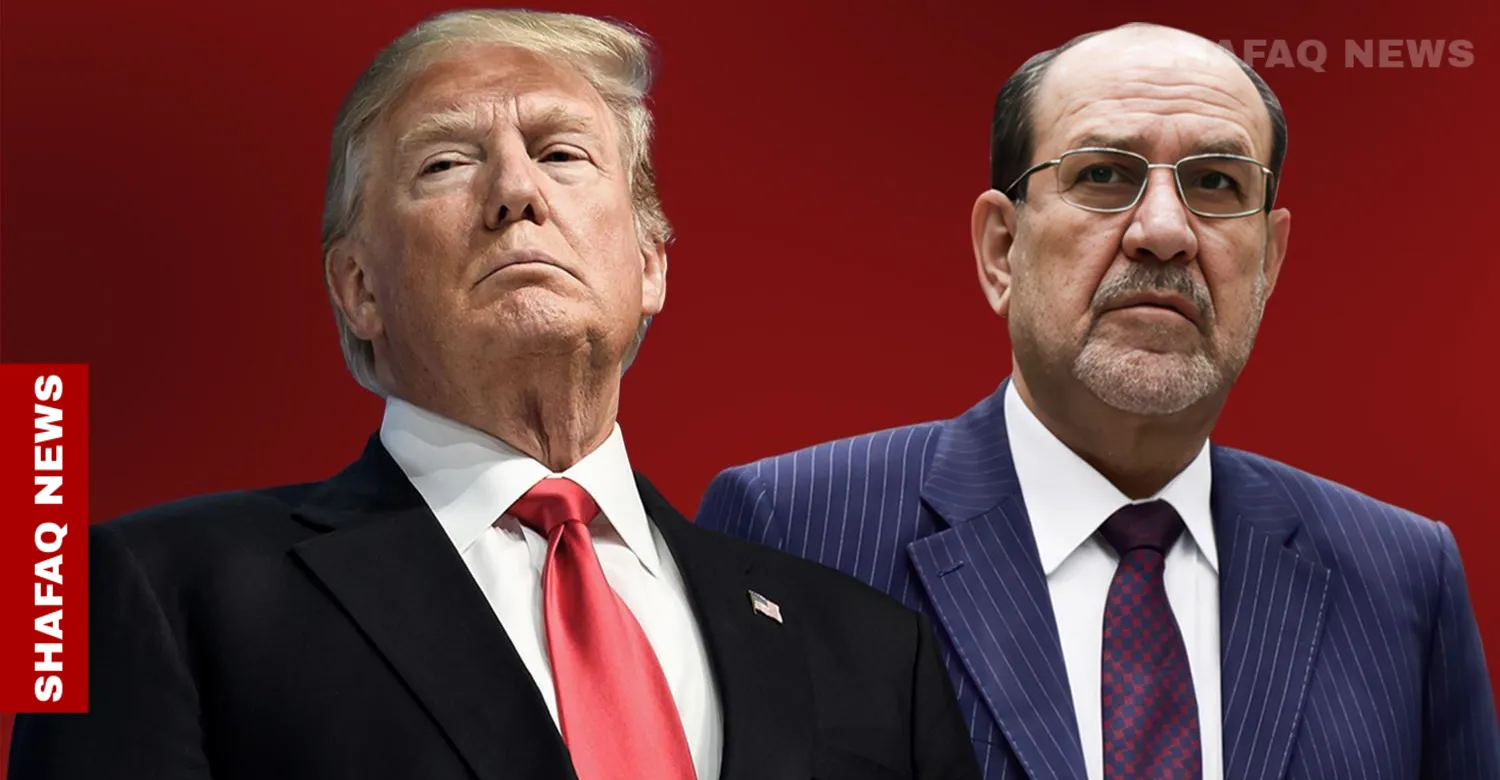 Shafaq News – Special Translation
The public American objection to the nomination of Nouri al-Maliki for the premiership has disrupted the formation of the new government and placed the coordination framework in a critical position, according to an analysis by the American Atlantic Council, which considered that the easiest option now is for al-Maliki to withdraw, while the forces of the framework are now facing the decisive choice: either to find a way to back down in order to preserve relations with the United States, or to risk political and economic repercussions that may be imposed by the Donald Trump administration.
In a report titled “Why the Trump Administration Refuses to Accept a Third Term for Maliki,” translated by Shafaq News Agency, the Atlantic Council said that Maliki’s nomination by the Coordinating Framework appeared to be “a warning sign that Iraq may be moving backwards rather than forwards.”
Although the report indicated that Maliki responded to Trump with a challenge via the “X” platform on January 28, rejecting American interference in Iraqi internal affairs, and that the framework forces received the response and renewed his nomination for the position, negotiations behind the scenes are still ongoing.
The report continued that the House of Representatives session scheduled for February 1 was postponed, ostensibly due to the failure to reach an agreement between the Kurdistan Democratic Party and the Patriotic Union of Kurdistan regarding the position of President of the Republic. This postponement also gives the Coordination Framework more time to continue its internal negotiations, as the Iraqi Constitution stipulates that the President of the Republic is the one who tasks the Prime Minister candidate with forming the new government.
However, the report considered that “the easiest option for the coordinating framework is for Maliki to withdraw, which would allow Shiite political leaders to choose a new candidate.”
However, the report noted that this option might open the way for Mohammed Shia al-Sudani, but the price of al-Maliki’s withdrawal might be the Coordination Framework’s demand to support a candidate closer to him politically.
The report continued that if Maliki refuses to withdraw, the coordinating framework may seek alternatives that save face and hinder his access to the position, by requesting guidance from the highest Shiite religious authority, Ali al-Sistani, or even proceeding with Maliki’s nomination to the House of Representatives on the assumption that the Sunni and Kurdish blocs will not vote in his favor.
But the report said that relying on other leaders to obstruct Maliki’s assumption of the premiership represents a risky approach, and is, to some extent, the same approach that he endorsed in the first place.
After noting the changing world, the report stated that the stakes associated with the next Iraqi prime minister are very high, adding that the coordinating framework, as well as Sunni and Kurdish leaders, must accept new realities in a changing world, and that their choice of prime minister should reflect these realities, not to appease external powers, but to maintain internal security and economic prosperity.
The report noted that, on the international level, the Prime Minister will find himself facing a resolute US administration that is not inclined to be lenient, pointing out that Iran faces the risk of further strikes from the United States and Israel, with the constant possibility that any escalation could extend to Iraq.
In addition, the report noted that Iraqi leaders must deal with a new Syrian leadership whose extremist Sunni roots are viewed with suspicion by the Shiite leadership in Iraq, adding that the new government in Baghdad is required to make careful choices that enable it to navigate cautiously amid these challenges.
On the domestic front, the report noted that the next prime minister will face no less difficult problems, including disarming armed groups that threaten stability, settling an impending financial crisis that threatens millions of Iraqis who depend on government payments, and reaching a sustainable agreement with the Kurdistan Regional Government on oil revenues and financial transfers.
In addition, the report said that the stakes are also high for the United States and the future of the Iraqi-American relationship, explaining that American interests in Iraq and the region lie in the existence of a stable Iraqi state capable of asserting its sovereignty in the face of Iranian interference.
The report noted that Iraq’s decision to accept 7,000 ISIS prisoners at the request of Washington is a reminder of the ability of the Iraqi-American partnership to achieve important results.
He went on to say that although Iraq may not be at the top of Washington’s priorities at the moment, ignoring it carries serious risks, noting that Trump’s hardline message regarding al-Maliki’s nomination confirms that American interests in Iraq are too important to ignore.
shafaq.com
