Trump vs. Maliki: A nomination crisis threatens Iraq’s future
Trump vs. Maliki: A nomination crisis threatens Iraq’s future
2026-01-29
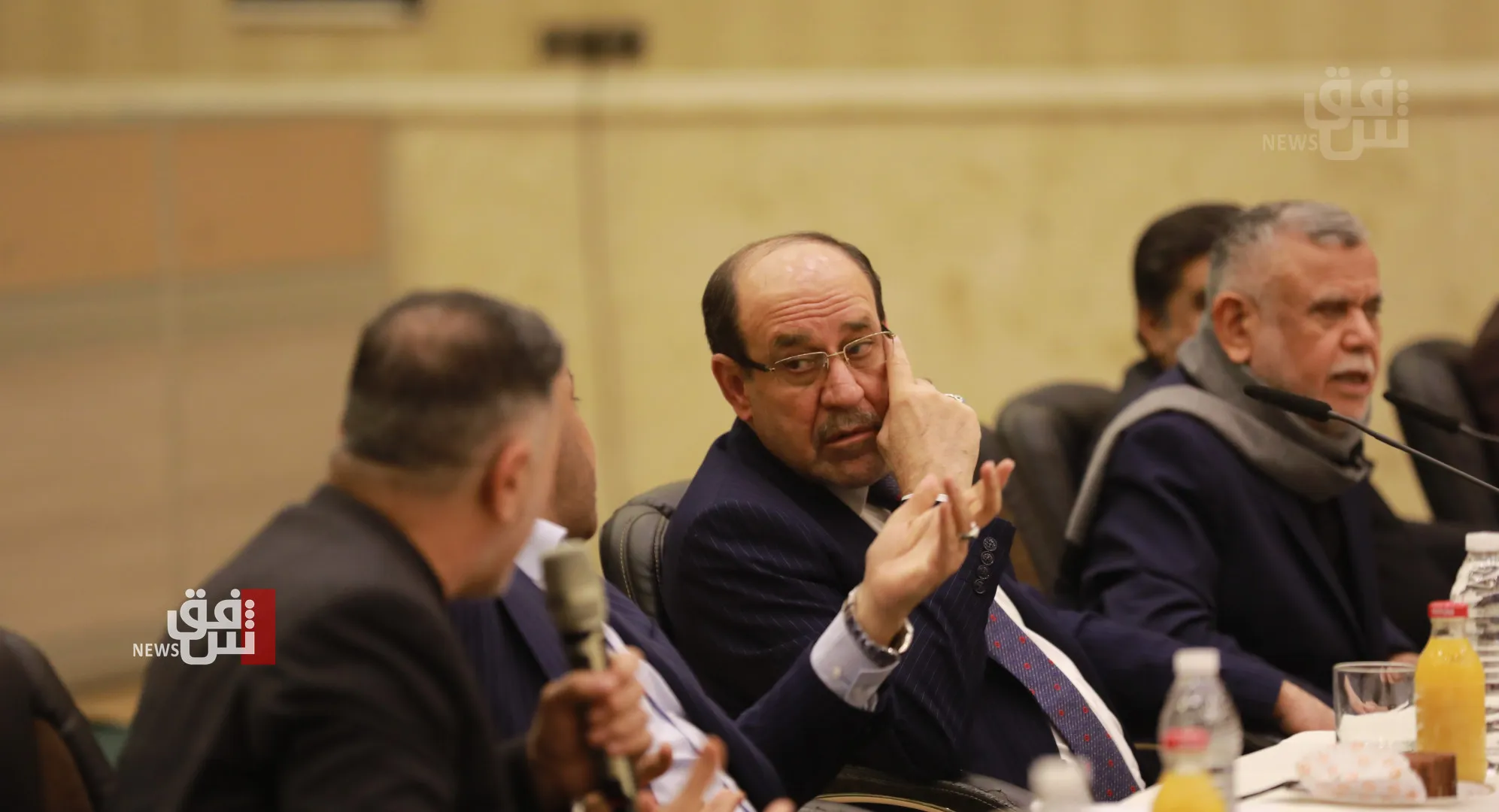 Shafaq News – Baghdad/London
The public rejection by US President Donald Trump of the return of Nouri al-Maliki, head of the State of Law Coalition, to the Iraqi premiership has reopened one of the most sensitive issues in the Iraqi political scene, placing the political process before a complex test in which the internal intersects with the external and the sovereign with the economic, at a moment of extreme regional and international turmoil.
While Washington sees Maliki as an extension of Iranian influence that it seeks to reduce, forces within the coordinating framework that brings together the ruling Shiite political forces in Iraq insist that the selection of the prime minister is a purely Iraqi matter that does not accept dictates.
This crisis comes in the context of broader geopolitical shifts, following an unprecedented military escalation in the region and a change in US policy priorities, which has made the issue of forming the Iraqi government transcend its local boundaries, to become part of the struggle for influence and regional and international balances.
American approach
In this context, Haitham al-Hiti, a professor of political science at the University of Exeter in Britain, believes that Trump’s rejection of al-Maliki’s nomination “cannot be separated from the new American strategy in Iraq,” explaining that this strategy is based on rejecting any influence of militias or Iran within the state structure.
Al-Hiti, speaking to Shafaq News Agency, points out that Maliki is viewed by the Americans as “a representative and protector of this influence,” noting that his nomination, even with promises made to the United States, was “an attempt to evade and conceal the role of the militias for a temporary period, pending a change in the American administration.”
Al-Hiti believes that Washington is moving today towards a completely different approach to Iraq, “an approach that may change its political reality in the future, by distancing it from the Iranian path, through removing figures who represent the depth of the deep state and its regional influence.”
International transformations
For his part, political analyst Omar Al-Nasser links Trump’s stance on Maliki to a broader international context, considering that the US president is acting according to a new philosophy imposed by recent geopolitical shifts in the world and the region.
Al-Nasser tells Shafaq News that the Middle East witnessed, after the 12-day war between Israel and Iran, in addition to other issues such as the arrest of the Venezuelan president and the conflict over oil, “a transformation in the nature of the international system,” noting that the world is now moving towards new arrangements outside the traditional frameworks.
He adds that the “Gaza Peace Council,” proposed by Trump, could constitute “a pivotal turning point in the history of the world order,” requiring American policy in the Middle East to fully adapt to this new vision.
According to Al-Nasser, Trump’s rejection of Maliki falls within the game of balancing Iranian influence, the economy, and energy, which is consistent with Trump’s personality “as a businessman and trader who puts economic interests at the heart of his decisions.”
Al-Nasser holds the Iraqi political class responsible for failing to produce clear criteria for selecting heads of government, noting that the consensus on which the political system was founded after 2003 has not been translated into a “strategic roadmap,” but rather has remained hostage to temporary solutions that are repeated with each government.
Confusion and fears
For his part, political analyst Ahmed Youssef confirms that Trump’s position caused “great confusion within the coordination framework,” and embarrassed the parties that pushed for al-Maliki’s nomination for a third term.
Youssef explains to Shafaq News Agency that Trump based his rejection on Maliki’s two previous experiences between 2006 and 2014, and the “chaos and security and political turmoil” that accompanied them, as well as an American conviction that there is a close link between Maliki and Iran, at a time when Washington is seeking to end Iranian influence in the region, especially after the recent escalation between the two sides.
Youssef believes that the coordinating framework “made a mistake in its choice” because Maliki does not have comprehensive national acceptance, nor regional and international backing, warning that insisting on his nomination “will complicate the political scene and put Iraq to a difficult test.”
He also points to serious economic risks, represented by the possibility of imposing sanctions or stopping the supply of dollars to Iraq, especially since the revenues of Iraqi oil are deposited in the US Federal Reserve Bank, which Trump explicitly hinted at when he spoke about stopping US support if al-Maliki’s nomination goes ahead.
Youssef concludes that the current stage requires the presentation of “a non-controversial figure, without negative governance experiences, and who enjoys national support that transcends the various components,” in order to overcome the upcoming political storm.
Frame sound
In contrast, MP Mukhtar al-Moussawi, from the Badr Organization, acknowledges that there are internal reasons behind the American rejection, considering that Trump’s stance on Maliki is related to “the rampant corruption in the country.”
Al-Moussawi told Shafaq News Agency that the coordinating framework should “reconsider the nomination of Maliki,” adding that “America today, whether we agree or disagree with it, is the strongest player, and this does not mean surrender, but rather it was supposed from the beginning not to nominate a controversial figure.”
He points out that the objection to Maliki does not only come from outside, but also from within Iraq itself, and even from some parties within the coordination framework, which reflects the depth and complexity of the crisis.
Amid this crisis, attention is focused this Wednesday evening on the emergency meeting of the Coordination Framework, as a source within the framework told Shafaq News Agency that the framework’s leadership called on its members to meet at the office of the head of the State of Law Coalition, Nouri al-Maliki, to discuss the recent American position and what it may impose on the future of the political process in Iraq.
shafaq.com
