Maliki and the “third” option: A battle of difficult choices under Trump’s pressure
Maliki and the “third” option: A battle of difficult choices under Trump’s pressure
2026-01-26
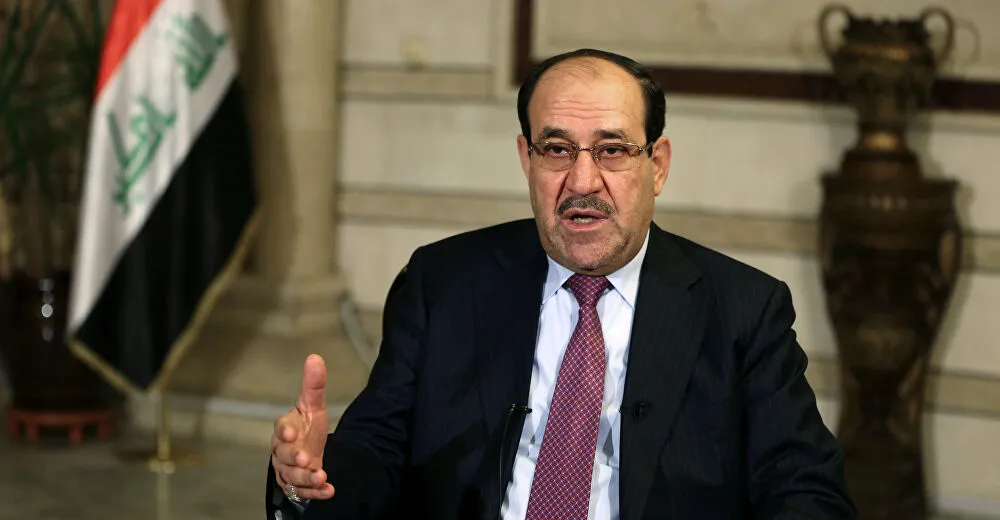 Shafaq News – Baghdad
The name of the leader of the State of Law Coalition and former Iraqi Prime Minister, Nouri al-Maliki (75 years old), has returned to the forefront of the Iraqi political scene, after the Coordination Framework that brings together the ruling Shiite political forces in the country announced his official nomination for the premiership, as the candidate of the largest parliamentary bloc, in a move that has sparked a divergence in political positions, especially within the Sunni forces.
This nomination comes amid a race against constitutional deadlines, as Parliament is expected to hold a session to elect the President of the Republic tomorrow, in preparation for assigning the candidate of the largest bloc to form the government, amid confirmation from supporting political forces that Maliki’s choice enjoys broad political acceptance internally, and does not face regional or international objections.
American warning
But the picture could change at any moment, as US Secretary of State Marco Rubio warned Baghdad against forming a new Iraqi government controlled by Iran, adding: “A government controlled by Iran cannot successfully put Iraq’s own interests first, keep Iraq out of regional conflicts, or promote a mutually beneficial partnership between the United States and Iraq.”
This came in the latest American stance following al-Maliki’s nomination to form the government, as Rubio made a phone call to the current caretaker Prime Minister, Mohammed Shia al-Sudani, and discussed with him Iraq’s ongoing deliberations to form a government, and stressed the need for a shared commitment to ensuring that Iraq can achieve its full potential as a force for stability, prosperity and security in the Middle East.
Internal reservation
Nouri al-Maliki’s nomination for a third term as prime minister comes amid political division, given that his previous term ended in 2014 amid major political and security crises that coincided with the invasion of large areas of the country by the “ISIS” organization.
The nomination raised reservations among Sunni leaders, as the head of the “Progress” party, Mohammed al-Halbousi, warned in a post dated January 19, 2026, against a return to “painful lean days,” calling for consideration of “national acceptance,” in a reference widely understood as an objection to the return of al-Maliki.
In the same context, Ali Al-Mahmoud, a member of the “Progress” party, expressed his reservations about Al-Maliki’s nomination, explaining that “Al-Maliki’s rule witnessed explosions, marginalization and exclusion in the Sunni provinces, and we do not object to the performance, but we were not consulted as partners in the political process when the candidate was chosen, while when we nominated the Speaker of Parliament we consulted all the political blocs.”
Al-Mahmoud adds, during his interview with Shafaq News Agency, that “the Shiite coalition was not in complete agreement on nominating al-Maliki, and the proof is that the decision was issued by majority vote and not unanimously.”
For his part, Auras al-Mashhadani, a leader in the Azm Alliance headed by Muthanna al-Samarrai, affirms that his position is not related to al-Maliki’s personality, but rather focuses on current entitlements, noting that “the current opposition has the authority to hold those who committed abuses in the past accountable.”
Al-Mashhadani explained to Shafaq News Agency that his alliance “informed the coordinating framework of its acceptance of any decision that does not cause a rift within the Shiite political establishment, and we will proceed with it.”
He concluded that their support was for “the person capable of restoring balances and managing foreign relations that Iraq needs at this time, which is available in Maliki’s experience, especially in dealing with the United States and protecting Iraq’s interests in the Middle East region.”
In depth
But Khalid Walid, a member of the Reconstruction and Development Coalition headed by al-Sudani, affirms that the coalition is “proceeding, with the support of the political process partners, to complete the constitutional requirements within their specified timeframe.”
Walid tells Shafaq News Agency that “Al-Sudani supported the nomination of Nouri al-Maliki out of a firm conviction that the candidate must be strong and decisive, not a compromise candidate who is closer to an employee than to a leader who has political and electoral space.”
He adds that the Reconstruction and Development Coalition “is dealing with a high degree of realism and focusing on a clear approach and vision instead of a conflict of names and personalization,” considering that “talking about challenges or future rejection is not in anyone’s interest,” and that “proceeding with the majority decision taken, according to a program that achieves sustainable stability, represents the only way to confront political, economic and social challenges, as well as external challenges related to the regional situation and American pressures.”
Acceptable and appropriate
For his part, Imran al-Karkoushi, a leader in the State of Law Coalition headed by Nouri al-Maliki, explains that “the issue is now left to the Iraqi parliament, and there will be a session to vote during the next few days of this week,” noting during his interview with Shafaq News Agency that “there is broad acceptance of al-Maliki in general, and this is the right of the coordinating framework as the largest bloc first.”
The coordinating framework, which includes major Shiite forces and holds a parliamentary majority, affirms that al-Maliki’s nomination was based on his political and administrative experience and his previous role in running the state for two consecutive terms between 2006 and 2014, while emphasizing the commitment to the constitutional path and working with all national forces to form a government capable of facing challenges and protecting Iraq’s security and unity.
In an analytical reading of the scene, former MP Kamel Nawaf Al-Ghurairi believes that “Nouri Al-Maliki is the most suitable person for the premiership at the present time, especially in light of American pressures,” considering that “no prime minister is capable of dealing with these pressures and complex internal issues except Al-Maliki.”
Al-Ghurairi, speaking to Shafaq News Agency, points out that “Al-Maliki has the ability to resolve important issues, including armed factions and managing foreign relations, especially with the United States.”
He adds that “solving Iraq’s problems at this stage goes through Maliki,” but at the same time he acknowledged the existence of a Sunni position rejecting a third term, explaining that “the Sunni provinces suffered during his rule from unjust and dark days, which explains the Sunni component’s refusal to return to that stage.”
Al-Ghurairi concludes by stressing that Maliki’s success, should he assume office again, “requires turning a new page and looking at Iraqis with one eye, with all their sects, religions, and ethnicities,” referring to the importance of achieving national acceptance and overcoming the legacy of political division.
shafaq.com
