Maliki at the center of a regional storm… cautious acceptance from the Trump administration
Maliki at the center of a regional storm… cautious acceptance from the Trump administration
2026-01-26 03:21
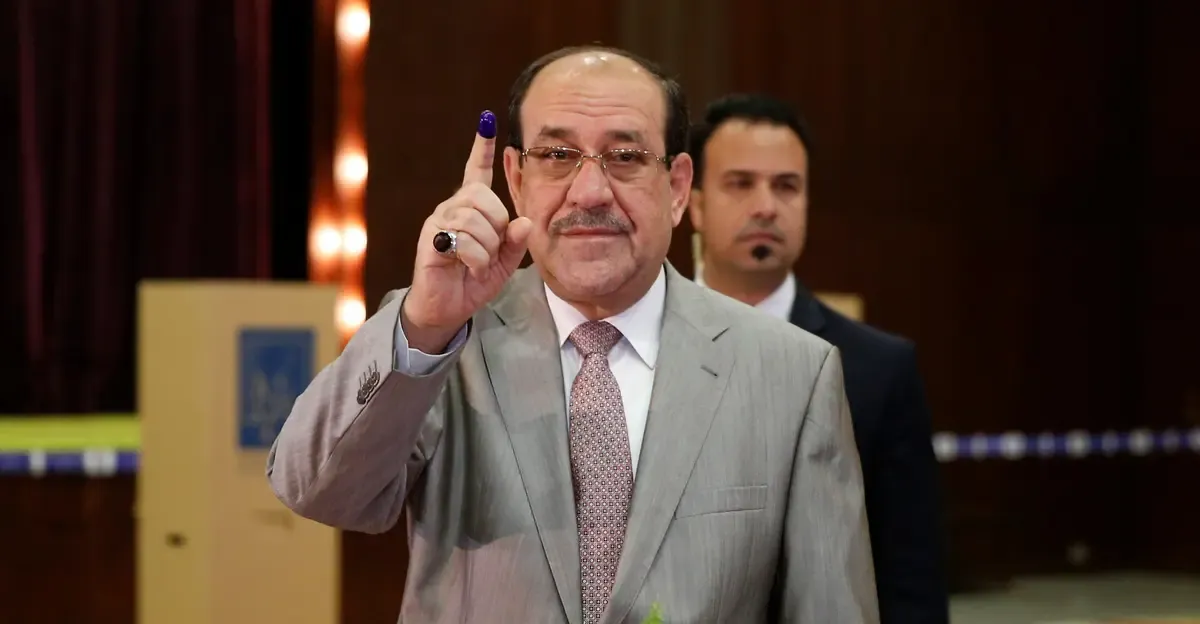 Shafaq News – Special Translation
Iraq faces unprecedented challenges, especially with regard to Syria and Iran, which intersect with what is happening on the domestic scene. The American ” Soufan Institute ” says that these challenges contributed to the recent decision of the coordination framework regarding the nomination of Nouri al-Maliki to head the new government, a return that the United States may accept, and which will also work to push Baghdad to remove the pro-Iranian militias from the government and disband their armed groups.
The American Institute summarized the challenges facing Iraq as repercussions of October 7, 2023, on Iraq’s western and eastern borders, exacerbating tensions among Iraqi leaders over government formation, pointing to the Syrian regime’s efforts to extend its control over northeastern Syria, which has reinforced Baghdad’s fears of the resurgence of ISIS, and forced the Iraqi Kurdish community to engage in the Syrian Kurdish struggle against Damascus.
The report, translated by Shafaq News Agency, addressed what is happening to the east of Iraq, where Iran has been greatly weakened by US and Israeli military attacks and by large domestic protests (the uprising). For this reason, Iran’s leaders are looking to Iraq to continue to secure Tehran’s strategic depth and help re-establish Iran’s declining regional influence.
According to the American report, the unrest on Iraq’s borders has affected Baghdad’s efforts to prevent the United States and Iran from using Iraq as an arena for their power struggle. The team of US President Donald Trump is looking to Iraq to help him punish Tehran for its crackdown on the demonstrations. Experts expect Trump’s team to try to influence Baghdad’s choice of the new ruling team, with the aim of ensuring the new Iraqi prime minister’s cooperation with US policy in the region.
Nevertheless, he explained that many of the Shiite forces that control the Iraqi political structure are prepared to resist pressure from Washington to mitigate the renewed threat from ISIS and the Sunni Islamist-dominated government in Damascus, especially since President Ahmed al-Sharaa had been fighting in alliance with al-Qaeda against the government in Baghdad and US forces in Iraq after the overthrow of Saddam Hussein’s regime.
The report continued, saying that although the “Iranian-American” rivalry in Iraq has long existed and poses a challenge to policymakers in Baghdad, the new and unexpected threat of the Syrian authorities’ push to impose their control over Kurdish society has raised concerns among Iraqi leaders, as attacks by the Shara forces against the Kurdish-led Syrian Democratic Forces have led to the escape of dozens of ISIS prisoners.
The report mentioned Iraq’s agreement with the United States and Syria to receive about 7,000 ISIS prisoners, a move praised by US Secretary of State Marco Rubio. It noted that Iraq had strengthened patrols along its border with Syria, and tanks were lined up along the border in the northern Sinjar province and other locations along the border.
Furthermore, he added that “Iraq’s concerns about the return of ISIS have shifted the political landscape within Iraq in favor of a more hardline, pro-Tehran figure in the competition for the highest executive power, the premiership, referring to the nomination of Nouri al-Maliki, who had previously served two terms, and whose policies were held by Washington responsible for ISIS’s takeover of large areas in Iraq in 2014, and whose attempt at the time to obtain a third term was thwarted.”
According to the report, Trump officials were initially encouraged by Mohammed Shia al-Sudani’s strong electoral performance in the recent elections, but they gradually became more concerned that the leaders of several smaller, hardline pro-Tehran blocs within the coordination framework would try to deny al-Sudani a second term, fearing that the militia-linked factions believe al-Sudani is too willing to cooperate with Trump’s efforts to pressure Tehran economically, diplomatically, and militarily.
Therefore, the Soufan Institute said that the leaders of the hardline Shiite movement decided that they needed a more sectarian figure to reduce the accumulating threats from Syria by running a Sunni Islamic government, and to help keep Tehran away from Trump’s pressure, explaining that the US and Israeli attack, and the massive anti-Iranian regime demonstrations, are factors that pushed for Maliki’s return, according to estimates that he would secure Iran’s strategic depth in Iraq.
The report indicated that the assumption is that a more pro-Tehran leader in Baghdad would help pressure Trump not to follow through on his threats to attack Iran, adding that Maliki, as prime minister, also has the executive power to prevent Washington from being able to launch attacks on Iran using Iraqi bases, should Trump decide to attack Iran.
He pointed out that, given the reactions from a wide range of Iraqi factions, Maliki would be able to form a government, recalling in this context the support of Kurdish leader Masoud Barzani for Maliki’s nomination, as well as the leaders of the Patriotic Union of Kurdistan, explaining that “Barzani is a reliable partner for Washington and helped American officials mediate to stop the escalation of fighting between Damascus and the Syrian Democratic Forces.”
The report also stated that some Iraqi leaders expect Trump, through his envoy Mark Savaya, to try to thwart Maliki’s attempts to form a government, noting that if Maliki fails to obtain the House of Representatives’ approval for his cabinet, the coordination framework may nominate Sudani or another moderate Shiite leader as a “consensus” candidate.
He explained that the Trump team’s view of Maliki is that he is likely to fuel Iraqi Sunni support for armed groups opposed to the government, and he also represents an obstacle to Trump’s increasing efforts to pressure Iran.
However, the American report confirmed that Trump’s team estimated that public pressure to prevent Maliki’s return to office could lead to a widespread Iraqi Shiite backlash against American intervention.
He concluded by saying that if Maliki returns to his post, the likelihood is that Trump’s officials will focus on their ongoing efforts to prevent the leaders of any armed force allied with Iran from being integrated into the new government. He recalled in this context that US officials have threatened senior Iraqi politicians in recent weeks with imposing sanctions targeting the Iraqi state, including its vital oil revenues, if armed groups allied with Iran are included in the next government. This comes a year after US pressure on Sudani, who failed to disarm the Popular Mobilization Forces and impose government control. The US warnings were delivered through US Chargé d’Affaires Joshua Harris during his talks with Iraqi officials and leaders of Shiite forces.
shafaq.com
