Speaking through his son, Sistani reiterates his refusal to interfere in the nomination of Iraq’s prime minister.
Speaking through his son, Sistani reiterates his refusal to interfere in the nomination of Iraq’s prime minister.
2026-01-11
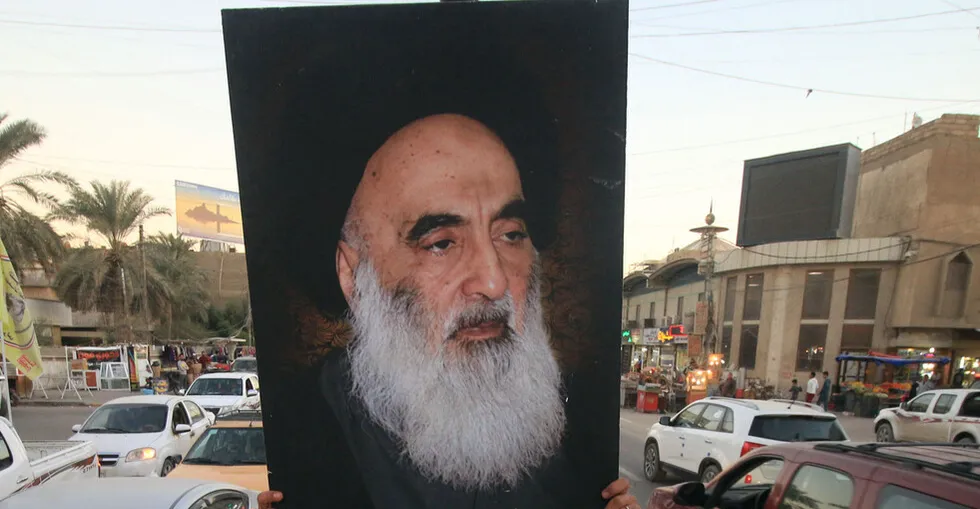 Shafaq News – Najaf
On Sunday, the highest Shiite religious authority in Iraq, represented by Ayatollah Ali al-Sistani, reiterated its position rejecting interference in the matter of nominating a candidate to assume the position of Prime Minister in the new Iraqi government.
The leaders and commanders of the Shiite Coordination Framework had recently sent a message through a close associate of the religious authority inquiring about the possibility of choosing a name from a group of candidates for the position of Prime Minister.
According to information obtained by Shafaq News Agency, Mohammad Reza, the eldest son of Ayatollah Sistani, responded to the letter by rejecting the Marja’iyya’s intervention in that issue, while expressing his annoyance at the repeated attempts by the Coordination Framework in this regard.
The Marja’iyya’s decision not to receive politicians, which has been in place since 2015, is linked to a protest stance against the ruling class’s failure to combat corruption and improve services, while avoiding granting any meetings that could be interpreted as political endorsement of any party.
The Marja’iyya’s tightening of its grip on reducing its meetings with politicians came in the context of the 2015 wave of protests against corruption and deteriorating services, when it called for serious reforms and accountability for those obstructing them, before later leaning towards a policy of not receiving officials, while maintaining limited meetings with representatives of the United Nations as an international channel.
An informed source stated on January 8 that leaders within the coordination framework had directed inquiries, about a month prior, to the supreme religious authority in Najaf regarding the process of forming the government and the names of potential candidates for its leadership, without receiving a response.
The source told Shafaq News Agency at the time that “some leaders of the Coordination Framework, with the launch of government formation talks three weeks ago, and in light of the circulation of names of bloc leaders and former prime ministers as candidates for the position, contacted the religious authority in Najaf by sending inquiries related to the candidates.”
He added that “the religious authority has not responded, and the possibility of not responding remains, in line with an approach it has followed for years based on not interfering in political affairs and not receiving political figures.”
The coordination framework is experiencing internal disagreements regarding the candidates for the premiership, and recent discussions have focused on a shortlist that includes the head of the State of Law Coalition, Nouri al-Maliki, the outgoing Prime Minister, Mohammed Shia al-Sudani, and the head of the Victory Coalition, Haider al-Abadi, as the most prominent, along with the head of the intelligence service, Hamid al-Shatri, and the head of the Accountability and Justice Commission, Basim al-Badri.
The coordinating framework that brings together the ruling Shiite political forces in Iraq announced in a statement on Saturday evening that it would continue to discuss the formation of the next government and decide on the appointment of the prime minister, following controversy over the nomination of Nouri al-Maliki, head of the State of Law Coalition, for a third term.
Media outlets and social media widely circulated news that the Coordination Framework forces reached an agreement in yesterday’s meeting to nominate former Prime Minister Nouri al-Maliki to head the next government, a matter which was not officially addressed in the Framework’s statement.
Since the ratification of the election results held in November 2025, the Coordination Framework has begun holding meetings and conducting discussions among its forces and with other parties to decide on the position of Prime Minister, which is allocated to the Shiite component according to the custom in place after 2003.
shafaq.com
