Iraqi markets plunge into recession: sales collapse and escalating warnings
Iraqi markets plunge into recession: sales collapse and escalating warnings
2025-07-24 07:23
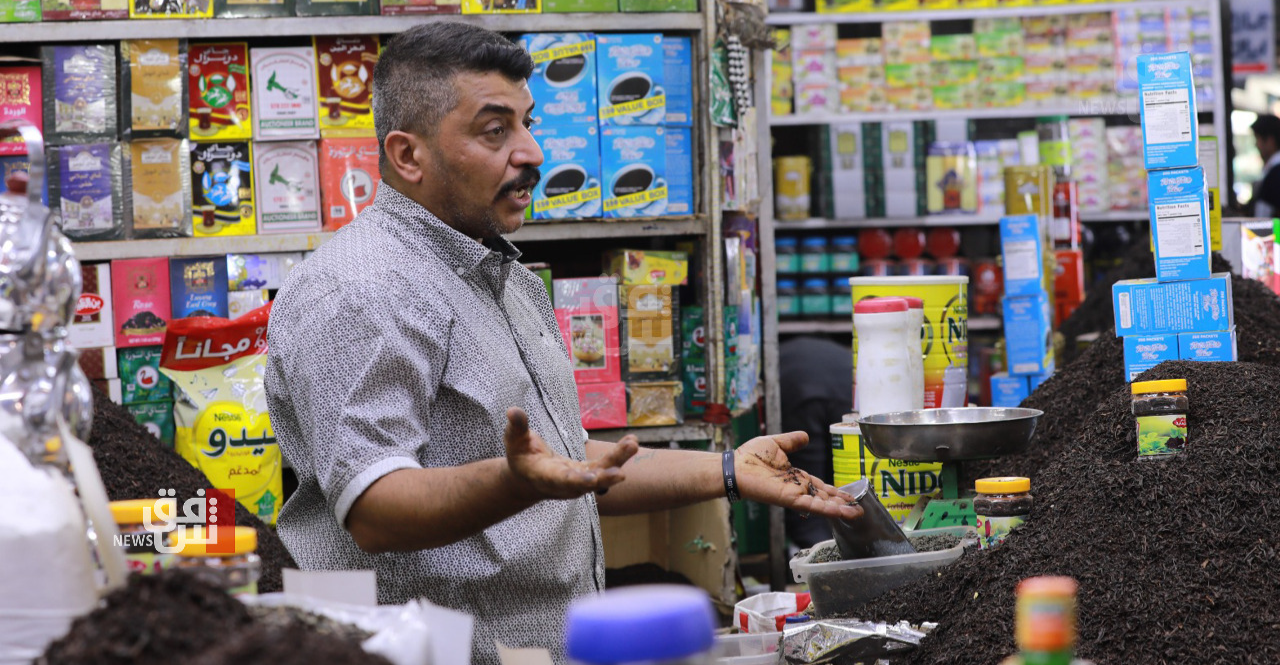 Shafaq News – Baghdad
Iraqi markets are experiencing an unprecedented recession, with business transactions and sales declining by more than half, according to the Baghdad Chamber of Commerce. This decline is the result of multiple economic factors that have negatively impacted commercial activity and led to significant losses for businessmen and company owners.
Experts believe this contraction is the result of declining purchasing power, weak public spending, and a declining exchange rate of the dollar against the Iraqi dinar. This comes amid warnings that the crisis will worsen if urgent reform measures are not taken in the coming period.
Sales collapse to less than half
In this context, Rashid Al-Saadi, spokesperson for the Baghdad Chamber of Commerce, explains that “most economic sectors, particularly investment and real estate, are at a near-standstill, which has negatively impacted local market activity.”
Al-Saadi told Shafaq News Agency, “Construction activity typically drives related markets, such as the construction sector, transportation, and daily labor, whose wages contribute to driving the economic cycle.”
As a result, Al-Saadi documents “a significant decline in buying and selling activity in local markets, with corporate sales falling by more than half. The recession has also affected exchange offices, which are also facing a stagnation in monetary exchange activity due to the decline in the dollar exchange rate against the Iraqi dinar.”
He explained that “the rise in the dollar exchange rate stimulates travel, as the gap between the parallel market and the official rate is large. However, the gap has now narrowed and no longer covers travel expenses. Therefore, the dollar’s decline has had an impact on the economic recession.”
He points out that “the practical steps taken by the Central Bank, along with relevant organizations such as the Federal Reserve and other monetary institutions and banks, have led to a decline in the dollar against the Iraqi dinar. When the dollar is unstable, the local market is exposed to recession.”
According to Al-Saadi, this is due to the fact that “the Iraqi economy is affected by a number of factors, including the rise and fall of the dollar as a result of decisions by the Central Bank and the Council of Ministers, and unstable geopolitical factors in the region, which have exposed businessmen and owners of commercial companies to negative impacts and a major commercial downturn.”
contraction and sharp slowdown in demand
For his part, economic expert Ahmed Abdel Rabbo asserts that “Iraqi markets are experiencing a clear contraction, driven by declining purchasing power, reduced public spending, and global inflationary pressures.”
Despite recording a relatively low inflation rate of 2.2% in the first quarter of 2025, according to Abdel Rabbo, market activity reflects a sharp slowdown in demand and a stagnation in business activity, particularly in non-essential sectors.
Speaking to Shafaq News Agency, Abdul Rabbo warned that “the government’s failure to take urgent steps to stimulate the economy and diversify sources of revenue could lead to a partial recession that could develop into a deeper crisis by the end of the year.”
He notes that “restoring activity in the Iraqi market will not be achieved through government spending alone, but rather requires building a stimulating economic climate, carefully liberalizing market mechanisms, and achieving a delicate balance between monetary and fiscal policies.”
Abdul Rabbo asserts that “Iraq possesses the human resources and strategic location that qualify it for progress, but the matter remains contingent upon a serious reform will and more dynamic financial management.”
Warnings of a worsening crisis
For his part, economic researcher Ahmed Eid attributes the current downturn in Iraqi markets to “accumulated structural factors, most notably the decline in purchasing power due to inflation, as well as the absence of effective policies to protect income within the country.”
But the most dangerous thing, Eid told Shafaq News Agency, is “the continued dominance of political parties over economic decision-making and the absence of planning based on independent institutions capable of effectively dealing with crises.”
Eid points out that “the spread of corruption within institutions, particularly in the economic and service sectors, has drained public funds and paralyzed investment.”
This reality, he adds, “has pushed the Iraqi economy to rely excessively on consumer spending, without any actual production capable of creating jobs or supporting stability.”
He continued, “The delay in approving budget schedules, as with previous budgets, and the absence of a clear development vision are factors that have contributed to exacerbating the underlying stagnation we are experiencing today.”
Eid warns that “if these factors continue to combine without genuine reform of the administrative and economic structure, the coming months could witness a more severe recession affecting markets and the entire social fabric, threatening overall stability.”
Inflation under control
For his part, economic expert Safwan Qusay says, “The Central Bank’s monetary policy is to sustainably provide foreign currency to finance international trade, and this financial stability is ensured by reserves exceeding $97 billion.”
Qusay added to Shafaq News Agency, “As for the budget schedules that the Ministry of Finance is supposed to prepare for 2025, they are supposed to maintain the level of public spending so that it does not decrease from 2024, in light of the presence of more than 160 trillion dinars that can be spent during this year and financed through oil and non-oil revenues.”
Qusay points out the importance of “converting a portion of cash spending to in-kind spending to reduce the deficit and maintain financial sustainability in the Iraqi environment.”
He continued, “There are ongoing government measures aimed at revitalizing the housing sector, as the housing projects currently underway are contributing to stimulating spending on construction materials, in addition to providing job opportunities within this vital sector.” At the same time, he emphasized, “The formal private sector is still performing well, avoiding recession.”
In addition, Qusay adds, “The Central Bank has launched initiatives to support small and medium-sized enterprises and increase local production as an alternative to imports, ensuring the economy does not enter recession.”
Regarding global inflation, he explained that “inflation indicators remain under control in Iraq due to the availability of a food basket, ration card items, and the stability of the Iraqi dinar. Therefore, despite global inflation indicators, Iraq has a set of buffers that can keep this inflation away from the Iraqi environment.”
Qusay concluded his remarks by emphasizing “the need to maximize non-oil revenues, governmental initiatives to stop gas flaring, invest in electricity, accelerate self-sufficiency, and develop local industries away from imports.”
shafaq.com
