Iraq imports $70 billion annually, raising concerns about a rentier economy.
Iraq imports $70 billion annually, raising concerns about a rentier economy.
2026-10-17
 Shafaq News – Baghdad
The Iraqi Ministry of Trade affirmed on Saturday that its affiliated entities play a “pivotal role” in implementing the country’s economic policy by regulating commercial activity, maintaining market stability, ensuring fair prices, and guaranteeing the availability of goods to citizens with reliable quality.
The Undersecretary of the Ministry of Trade, Sattar Al-Jabri, told Shafaq News Agency that “the ministry’s responsibility is not limited to protecting the livelihood of citizens, but extends to supporting society and alleviating the burdens of living for families,” explaining that “these tasks do not represent administrative duties only, but rather national and moral responsibilities that require concerted efforts and continuous work to meet the needs of citizens.”
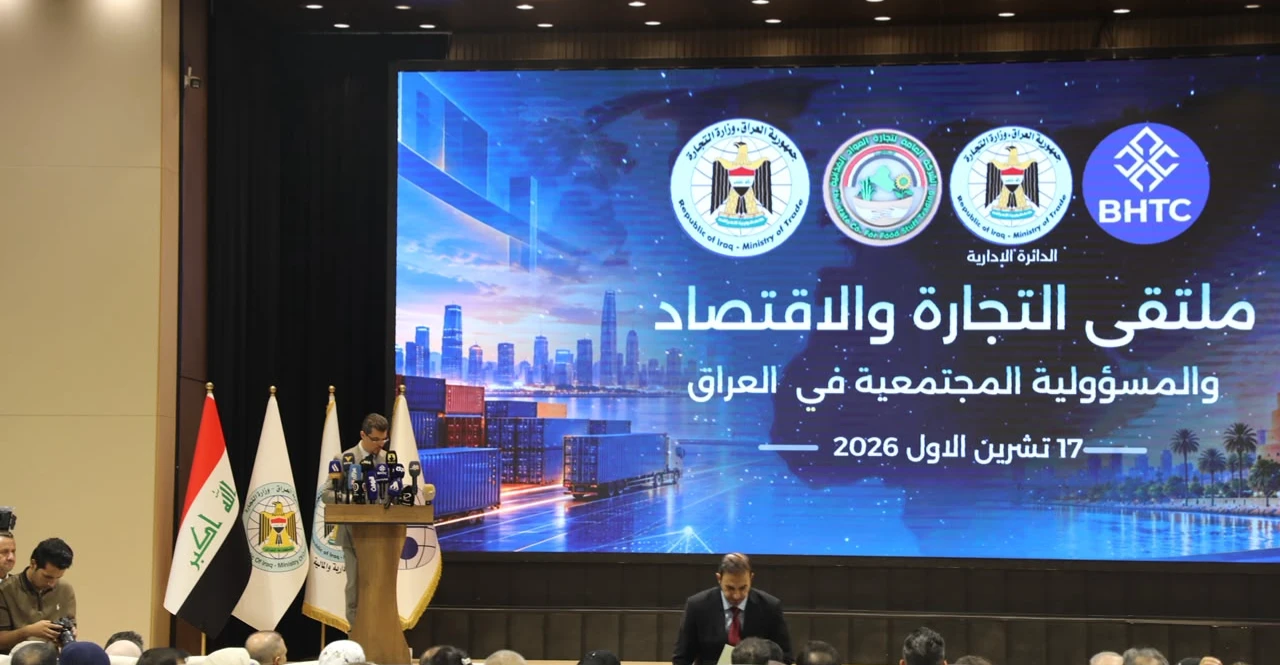
This came during the launch today by the Ministry of Trade of the Trade, Economy and Social Responsibility Conference and Forum in Iraq, with the aim of discussing the future of trade and the economy, and the role of social responsibility in supporting sustainable development and enhancing partnership between different sectors.
For her part, the Director General of the Administrative and Financial Department at the Ministry of Trade, Ibtihal Hashim Al-Rubaie, stressed the importance of encouraging initiatives, training youth and women, supporting productive projects, and providing a transparent, stable and stimulating business environment for investment, which contributes to achieving sustainable development.
Al-Rubaie added to Shafaq News Agency that “social responsibility represents one of the basic pillars of real development,” noting that “the success of institutions and companies is not measured by profits or the size of economic activity only, but by the extent of their positive contribution to society, through providing job opportunities, supporting education and training, protecting the environment, participating in development initiatives, and adhering to the principles of integrity, transparency and governance.”
She explained that “the next stage requires moving social responsibility in Iraq from scattered initiatives to an institutional culture and a sustainable work methodology, in which state institutions, the private sector and civil society organizations participate, within a clear national vision that sets priorities and directs capabilities towards the most needy sectors.”
Al-Rubaie pointed out that “confronting economic challenges requires strengthening dialogue, coordination and partnership between the various parties,” explaining that “specialized conferences represent a space for exchanging ideas, raising challenges and coming up with practical recommendations that contribute to developing the business environment, enhancing food security, supporting production and investment, providing job opportunities and establishing the concept of social responsibility in institutions and companies.”
She stressed “the need for the conference’s outcomes not to end with the conclusion of its sessions, but rather for its recommendations to form a starting point for initiatives, partnerships, and programs that are measurable, monitorable, and implementable, ensuring that the ideas presented are translated into practical steps that citizens can feel the impact of in their daily lives.”
The conference included specialized dialogue sessions on the future of the Ministry of Trade, and one of the most prominent speakers was the financial advisor to the Prime Minister, Mazhar Muhammad Salih, who warned in his intervention against “the continued dependence of the Iraqi economy on imports financed by oil revenues,” calling for “redirecting trade policy towards supporting local production and diversifying sources of economic activity.”
Saleh said that “Iraqi private sector imports of goods and services, which are mostly consumer goods, amount to about $50 billion annually, while total imports, including government imports, reach about $70 billion, according to his estimates.”
He added that “about 95% of the Iraqi market’s needs depend on imports, with the exception of grains related to the ration card,” considering that “these data reflect a flaw in the structure of the Iraqi economy, which still depends on oil revenues to finance internal and external trade, in light of the limited local production base outside the oil sector.”
Saleh questioned the extent to which the Ministry of Trade could continue within the rentier economy system, stressing that “economic diversification should be reflected in trade policy, so that it shifts from a policy focused on meeting consumption to a policy that contributes to stimulating local production.”
He pointed to the “limited link between commercial activity and agricultural production and craft industries, with the exception of grains,” calling for “strengthening integration between trade and productive sectors, in order to support job opportunities and stimulate the Iraqi economy.”
Saleh proposed “establishing an authority concerned with trade and production for small and medium-sized activities in the fields of agriculture and handicrafts, which would support the marketing of local products and their integration into food chains, cooperatives and markets through commercial contracts.”
He also called for “studying the possibility of employing marketing initiatives to support local products, in coordination with the relevant authorities in the Ministry of Trade, with the aim of building a productive trade policy that contributes to diversifying the Iraqi economy and reducing its dependence on imports and oil revenues.”
shafaq.com
