“The citizen’s pocket is not the solution”: Parliamentary anger over the decision to raise the dollar exchange rate
“The citizen’s pocket is not the solution”: Parliamentary anger over the decision to raise the dollar exchange rate
2026-10-07
 Shafaq News – Baghdad
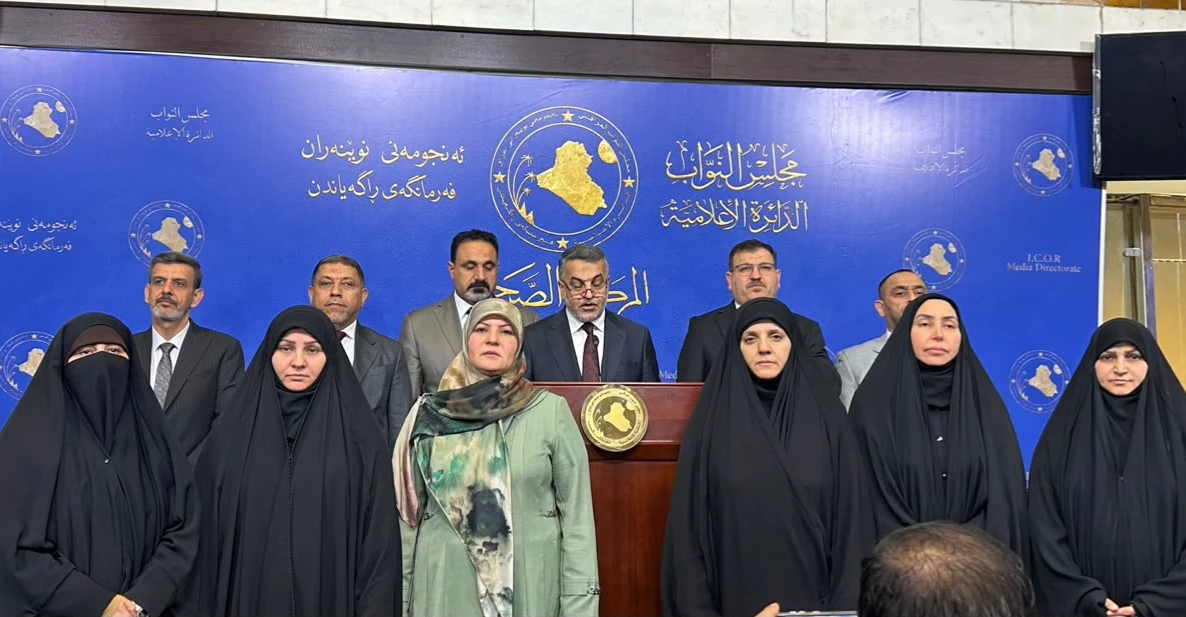
Hassan al-Asadi, head of the National Approach bloc, called on the government on Wednesday to reverse its decision to raise the dollar exchange rate and cancel it quickly, warning of its repercussions on various segments of society.
Al-Asadi said during a press conference held in the parliament building, attended by members of the bloc and Shafaq News Agency, that the decision to raise the dollar exchange rate will lead to “widespread damage to broad segments of the Iraqi people,” indicating that its effects will not be limited to the poor and those with limited income, but will extend to those with middle income.
He added that this means millions of citizens are under pressure regarding basic needs, primarily food, medicine and other service requirements.
Al-Asadi expressed his concern about the repercussions of the decision, recalling what accompanied the decision to raise the price of the dollar at the end of 2020, saying that the price difference between the sales of the Central Bank and the sales of private banks at that time reached large amounts, “from which the state’s public treasury did not benefit, but rather undeserved profits went to the owners of private banks and speculators in hard currency.”
He pointed out that the decision will also affect the movement of imports of goods and items included in the necessities of life and the economic stability of the local market, adding that the construction sectors, raw materials used in industries, food and medicines will be affected by the decision and their value will increase, which, according to his estimation, will increase the suffering of the Iraqi citizen and his economic hardship.
Al-Asadi continued, saying that there are “many solutions” through which additional revenues can be provided to the public treasury, instead of raising the dollar exchange rate.
He proposed a serious follow-up on collecting and maximizing non-oil revenues, reducing unnecessary spending, along with reviewing the high costs of oil and gas management contracts, and reviewing mobile phone licensing contracts, which he said “are being lost by the public treasury because they are not fair to the Iraqi state,” as well as other resources.
Al-Asadi stressed the need to expedite the cancellation of the decision, warning that continuing to implement it could lead to significant differences between the official dollar exchange rate and its price in the parallel markets, and the resulting impact on the poor and vulnerable classes, as well as the extension of pressures to the middle-income classes.
In this context, MP Saba Al-Saadi, from the Reconstruction and Development Coalition, said during a press conference held in the parliament building and attended by a correspondent from Shafaq News Agency, that what is happening in the dollar exchange rate is a “direct result of the inadequacy of fiscal and monetary policy,” considering that the Ministry of Finance and the Central Bank bear responsibility for what she described as “clear confusion.”
Al-Saadi added: “There is no plan to regulate the market, nor any measures to protect the dinar, and the result is that the parallel market is the one that controls the citizen’s livelihood.”
She continued, “The governor of the central bank’s primary task is to stabilize the currency, while the finance minister is thinking of bridging the deficit by raising the exchange rate, as if the citizen’s pocket is the ready-made solution for all these failures.”
Al-Saadi stressed: “We will not allow any tampering with the official exchange rate, and any attempt to raise it to address the deficit is a red line, and we will resort to parliamentary questioning and accountability.”
She revealed that there is a movement within the House of Representatives to collect signatures from a number of members of the council to hold a session to discuss changing the exchange rate of the dollar against the Iraqi dinar and to reject the decision.
Meanwhile, Suzan Al-Saad, a member of the parliamentary industry committee, announced that she had collected more than 50 signatures from members of parliament to demand that the agenda of today’s session be stopped and dedicated to discussing the decision to raise the exchange rate of the dollar against the Iraqi dinar.
Al-Saad told Shafaq News Agency that the signatures were collected with the aim of dedicating today’s session to discussing the repercussions of the decision to raise the dollar exchange rate, and examining its effects on citizens and the Iraqi economy, calling for a delay in implementing the decision, and allowing the House of Representatives to discuss its dimensions and repercussions before proceeding with it.
This comes after the adoption of new exchange rates, according to which the purchase price of the dollar from the Ministry of Finance was set at 1500 dinars, and its sale to banks at 1510 dinars, while its sale price to the public was set at 1520 dinars, with the previous price to be discontinued starting from the beginning of the work day on October 7, 2026.
Earlier on Wednesday, the Central Bank of Iraq described the decision to raise the exchange rate of the dinar against the US dollar as a “strategic step” to enhance financial stability, reassuring citizens and the economic sector of the adequacy and strength of its foreign reserves.
shafaq.com
