Oil Minister: Iraq produces 2.7 million barrels per day and exports approximately half of it.
Oil Minister: Iraq produces 2.7 million barrels per day and exports approximately half of it.
2026-08-08
 Shafaq News – Baghdad
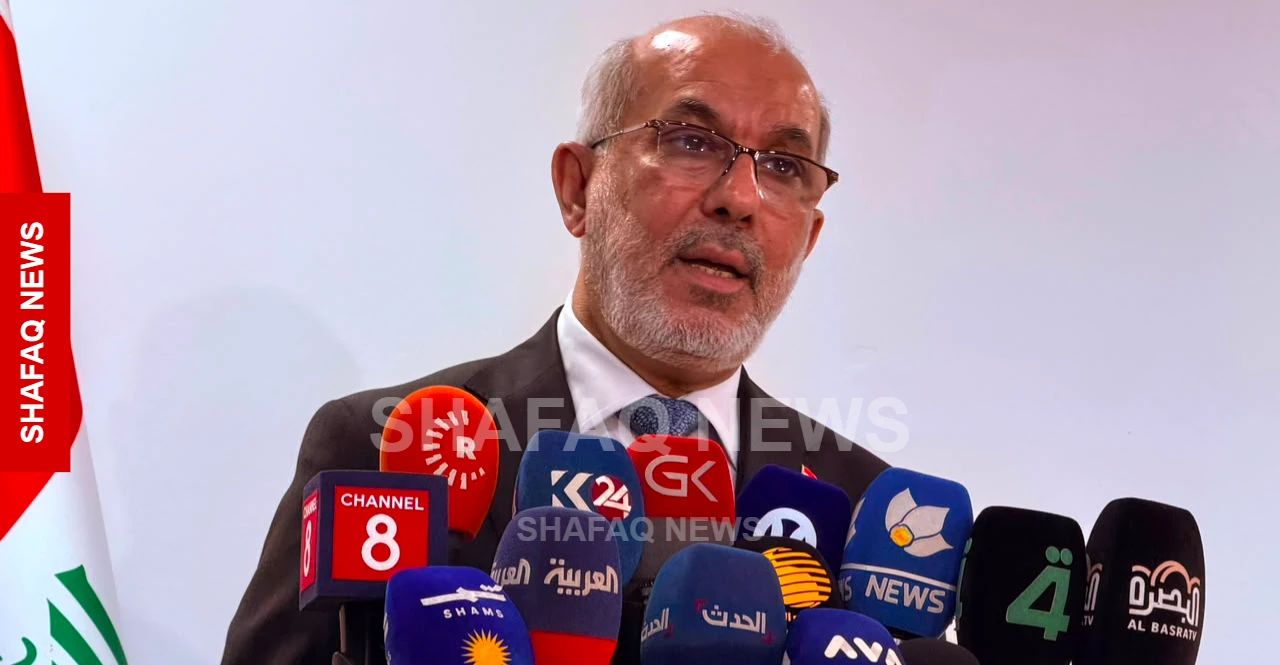
Iraqi Oil Minister Bassem Mohammed Khudair confirmed on Saturday that Iraq is currently producing 2.7 million barrels per day, while exports range between 1.5 and 1.7 million barrels per day, noting that there is a dialogue with Iran to allow the export of Iraqi oil, but it has not yet been implemented.
The Minister of Oil said in a press conference, which was followed by Shafaq News Agency, that “despite the challenges and problems related to the Strait, the Ministry was able to secure oil products for citizens,” indicating that “the Ministry seeks to develop the oil industry, increase production and exports, build infrastructure, as well as increase investments and attract international companies to invest in oil and gas in the best possible way.”
He added that “Iraq needs to build advanced infrastructure after the country has gone through fifty lean years of wars and terrorism,” stressing that “the government is proceeding with its program and is determined to ensure that Iraq assumes a leading position, which will positively impact the economic and living conditions.”
Khodair pointed out that “the ministry’s exploration teams are conducting surveys in a number of governorates with the aim of compensating for the depleted reserves.”
He explained that “the ministry is working on two parallel tracks in the gas file, the first is ending the issue of flared gas, and the second is investing in gas fields,” adding that “Iraq spends large sums of money on gas, and therefore we are working to invest in it, with 14 contracts referred to international companies for this purpose.”
Khodair continued, saying that “the ministry is also seeking to develop export infrastructure,” explaining that “the recent visit to the United States represents a new chapter of cooperation with global companies, and that the presence of American companies in Iraq reflects the attractiveness of the investment environment in the country.”
He pointed out that “international companies are capable of training Iraqi personnel and contributing to providing infrastructure, as well as attracting large numbers of workers,” adding that “the ministry signed memoranda of understanding and contracts that included seven clauses, including two contracts for developing contracts and investing in associated oil and gas, in addition to signing an addendum to the agreement on Qurna-2, the Nasiriyah project and the four blocks.”
He noted the signing of three memoranda of understanding with American companies, explaining that these memoranda would provide significant investment opportunities, and there is a step related to the export project through Aqaba.
Khodair explained that “Iraq used to export about 3.4 million barrels per day through the Strait of Hormuz before the war, but the export quantities through this outlet decreased after the war,” stressing the need to “find future solutions to diversify export outlets.”
According to the Iraqi minister, the Basra-Fishkhabur pipeline project will be built according to the Build-Operate-Transfer (BOT) system, with one of the companies undertaking its construction and operation according to the investment system, noting that oil production currently cannot reach the previous quantities, but after the end of the war, exports can be restored to what they were.
Regarding the oil agreement with Turkey, the minister said, “The agreement was renewed and included certain conditions, while Turkey suggested that it be limited to transporting oil and Iraq’s participation in some projects,” noting that “the planned quantity of 700,000 barrels cannot be provided through Kirkuk.”
Regarding the oil and gas file in the Kurdistan Region, Khudair confirmed that “there is a tripartite agreement between the federal government, the region and the oil companies, and it can be amended according to negotiation,” stressing that the ministry “does not differentiate between a citizen in Kurdistan and any citizen in another governorate.”
He concluded by saying that “the region’s file needs a lot of dialogue, with the importance of continuing negotiations to reach solutions that serve the national interest,” noting that “one of the goals of the Ministry of Oil is to find reservoirs in some countries, and there is dialogue and work underway on this file.”
shafaq.com
