Within 55 days… Will Iraq succeed in controlling weapons?
Within 55 days… Will Iraq succeed in controlling weapons?
2026-08-07
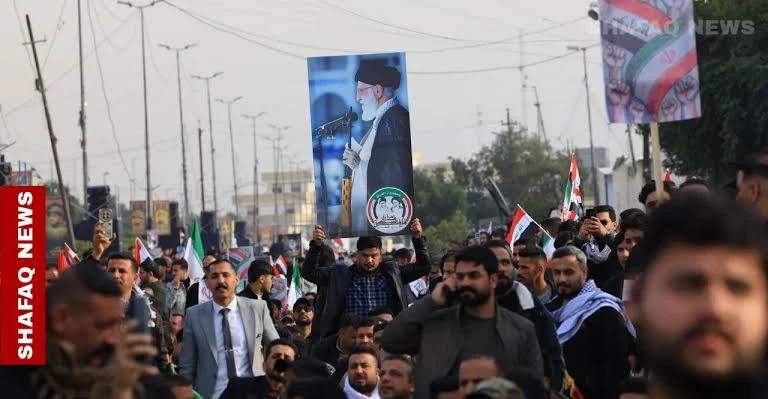 Shafaq News – Baghdad
Only 55 days remain until the deadline set by the “Coalition for State Administration,” which brings together the blocs and parties participating in the political process in Iraq from various components, to proceed with steps to restrict weapons to the state, while some armed factions still refuse to give up their military arsenal.
These factions assert that their weapons are linked to what they describe as “resistance” and regional threats, at a time when the government of Prime Minister Ali Faleh al-Zaidi is trying to manage one of the most difficult security and political issues in years.
These developments come amid escalating internal and regional tensions, after Iraqi security and military forces raised their readiness level on Thursday and cancelled the leave of a number of commanders and officers in anticipation of any emergency.
This came as the deadline given by armed factions to the government to take a position on the American and Saudi strikes that targeted sites belonging to the Popular Mobilization Forces on July 29th expired, and as the September 30th deadline set by the “Coalition for State Administration” to end any armed activity outside the framework of official institutions approached.
September entitlement
The “Coalition for State Administration” had confirmed in its last meeting last Wednesday, in the presence of President Zar Amidi, Prime Minister Ali al-Zaidi, Speaker of Parliament Hebat al-Halbousi, President of the Supreme Judicial Council Faiq Zaidan, and President of the Kurdistan Region Nechirvan Barzani, the necessity of restricting weapons to the hands of official institutions.
The coalition warned that any armed activity outside the framework of the state after September 30, 2026, will be dealt with according to the counter-terrorism law.
In this context, political analyst Ziad Al-Arar says that Al-Zaidi is “determined to control the management and movement of weapons in the country,” noting that the recent meeting of the “Coalition for State Management” represented new political support for the government on this issue.
Al-Arar adds, to Shafaq News Agency, that the presence of the three presidencies and the President of the Kurdistan Region reflects a shared conviction of the danger of the continued presence of weapons outside government control, especially in light of the difficult economic conditions that Iraq is going through.
He explains that the next stage will witness intensified consultations with the factions that refuse to hand over weapons, suggesting that understandings will be reached before the end of the deadline, and perhaps entering into a “transitional phase” to manage this complex issue instead of going to a direct confrontation.
Meanwhile, the Security Media Cell officially announced on Thursday evening, under the direction of the Commander-in-Chief of the Armed Forces, that it had raised the level of readiness and combat preparedness of the security and military forces, including troop movements and field exercises.
broad political cover
For his part, security expert Sarmad Al-Bayati believes that Al-Zaidi’s success in restricting weapons does not depend solely on the government’s decision, but is linked to a set of internal and external factors.
Al-Bayati tells Shafaq News Agency that the first factor is internal support, especially from the “Coalition for State Administration” and the Supreme Judicial Council, given that the case needs broad political and legal cover.
He points out that there is support from neighboring countries that seek to help Iraq control its security, considering that this support does not represent interference in internal affairs as much as it is related to regional concerns about the use of Iraqi territory in conflicts outside the borders.
Al-Bayati continues, saying that the classification of the factions is not uniform, explaining that “some factions do not reject the restriction of weapons absolutely, but they link the matter to the withdrawal of the international coalition.”
According to the security expert, the phase following the end of the coalition’s existence will be clearer in identifying the parties willing to fully engage within state institutions and the parties that will remain committed to their independent military structures.
Al-Bayati emphasizes that the government is required, in return, to provide protection and guarantees for these factions, saying that their members “remain Iraqis,” and that addressing the issue must take into account the security and social dimensions.
In this context, multiple political and governmental sources revealed the behind-the-scenes details of the turbulent hours that Baghdad experienced on Thursday night and Friday morning, which ended with an understanding between Prime Minister Ali Faleh al-Zubaidi and the leader of the Badr Organization, Hadi al-Amiri, which stipulated a mutual truce between the government and the armed factions, and opened the way for Iraqi diplomatic action to address the crisis with Saudi Arabia.
According to sources speaking to Shafaq News Agency, Al-Amiri held a dawn meeting with Al-Zaidi, at the height of the security alert witnessed in the capital and other governorates. During the meeting, they discussed the threats issued by armed factions to retaliate against Saudi Arabia, in response to the measures that the government was preparing to take against armed groups and parties accused of carrying out attacks outside the borders.
Linking weapons to withdrawal
For their part, the forces close to the armed factions believe that the issue cannot be separated from the presence of foreign forces in Iraq.
In this regard, political analyst Imad al-Musafir, who is close to the coordination framework, believes that the factions’ weapons, from their point of view, emerged as a result of the need to confront the American occupation of Iraq, and that the agreement on the withdrawal of American forces on September 30 represents a turning point in this matter.
Speaking to Shafaq News Agency, Al-Musafir added that there is a possibility of continuing the dialogue between the government and the factions to reach arrangements that ensure the ability of the Iraqi state to manage its internal affairs, while preserving the role of the forces that participated in confronting the “ISIS” organization.
He indicates that the government does not want to enter into a confrontation with the factions, and that the factions are not seeking to “cripple the government,” noting that the relationship between the two sides is complicated due to its political and social entanglement, and that the government realizes that these factions are part of the Iraqi fabric, and therefore the option of dialogue remains the most likely path.
Refusal to restrict weapons
The Secretary-General of Kataib Hezbollah, Abu Hussein al-Hamidawi, had announced the refusal to hand over weapons, stressing the trend towards developing and maximizing military capabilities, considering that regional developments and the recent American and Saudi strikes represent an additional reason to hold on to weapons.
Other factions, including the al-Nujaba Movement and the Sayyid al-Shuhada Brigades, also announced their refusal to relinquish their military capabilities, arguing that any discussion about weapons should be linked to the withdrawal of foreign forces and guarantees to protect Iraq from external attacks.
Meanwhile, some factions have announced their readiness to reorganize their relationship with the state, at a time when the government is talking about a gradual path based on integrating security decision-making within state institutions.
Despite the firm tone that accompanied the decision of the “Coalition for State Administration,” a source within the coordination framework believes that the September 30th date may not necessarily be an irreversible turning point.
The source told Shafaq News Agency that the framework may view the date as a “flexible ceiling open to negotiation,” explaining that the ability of the al-Zaidi government to proceed with the file does not depend solely on military or legal tools, but also on its ability to manage the balance between American pressures and factional reservations.
He adds that the United States possesses important economic and political leverage, while the factions have security and military influence on the ground, which makes any solution require broader understandings than just a government decision.
The source concludes that the success of the file requires a security and regional understanding that makes the withdrawal of American forces a tangible reality, otherwise the September 30 date may turn into a political declaration followed by an implicit extension or new arrangements.
shafaq.com
