With Iraq’s participation, the “Four Seas Initiative” was launched in Washington.
With Iraq’s participation, the “Four Seas Initiative” was launched in Washington.
2026-06-11
 Shafaq News – Washington
Mustafa Hashim
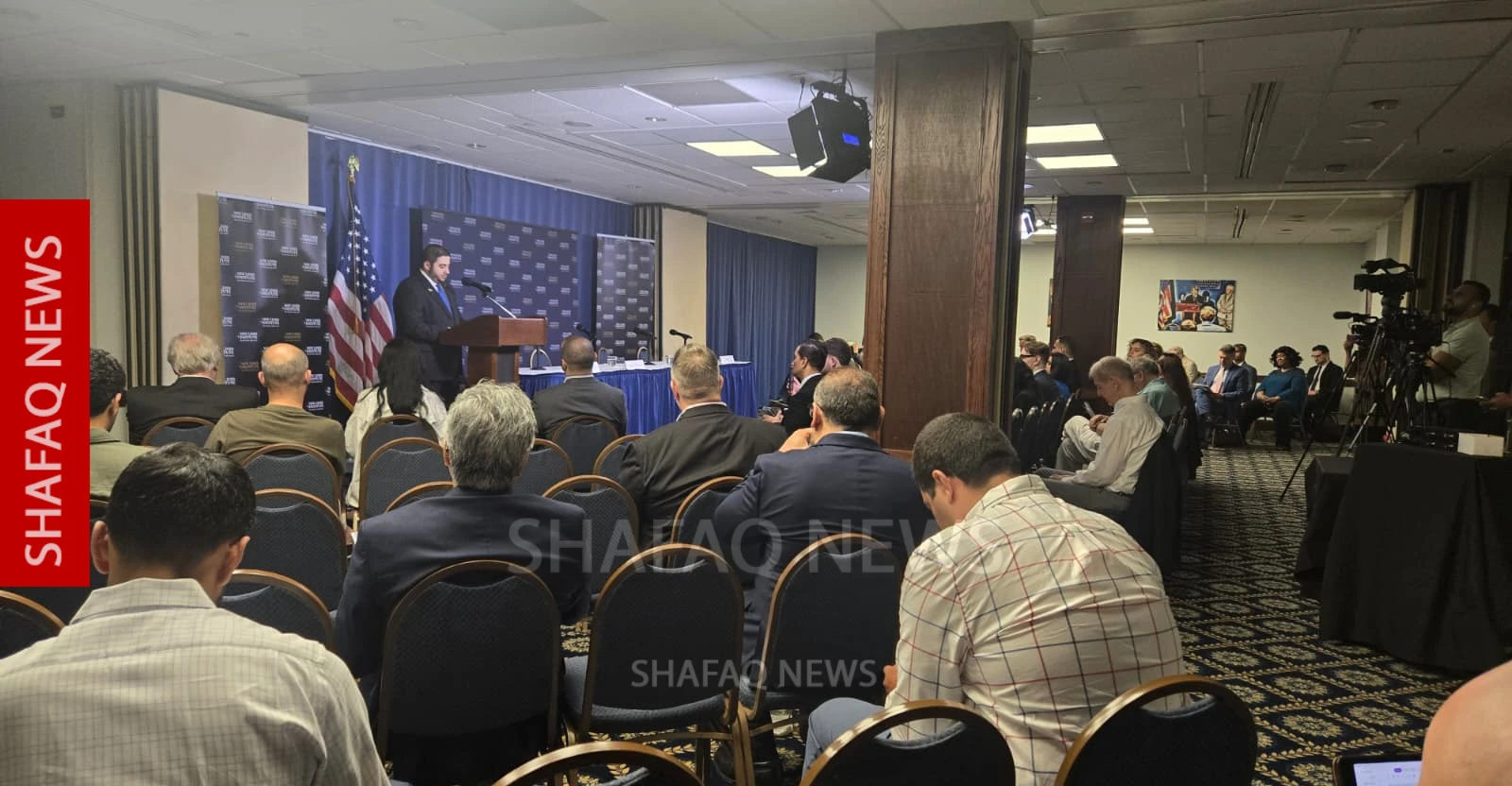
On Thursday, the National Press Club in Washington, D.C., witnessed the official launch of “The Four Seas Initiative,” a strategic transatlantic project that aims to connect the Arabian Gulf, the Caspian Sea, the Mediterranean Sea, and the Black Sea via a transit corridor and energy pipelines passing through Syria and Turkey.
The event, which was attended by Shafaq News Agency, was organized by the New Lines Institute for Strategy and Policy, and was attended by a high-level audience including officials, diplomatic representatives and advisors from countries involved in the project and concerned about the future of the region.
In-depth discussions
The launch of the initiative began with opening remarks by prominent figures, including Dr. Azeem Ibrahim, Head of Strategy at the New Lines Institute, and Themistoklis Astenides, Senior Advisor at the Institute, along with the participation of US Congressmen Jeanne Shaheen and Congressman Joe Wilson.
The opening ceremony also witnessed a notable diplomatic presence from the countries concerned, represented by a speech from the Iraqi ambassador to the United States, Nizar Khairallah, and the chargé d’affaires of the Syrian embassy in Washington, Muhammad Qantari.
The conference proceedings were divided into two main sessions:
The first session focused on “The Political Economy of the Four Seas Initiative,” and was moderated by Dr. Dania Arissi from the New Lines Institute, with the participation of experts from the Arab Gulf States Institute in Washington and the Middle East Institute.
The second session discussed the “political aspect of the initiative,” and was moderated by Dr. Sultan Al-Amer from the Middle East Policy Council. It featured extensive discussions on regional balances with the participation of representatives from the US-Syria Business Council, the Middle East Institute, and the Atlantic Council’s Türkiye Program.
The essence of the initiative
This initiative, inspired by the US-backed “Three Seas Initiative” in Europe, will extend over 6,300 kilometers, taking advantage of Syria’s salvageable pipeline network and existing Turkish infrastructure.
The initiative is based on four overlapping corridors that meet at the Syrian-Turkish border:
1. The Gulf-Mediterranean Corridor: Connecting Saudi Arabia, the UAE and Kuwait via Jordan and Syria to the Banias station, with the revival of the historic “Tapline” pipeline to accommodate about 1.5 to 2 million barrels per day, bypassing the Strait of Hormuz and the Suez Canal.
2. Iraq-Syria Corridor: Aims to rehabilitate and expand the Kirkuk-Banias pipeline, which has been closed for decades.
3. Caspian-Anatolian Corridor: To connect the Syrian infrastructure to the Trans-Anatolian Natural Gas Pipeline (TANAP) for the export of Azerbaijani and Turkmen gas to Europe.
4. Upgrading the Arab Gas Pipeline: At a cost of $1.2 billion, to rehabilitate the pipeline linking Egypt, Jordan, Syria and Lebanon, and to integrate Egyptian, Cypriot and Lebanese gas.
Strategic moment
According to official documents issued by the institute, three key developments made 2026 the ideal time to launch the project:
The new political reality in Damascus: Following the fall of Bashar al-Assad’s regime in December 2024, and the engagement of Ahmed al-Sharaa’s interim government with the West, the Gulf and Turkey, with the lifting of sanctions and the reconnection of the Syrian Central Bank to the global “SWIFT” system.
Pressures on waterways: With ongoing tensions in the Strait of Hormuz and Bab el-Mandeb, having a land-based alternative for energy transport has become a top strategic necessity.
Initial agreements concluded: Major energy deals have already been signed, including a $7 billion US-Qatari-Syrian-Turkish energy agreement in May 2025, a memorandum of understanding between Chevron and Qatar Energy, and the establishment of a $2 billion Saudi investment fund for Syria in February 2026.
feasibility
The project seeks to achieve common Western and regional strategic goals, most notably enhancing European energy sovereignty by reducing dependence on rival suppliers (such as Russia), ensuring commercial dominance for American companies in the liquefied natural gas market, as well as countering Chinese economic expansion and “Belt and Road” projects in the region.
From an investment perspective, the initial capital of the alliance is estimated at $8 to $10 billion, and total investments at approximately $25 to $30 billion over 10 years.
The initiative is expected to generate annual returns for Syria ranging from $8 billion to $12 billion by the early 2030s, providing a self-financing base for reconstruction without total dependence on international aid funds.
Project governance
The institute’s report proposes an organizational structure for the project that includes a “Four Seas Ministerial Forum” bringing together energy ministers from the countries concerned (Syria, Turkey, Iraq, Saudi Arabia, the UAE, Qatar, Jordan, Egypt, and Kuwait) along with the United States and the European Union.
In the long term, the initiative sets a future vision for expansion, transforming from the “Four Seas” to the “Five Seas Project” by 2042, to include the Red Sea waterway and link the ports of Aqaba, Jeddah, Aden, Djibouti, Port Sudan, and Suez, in a geographical area with 700 million people and a GDP exceeding $5 trillion.
The report concluded by emphasizing that “the Four Seas Initiative is not a charitable act towards Syria, but rather an intelligence and strategic move by the West to create an infrastructure that will determine energy security for the next half of the century.”
shafaq.com
