The Manama meeting sets a framework for regional Arab security.
The Manama meeting sets a framework for regional Arab security.
6-27-2026
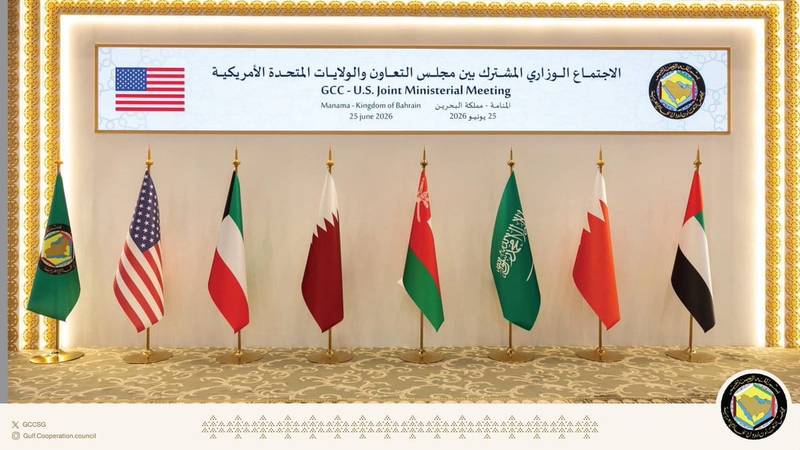 On June 25, 2026, the joint ministerial meeting of the Gulf Cooperation Council (GCC) countries with the US Secretary of State (Marco Rubio) was held in the Bahraini capital (Manama) to discuss political and security developments in the Arabian Gulf region. The importance of the consultative meeting is that it comes after the cessation of the US-Israeli-Iranian military confrontation and the signing of the memorandum of understanding between Washington and Tehran through Pakistani-Qatari mediation and Arab support for it at the Gulf, regional and Turkish levels, and support from China, one of the pillars of the UN Security Council.
The foundations adopted by the meeting can be identified in a precise transition process from the stage of following up on negotiations to the stage of seeking to influence the decisions and their political and executive dimensions related to the clauses of the memorandum of understanding.
The meeting served to reaffirm the strategic alliance and close relations, as well as the American commitment to maintaining and strengthening ties with the Gulf Cooperation Council (GCC) states. This was emphasized in the joint statement, which highlighted the strategic partnership and its evolution into shared political and security principles that define the features and prospects of the next phase. These principles include preventing Iran from acquiring nuclear weapons, countering its missile and drone programs, and halting support for militias and armed factions. This follows numerous operations that uncovered several Iranian spy networks linked to the Iranian Revolutionary Guard Corps (IRGC). These networks operated as intelligence cells in various Gulf cities, providing Tehran with precise information and crucial coordinates of military, security, economic, industrial, and civilian commercial sites. These sites were used to target Gulf Arab security during the US-Iranian-Israeli military confrontation that began on February 28, 2016.
The political and security statement issued at the conclusion of the Gulf-US Consultative Council meetings can be considered a fundamental and important basis for outlining the strategic partnership. It will help assess the outcomes of US-Iranian dialogues and negotiations and their potential to enhance regional security, political sovereignty, and the stability of the GCC states. The statement provided precise answers to legitimate Arab Gulf concerns. Regarding security arrangements for the future of a vital region concerned with international trade and global energy affairs,
the joint statement emphasized that any US understanding with Iran will not come at the expense of the Arab national security of the region’s states. This security is defined as being contingent upon the continuation of negotiations and Iran’s commitment to halting its nuclear activities, military and security programs, and its expansionist political influence. The statement also stressed the importance of ensuring safe navigation in the Strait of Hormuz and the security of the Arabian Sea as a shared political and security priority, not merely an economic issue. This is particularly crucial given Iran’s exploitation of the Strait as an economic tool, threatening global trade and energy security, and disrupting the movement of ships and tankers in maritime routes.
The Gulf Cooperation Council (GCC) states sought political guarantees, on-the-ground assurances, and the establishment of a firm foundation of principles and constants within a political and security framework. This framework would guide any future regional arrangements by strengthening maritime security, respecting the sovereignty of the states bordering the Arabian Gulf and the Strait of Hormuz, preventing Iran from acquiring nuclear weapons, halting its support for its proxies and armed and security networks, and providing full support to the political and security institutions of the region’s states, recognizing them as the primary guarantors of international and regional stability.
In light of political developments and realities on the ground, the US-Iranian agreement remains based on managing the danger and containing the crisis, not resolving it comprehensively and overcoming the differences, specifically regarding the ongoing activities in the Strait of Hormuz. The latest of these activities was the downing by US military forces of four Iranian drones that were directed on June 26, 2026, towards a number of naval vessels passing through the Strait of Hormuz. This was an Iranian attempt to demonstrate its capabilities, but the American response made it realize the seriousness of what it had done. The danger lies in Iran’s attempt to transform the Strait of Hormuz from an open international waterway into a continuous Iranian bargaining chip. This was also evident in the military and security objection by the leadership of the Iranian Revolutionary Guard to the Omani authorities’ announcement of opening two shipping lanes through the Strait of Hormuz. They considered it a departure from the Iranian approach of dominating the Strait of Hormuz and emphasized that “safe passage through the Strait of Hormuz is only through the lanes designated by Iran, and any new lane announced without coordination with it is unacceptable and poses a danger to public safety.”
The Iranian threat and the official position of the Revolutionary Guard came after the speech of US Secretary of State Marco Rubio, in which he clarified the limits of the agreement that could result from the memorandum of understanding with Iran, saying that there would be “no fees for navigation in the Strait of Hormuz, no American or international funds for Iran, and no fund for its reconstruction.” These were American political messages to allies and friends, which he wanted to deliver from Bahrain, one of the Gulf Cooperation Council countries. He emphasized that any agreement with Iran must take into account the security and protection of the sovereignty of countries allied with the United States, and that his country would not agree to any arrangements that would undermine their security or threaten their stability. These proposals come at a critical time, as there are still unresolved issues due to the ongoing disagreements over dismantling the Iranian nuclear program and navigation arrangements in the Strait of Hormuz. This has prompted the American administration to emphasize its commitment to the security of its strategic allies in the Middle East and the Arab world.
The US-Gulf political and security coordination depends on translating what was agreed upon in the ministerial consultative meeting with (Rubio Marco) into practical steps and maintaining political, economic and military pressure to ensure Iran’s commitment to any comprehensive agreement in parallel with the continuation of US-Iranian negotiations.
Iranian Studies Unit
rawabetcenter.com
