The Iraqi currency is a wall of memories for some and a “shameful” space for others
The Iraqi currency is a wall of memories for some and a “shameful” space for others
2026-09-25
 Shafaq News – Baghdad
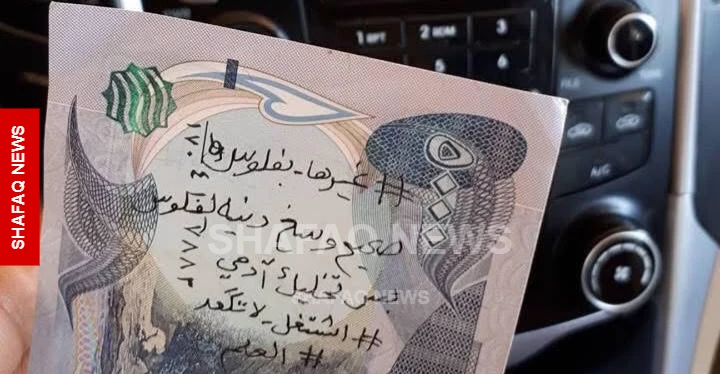
Zahraa Khaled bought some necessities from a grocery store, and when she finished, she took out a 25,000 dinar banknote to pay for the purchases, but she noticed that there were “indecent” phrases written on the banknote.
The girl refused to hand the paper to the grocer, and she also did not want to go to the exchange office to exchange it. She thought about going to a bank, but she realized that it might take time to wait, in addition to the transportation costs to the bank. Finally, she gave up and chose to destroy the paper and get rid of it.
For some time now, banknotes have become like a personal memory wall for some Iraqis, on which they write important dates in their lives or to express their emotions and sorrows, while others have made them a space for “indecent” phrases or a canvas for expressive drawings. This is with regard to the local currency. As for the dollar, it is “precious” and only a few dare to deface it with writings, but it has not escaped the stamps of exchange offices.
Birth of life
Citizen Haifa Ali told Shafaq News Agency: “I kept a 25,000 dinar banknote for two years because I wrote the birth date of my first child on it.”
She adds: “I didn’t carry this paper with my money out of pride, but I had to spend it one day because of need,” explaining that what prompted her to record her child’s birth date on a banknote was because “money is precious, and that’s why I wanted to keep this banknote, but need overcame my desire.”
It has become commonplace to see cryptic phrases, girls’ names, or mementos written on local currency. There are also phrases or drawings deemed “offensive,” and even phone numbers.
monetary value
Many questions revolve around the extent to which banknotes are affected by writing, and whether writing changes their identity, causes them to lose value, or prevents their circulation.
In this regard, Osama Al-Mushrifawi, owner of an exchange outlet and company, explains that the exchange rate varies depending on the banknote that has writing on it. Writing on the US dollar causes confusion for exchange companies, as many of these companies do not deal with dollar bills that have writing on them.
He points out that exchange offices and companies usually use their own seals to stamp the dollar, “and the high value of the dollar prevents it from being defaced with writings and drawings.”
He adds: “Generally, there is very little writing on the dollar compared to the local currency,” adding, “Also, company and exchange stamps are used in dealing with the fifty thousand Iraqi dinar note due to the prevalence of counterfeiting in this denomination.”
uncivilized phenomenon
Citizen Mu’ayyad Abdul Hamid believes that writing on banknotes is an uncivilized phenomenon.
He adds in an interview with Shafaq News Agency that “writing on banknotes harms others because it sometimes makes the currency unusable. As for me, I have banknotes from the 1960s with phrases and phone numbers written on them, and this indicates that this phenomenon is old in Iraqi society.”
For his part, economist Mustafa Hantoush told Shafaq News Agency that the phenomenon of writing on currency causes it to be consumed quickly, and this is not in line with monetary policy.
He adds that “the consumption of currency costs considerable sums, as some banknotes become unfit for circulation,” stressing that some banknotes bearing writings give the impression that this currency is counterfeit and needs to be examined. “The process of defacing currency is unacceptable and does not help in preserving the value of money, and the media must play an active role in stimulating awareness in preserving currency instead of defacing it.”
Legal consequences
With the spread of this phenomenon, questions are being raised about the legal position on these practices, and whether they affect the validity of the banknote for circulation, which is explained by legal expert Ali Al-Tamimi in an interview with Shafaq News Agency.
He says that Iraqi law differentiates between counterfeiting currency and defacing or writing on it, explaining that counterfeiting or imitating banknotes is a felony according to the Penal Code No. 111 of 1969, while the Central Bank of Iraq Law No. 56 of 2004 dealt with the penalties related to deliberately minting or possessing counterfeit currency.
Al-Tamimi explains that “writing, drawing, or placing seals on banknotes does not fall under the crime of counterfeiting, but it is considered a case of defacing or damaging the currency,” noting that the Central Bank has set controls to determine which banknotes are valid and which are not valid for circulation, including banknotes that contain writings or seals or have been damaged.
He adds that a banknote that contains writing or a stamp and does not significantly affect its external appearance may be classified as unfit for circulation, and its holder will be compensated according to regulations, provided that it is withdrawn from circulation and referred to the Central Bank for the purpose of destroying it.
Al-Tamimi points out that “responsibility varies according to the nature of the act. Just because a paper with writing on it reaches a person in daily transactions does not mean that he has committed a violation, while responsibility may arise when the currency is deliberately defaced or damaged to a large extent.”
shafaq.com
