Tehran responds to Trump by imposing tariffs on the Strait of Hormuz in Iranian rials.
Tehran responds to Trump by imposing tariffs on the Strait of Hormuz in Iranian rials.
2026-04-12
 Shafaq News – Tehran
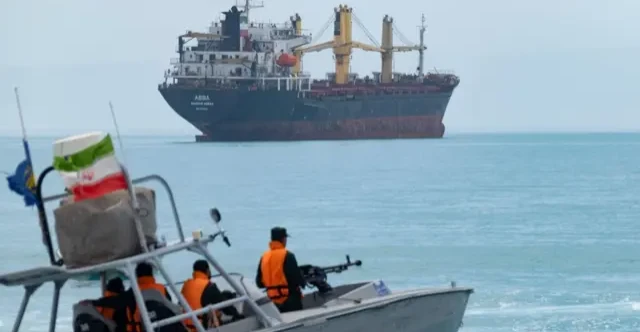
Iran has escalated its stance on the Strait of Hormuz, announcing on Sunday that it will continue to impose transit fees payable in Iranian rials, in response to previous threats by US President Donald Trump to reject any restrictions on navigation in the international waterway.
Iranian Deputy Parliament Speaker Hamid Reza Haji Babaei said in a statement today that “the fees for crossing the Strait of Hormuz must be paid in Iranian rials,” noting that Parliament has prepared a law on this matter, and that “250 MPs have endorsed the plan for the strait, through which 20% of the world’s oil and 35% of its gas pass, and which is entirely under our control.”
He stressed that “this strategic corridor is non-negotiable under any circumstances,” noting that “Iranian oil exports have exceeded 1.6 million barrels per day despite the sanctions,” and that “the country’s oil has become practically secure.”
He added that “American researchers warned Trump that Iran could turn into a superpower with a single spark,” considering that his country “stands alongside the four strongest powers in the world.”
In previous statements, US President Donald Trump vowed to “open the Strait of Hormuz very soon” and not allow Iran to impose transit fees, stressing that the strait is an “international waterway.”
Trump said the United States “will not allow” any restrictions on navigation, adding: “If it is not done quickly, we will be able to end it one way or another,” brandishing what he called the “trump card” and threatening a “naval blockade.”
These exchanges of statements come at a time when Iran is reportedly moving to regulate traffic through the Strait and allow a limited number of ships to pass through daily, while imposing fees that could reach $2 million per tanker, which threatens a new escalation in one of the most vital corridors for global energy supplies.
shafaq.com
