Sudanese: The budget deficit has affected all sectors of the state, and solutions will require time and patience.
Sudanese: The budget deficit has affected all sectors of the state, and solutions will require time and patience.
2025-12-25 02:50
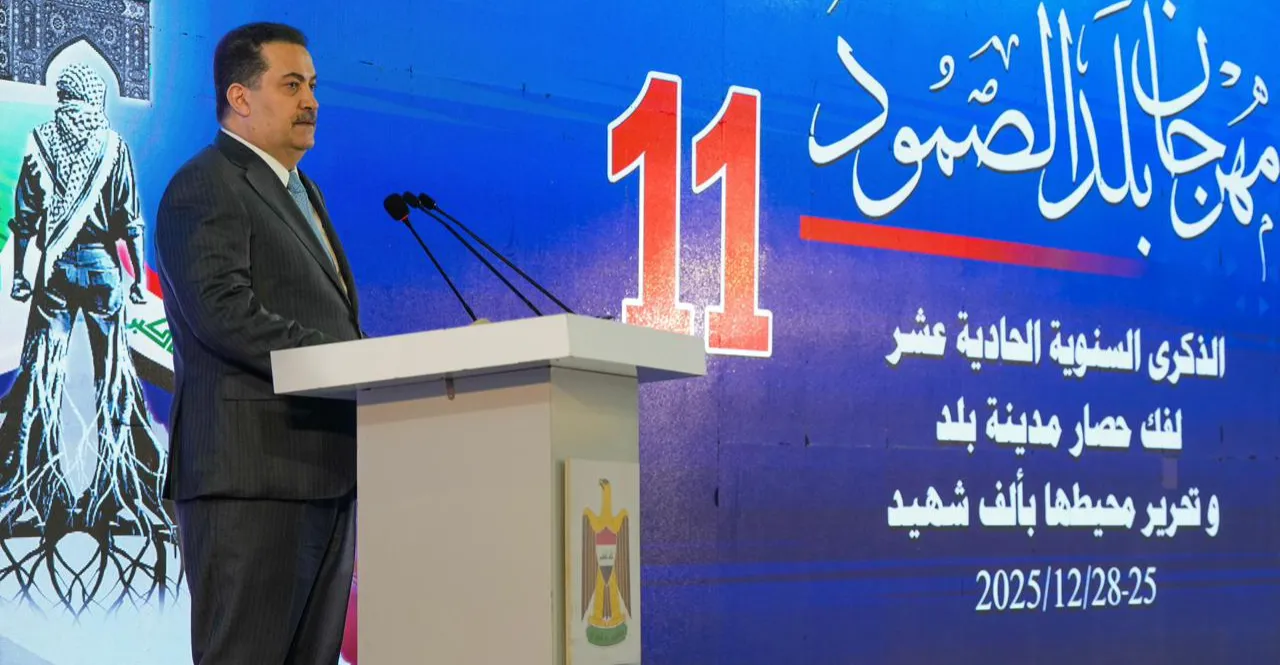 Shafaq News – Salah al-Din
Prime Minister Mohammed Shia al-Sudani stated on Thursday that the financial deficit incurred by the federal government is affecting all sectors of the Iraqi state, stressing that there are solutions to overcome this stage, but they require “time, patience, and understanding”.
This came in a speech he delivered during the opening, via video conference, of the “Martyr Fawzi Fakhri Al-Baldawi” water project in Balad district, Salah Al-Din Governorate.
In his speech, Al-Sudani said, “We face challenges, foremost among them the financial challenge. We hope that we will not have to reach the stage of stopping and delaying the pace of project implementation, but we need sound financial management that we direct towards important projects and within our priorities, and also according to the implementation rates.”
He added that “all companies and contractors in the private sector are supported and assisted by us,” adding, “but they also have to adapt to these circumstances because the financial deficit has affected all sectors of the state, but there are solutions, and these solutions need time, understanding, and patience in order for us to overcome this stage.”
On November 15, 2025, economist Manar Al-Obaidi warned that Iraq was facing a severe financial deficit that could exceed 15 trillion dinars by the end of 2025, as a result of increased public spending compared to limited non-oil revenues and the budget’s reliance on oil alone.
For its part, the Eco Iraq Observatory confirmed on September 6, 2025, that Iraq recorded a large financial deficit exceeding 7.5 trillion dinars during the first half of 2025, as a result of increased actual expenditures compared to limited revenues, with almost complete dependence on oil.
Ali Naji, a member of the observatory, indicated in a press statement received by Shafaq News Agency that the current price of oil ($68 per barrel) is not sufficient to achieve financial balance, as it needs $81.6, which reflects the limited options of the government to cover the deficit that is threatened with worsening in the future.
For his part, outgoing Prime Minister Mohammed Shia al-Sudani confirmed in a statement from his office, received by the agency on October 31, 2025, that Iraq is facing a financial deficit due to high government spending compared to limited revenues.
Al-Sudani pointed out that relying on oil as the sole source of income is unsustainable due to price volatility and regional events, explaining that the state’s spending in 2024 amounted to 150 trillion dinars out of a budget of 220 trillion dinars.
Accordingly, economist Manar Al-Obaidi, in his Facebook post seen by Shafaq News Agency, believes that the real solution requires a thorough review of public spending and uncovering waste in salaries, pensions, and social support, in order to avoid coercive measures that affect the poor and unemployed.
The Eco Iraq Observatory also stressed the need to reduce operational expenses not related to salaries and wages and to diversify revenue sources, in light of the rise in public spending, especially on wages and pensions.
shafaq.com
