Iraq bids farewell to UNAMI with a statement of “concerns”.
Iraq bids farewell to UNAMI with a statement of “concerns”.
2025-12-13 01:30
 Shafaq News – Baghdad
Iraq is preparing to bid farewell to the United Nations Assistance Mission for Iraq (UNAMI) after more than two decades of complex diplomatic and humanitarian work, in a development that is considered one of the most sensitive shifts in Iraq’s relationship with the international community since 2003.
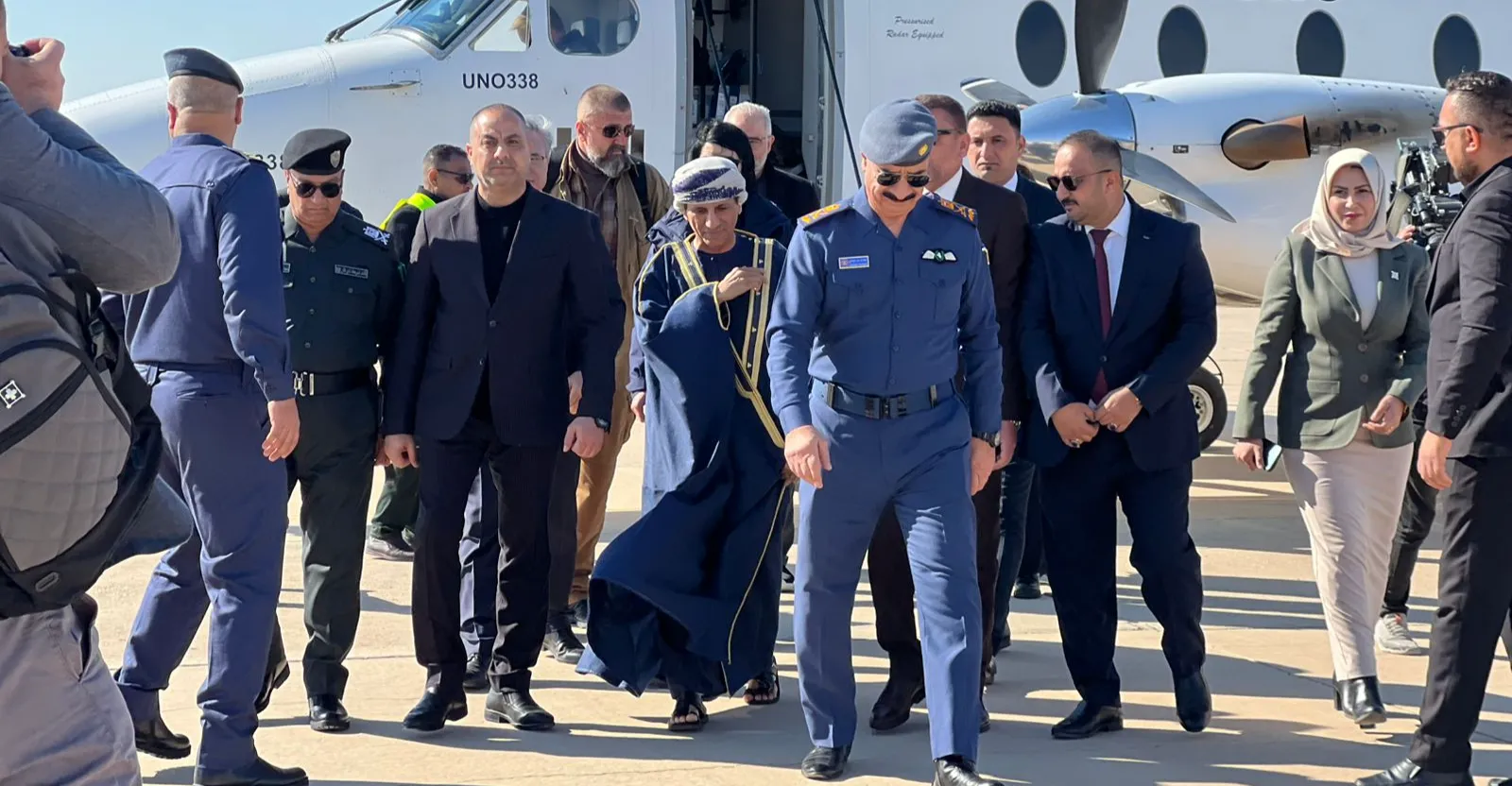
This comes as the Secretary-General of the United Nations, Antonio Guterres, arrives in the capital, Baghdad, to participate in the official ceremony announcing the end of the mandate of the United Nations Assistance Mission for Iraq (UNAMI).
As the Iraqi government moves towards ending the mission’s mandate at the end of 2025, concerns are mounting about a “humanitarian and political vacuum” that this step may leave behind, at a time when experts confirm that the decision was taken hastily and under pressure from the street more than based on an objective reading of reality.
The United Nations Assistance Mission for Iraq (UNAMI) is a special political mission established in 2003 by UN Security Council Resolution 1500, in response to a request from the Iraqi government.
In May 2024, the UN Security Council decided to extend the mandate of the mission that has been in the country since 2003, for a final period until December 31, 2025, at the request of the Iraqi government.
The outgoing Iraqi Prime Minister, Mohammed Shia al-Sudani, officially submitted a request on May 21, 2024, in a letter addressed to the Secretary-General of the United Nations, António Guterres, to terminate the mandate of the United Nations Assistance Mission for Iraq (UNAMI) permanently, effective December 31, 2025, with its efforts during the remaining time being limited to completing its work only in the files of economic reform, the provision of services, sustainable development, climate change, and other developmental aspects.
Negative humanitarian and political effects
The departure of the mission will leave a “wide humanitarian void,” according to experts in this field, as the Iraqi government does not have the ability to replace those programs or cover the needs that they used to meet, and there are no other parties capable of filling this gap at the present time.
Lawyer Mohammed Jumaa, who works for a United Nations organization, says that the Iraqi government’s decision to end the work of the United Nations mission was “hasty” and the result of popular pressure more than it was based on an objective reading of reality.
The United Nations mission, like all UN missions, is committed to leaving any country that officially requests it to end its mission. However, the Iraqi decision has clear negative aspects, especially since the mission was overseeing humanitarian programs serving thousands of beneficiaries from the most vulnerable groups in society, according to the lawyer’s statement to Shafaq News Agency.
On the political side, Jumaa believes that the mission’s impact was not substantial on the internal scene, but that ending its work will negatively affect Iraq’s international image and the assessment reports related to the commitments and the political and institutional environment in the country, noting that “the decision was taken in an ill-considered manner, under the influence of the general mood, without paying attention to its broad humanitarian consequences that will be borne by the most vulnerable groups.”
Since commencing its work, the mission has witnessed a significant expansion in its tasks, particularly after the issuance of Resolution 1770 in 2007, where UNAMI’s main mandate focuses on providing advice and support to the government and people of Iraq in several areas, most notably promoting inclusive political dialogue, supporting national and community reconciliation efforts, contributing to the electoral process, and facilitating regional dialogue between Iraq and neighboring countries.
The mission also plays a pivotal role in coordinating between government institutions and civil society organizations on the one hand, and UN agencies, programs and funds on the other, with the aim of organizing humanitarian and development efforts within Iraq.
Although UNAMI does not directly implement humanitarian and development programs, it works to highlight relevant challenges and connect Iraqi partners with available technical expertise within the United Nations system.
The mission is headed by the Special Representative of the Secretary-General of the United Nations in Iraq, assisted by two deputies, one of whom oversees political affairs and electoral assistance, while the other manages the United Nations’ humanitarian and development efforts, and also serves as the Resident Coordinator and Humanitarian Coordinator in Iraq.
At the beginning of this month, the Special Representative of the Secretary-General of the United Nations in Iraq, Mohammed Al-Hassan, said during his briefing to the Security Council on the situation in Iraq and before the end of UNAMI’s mandate, “This briefing comes before the end of UNAMI’s mission and is the last,” noting that “the end of the United Nations mission’s mission in Iraq does not mean the end of cooperation with it, but rather the beginning of a new chapter.”
Environmental and human rights files are at risk
The head of the Iraq Center for Human Rights, Ali al-Abadi, warns of the negative repercussions that may accompany the termination of the United Nations mission in Iraq, stressing that its departure will affect the ability of local institutions to deal with complex issues that require specialized international expertise.
Al-Abadi told Shafaq News Agency that the mission provided important technical support in the areas of pollution, the environment, human rights, and empowering regulatory institutions, adding that UN teams have international powers that cannot be easily replaced within national institutions.
There are many previous observations regarding the mission’s working mechanisms, including funding, the behavior of some staff members, in addition to what Al-Abadi described as “perceptions of bias” in dealing with some government files, which prompted a segment of civil society to criticize the mission’s performance in its later years.
According to the human rights advocate, the departure of the United Nations may, on the one hand, create a “positive space” for transparently disclosing the funding pathways and programs it managed, but on the other hand, it will leave a significant void in supporting independent organizations that were not allowed to operate freely enough during the mission’s presence.
Al-Abadi adds that one of the most prominent problems was the failure to clearly convey the Iraqi protest voice to the international community, stressing that many observations and human rights issues were not reflected in the required manner.
In conclusion, he points out that ending the mission’s work “will put Iraqi institutions to a real test” to compensate for the absence of international expertise and to continue working on humanitarian, environmental and oversight files, a large part of which was supervised by the United Nations.
On the humanitarian front, the United Nations Assistance Mission for Iraq (UNAMI) significantly strengthened its role during the war against ISIS, focusing its priorities on providing support and relief to millions of displaced people, coordinating the efforts of UN agencies in the areas of reconstruction, basic services and stabilization in liberated cities, and contributing to supporting health and education programs and drinking water projects, in close cooperation with Iraqi state institutions.
In the field of human rights, UNAMI has issued dozens of periodic reports that monitored prison conditions, enforced disappearances, cases of political assassination, and the targeting of minorities, in addition to documenting the violations committed by ISIS against the Yazidis. These reports have been adopted as primary references by international institutions and Iraqi legislative bodies.
Sharp criticism of the role of the United Nations
In addition, political researcher Nasser Draid, who resides in Canada, strongly criticized the United Nations for what he described as the “final stage” of its mission in Iraq, considering that the dispatch of the last UN envoy, Mohammed Al-Hassan, was not for the purpose of following up on the essential files, but rather to put the “final chapter” to end the mission of the international organization in the country.
In an interview with Shafaq News Agency, Duraid says that al-Hassan’s mission was not related to following up on human rights, women’s, detainees’, and freedom of expression files, nor to monitoring developments in the political system. Rather, it came to end the UN role “with the least possible losses” and to present a “softened testimony” that does not reflect the Iraqi reality, as he put it.
This approach is far removed from the efforts of the former UN representative, Jeanine Hennis-Plasschaert, who tried to communicate with Iraqi youth and convey their demands, according to Duraid, who continued, saying that “the latest report of the UN envoy does not reflect the extent of the violations and the ongoing decline in the internal situation, and that the continuation of this trend will be recorded in the future as a major failure of the United Nations because it saw what was happening and turned away from it.”
According to the Iraqi researcher, the state of silence and popular stagnation within Iraq encouraged the international community to ignore what is happening, indicating that the weak popular participation in the recent elections, and the lack of widespread protests, gave international powers “an additional justification” to reduce their interest in the Iraqi issue.
Duraid concludes his remarks by saying that “the end of UNAMI’s work is not a protocol event but a sad event akin to a funeral,” considering that “the mission did not just withdraw, but effectively ended as a result of three factors: the performance of the political authority, the abandonment by the international community, and the passivity of Iraqis towards what is happening.”
United Nations missions typically require the host country’s consent. Yesterday, the UN Security Council unanimously approved a request to extend the mandate of the UN mission in Iraq. The Council decided to extend the mission for a final 19-month period, ending on December 31, 2025, after which the mission will cease its operations entirely.
The mission was established in 2003 following the US and British invasion of Iraq. Its mandate, which was strengthened in 2007 and renewed annually, included providing support to the Iraqi government in several areas, most notably promoting inclusive political dialogue, national reconciliation, organizing elections, and reforming the security sector.
shafaq.com
