The Iraqi Prime Minister reveals the extent of the hopes pinned on the development road project
The Iraqi Prime Minister reveals the extent of the hopes pinned on the development road project
6-1-2024
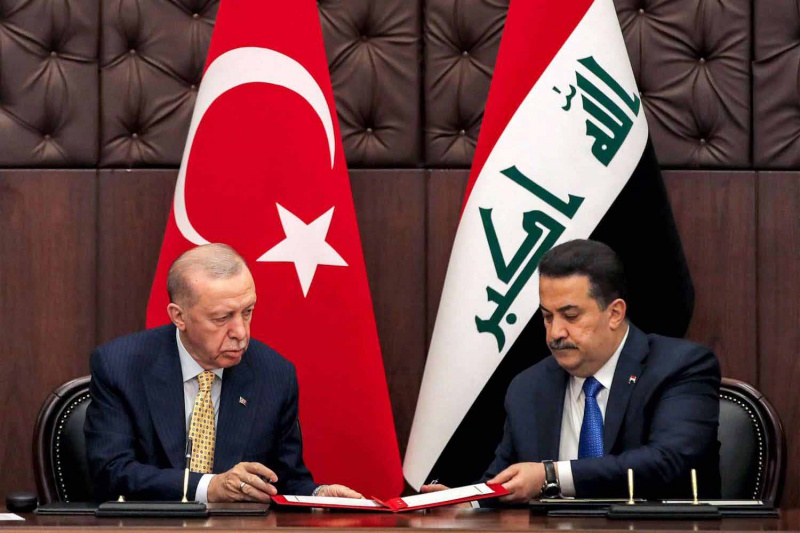 Statements by Iraqi Prime Minister Muhammad Shiaa Al-Sudani revealed the extent of the interest his government attaches to the development road project to be established in partnership between Iraq, Turkey, the UAE and Qatar.
It also explained the amount of hopes that Baghdad places on the project, which includes the construction of a land road and a railway extending from southern Iraq to Turkey, with a length of 1,200 kilometers within Iraqi territory, in breaking the stagnation in the development process in the country, diversifying its economic resources, and providing jobs for the increasing number of its young people entering the labor market. .
Al-Sudani said in an interview with the Turkish Anatolia Agency that the project means, according to current market equations and international trade movement, a link between the East and Europe via Iraqi and Turkish lands.
Turkish President Recep Tayyip Erdogan visited Iraq last April, where he and Sudanese sponsored the signing of his country, Iraq, Qatar and the UAE, a four-way memorandum of understanding for cooperation on the development road project.
The Prime Minister of Iraq spoke about the importance of the project, considering that it represents a restoration of Iraq’s role throughout the ages as a convenient and easy trade corridor.
The road will be the least expensive and fastest among the rest of the corridors, and regional and international trade is in urgent need of completion
He explained, “The region is witnessing conflicts and tensions that recede at times and escalate at other times, and this prompts us to focus efforts on projects that overlap in interests and overlap in benefits.”
Regarding Iraq’s expectations from the road project, Al-Sudani said that “it will provide an opportunity for the emergence of industrial cities on both sides of it that will complement the trade passing through it.”
He revealed his government’s intention to inaugurate the first berths at Al-Faw Port “to begin the flow of goods along the path of the development road initially.”
Al-Sudani continued, saying, “All indicators, economic readings, and feasibility studies say that this corridor is the least expensive and fastest among the rest of the corridors,” adding, “We do not say that it is an alternative, but rather regional and international trade is in real need of a development path, as it is a linking project and develops the overlap of interests.” And the reasons for economic sustainability.”
Following President Erdogan’s visit to Iraq, Turkish Minister of Transport and Infrastructure Abdulkadir Oraloglu said that with the operation of the development road, the volume of trade with Iraq will increase from 20 billion dollars to between 30 and 40 billion dollars.
Regarding the future volume of bilateral trade between Turkey and Iraq, Al-Sudani said, “The increase in the volume of bilateral trade with Turkey can be expanded vertically, but we are seeking horizontal expansion as well. In short, this is the role of the Development Road Project and the projects attached to it.”
He added, “Experiences and history have proven that the progress of a country alone and in isolation from its neighbourhood, is something that carries an unknown future despite all possibilities and conflicts. Therefore, we focus on increasing the capacity of exchange and actual partnership is the guarantee of stability and deep, long-term relations.”
He continued, “In our relationship with our Turkish brothers, we also focused on one of the most promising sectors in investment and cooperation, which is the agricultural sector, and soon we will witness practical steps in this aspect, and the participation of Turkish companies.”
Regarding investments in Iraqi gas fields, the Prime Minister of Iraq said, “Gas investment is a strategic test for Iraq, and our national wealth must be optimally employed in serving our people and development plans.”
He added, “It is not possible to continue burning gas, firstly due to the waste of this wealth that can be benefited from, and secondly due to the environmental impacts. We announced a special round of licenses to invest in gas fields.”
He continued, “We plan that Iraq will be self-sufficient in domestic gas production within three years, and Iraq is moving confidently to be an important element in the gas market within five years, and we will achieve self-sufficiency in this material at the expense of electricity production.”
Regarding potential partnerships in these investments, the Prime Minister of Iraq indicated that “the doors are open to every reputable and specialized company that wishes to participate in this sector, just as we welcome regional companies because they will expand the base of cooperation in other areas,” adding, “It is important to understand that investing in gas means… Providing additional resources for development in Iraq, which can be invested in various promising economic fields, and these fields will be open to the participation of Turkish companies and companies of other friendly countries.”
The Sudanese government intends to inaugurate the first berths at Al-Faw Port, to begin the flow of goods along the development road initially
Iraq’s current production of natural gas is about 2.7 billion cubic feet, and according to previous estimates, Iraq has a reserve of 132 trillion cubic feet of gas, of which 700 billion cubic feet were burned as a result of the weak ability to exploit it.
Regarding the flow of Iraqi oil, the Iraqi Prime Minister explained, “The cessation of pumping Iraqi oil extracted from the fields of the Iraqi Kurdistan region is undoubtedly a loss for Iraq, and at the very least it is the loss of an expected benefit that can support development plans in the provinces of the region and strengthen the Iraqi economy as a whole.”
He added, “We took the initiative to find acceptable settlements and legal solutions and solutions after a thorough legal study, but the matter is surrounded by a legal obligation, because the Federal General Budget Law requires calculating the cost of producing one barrel of oil in all fields to be within the national average of the cost of production, which is around $8 per barrel.” According to what was announced by the Federal Ministry of Oil.”
He continued, “But the Ministry of Natural Resources in the Kurdistan Regional Government, and within the contracts signed with the oil company operating there, the cost of production is calculated at around $26 per barrel, and we proposed that either the budget law be amended, or the agreements and contracts with these companies be amended.”
Al-Sudani explained, “From this standpoint, the companies stopped production, as the ban did not come from the federal government, and is waiting for a solution to be found. The companies refused to amend the contracts, while the regional government agreed,” stressing his saying, “For these reasons, the file requires more work to find a legal solution within the rights Iraq and its people come first in its wealth.”
Regarding the possibility of transporting Basra oil through Turkish ports, the Iraqi Prime Minister explained that “the matter is subject to study and determining the economic feasibility first of all.”
rawabetcenter.com
