Redeployment of forces and assignment of responsibilities: New security decisions regarding the cliff.
Redeployment of forces and assignment of responsibilities: New security decisions regarding the cliff.
2026-11-18
 Shafaq News – Baghdad
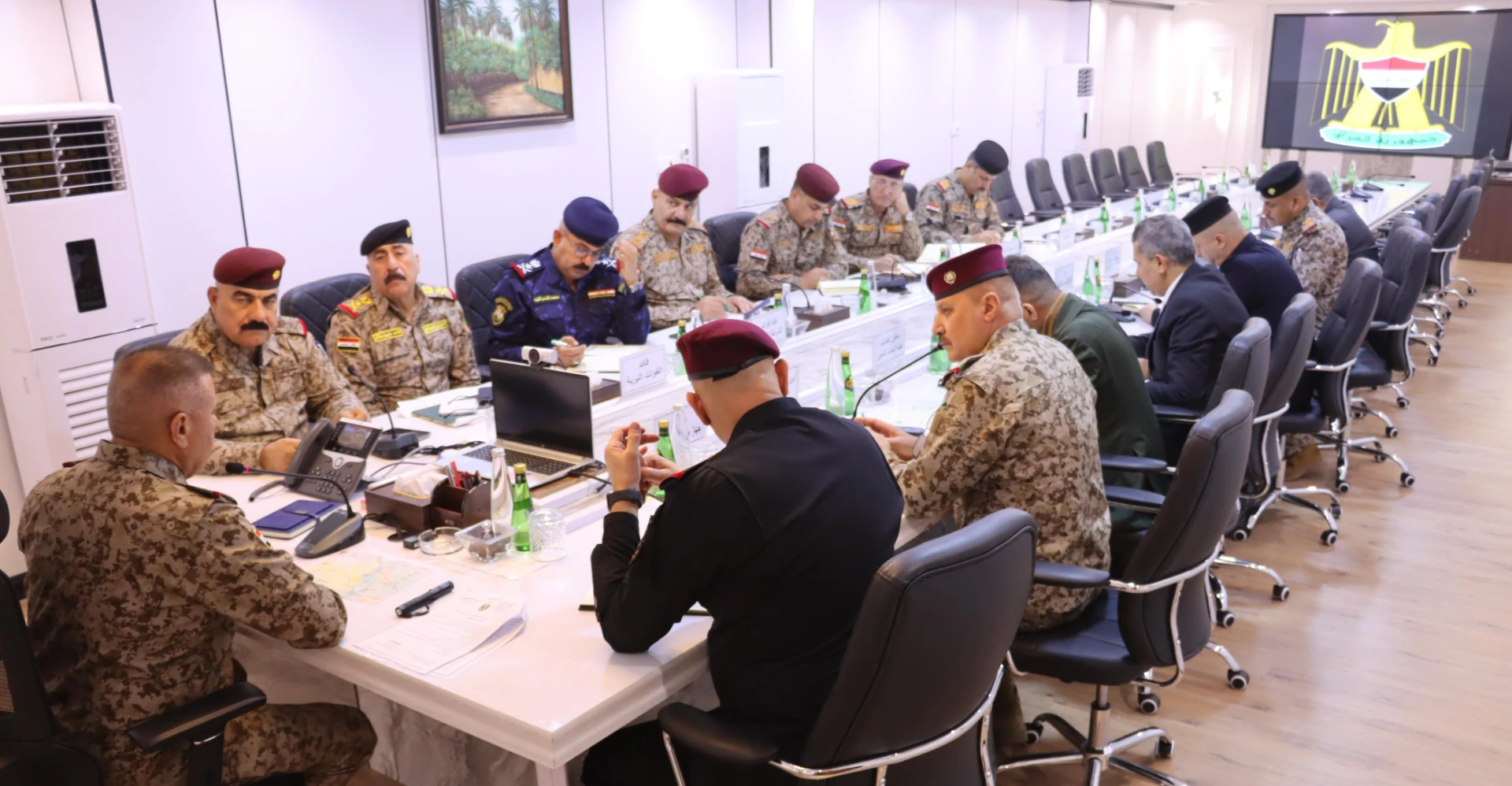
The office of the Commander-in-Chief of the Iraqi Armed Forces reported on Wednesday that a security meeting, chaired by the office director, Lieutenant General Abdul Amir al-Shammari, resulted in decisions and recommendations to enhance security and stability in the Jurf al-Sakhr (al-Nasr) district, north of Babylon, most notably a study on redeploying forces and distributing responsibility sectors.
The office said in a statement carried by the Security Media Cell and received by Shafaq News Agency that the meeting was held under the direction of the Commander-in-Chief of the Armed Forces, Ali al-Zaidi, and in the presence of the head of the Counter-Terrorism Service and leaders and officials in the Ministries of Defense and Interior and the Popular Mobilization Forces, as well as the operations commanders and the Federal Police.
He added that the two sides agreed to study proposals for redeployment, command and control arrangements, and the demarcation of boundaries between the areas of responsibility of adjacent security commands, in addition to protecting infrastructure targets.
The statement indicated that the recommendations included intensifying intelligence efforts and coordinating joint work between all security formations, with the aim of sustaining the security momentum in the northern Babil regions in general, and Jurf al-Nasr in particular.
The Jurf al-Sakhr (al-Nasr) area is witnessing security and political tensions against the backdrop of the government’s efforts to impose full security control over the area and end the presence of Hezbollah brigades there, following government investigations into suspicions of smuggling oil and its derivatives and the existence of oil refineries within the area.
Prime Minister Ali al-Zaidi had given Kataib Hezbollah a deadline of Friday evening, November 20, to hand over security responsibility for the district to government forces, while threatening military action if they did not comply. He also decided to dismiss nine security and administrative officials and refer those involved in the oil smuggling case to the judiciary, after receiving the results of the government investigation committee.
The past few days have witnessed political and security moves to contain the crisis, as the coordination framework meeting with al-Zaydi did not result in an agreement on the future control of the region, amid the Prime Minister’s adherence to his position and his refusal to extend the deadline, coinciding with the arrival of security reinforcements to the vicinity of the district.
In an attempt to reach a settlement, Iranian Quds Force commander Ismail Qaani, during his discussions with leaders within the coordination framework, proposed transferring brigades affiliated with Kataib Hezbollah from Jurf to the Iraqi-Syrian border and replacing them with three Popular Mobilization Forces brigades, while also involving the 3rd Federal Police Division in maintaining security. A tripartite committee, headed by Hadi al-Amiri and including Faleh al-Fayyad and Abdul Aziz al-Muhammadawi (Abu Fadak), was formed to convey the proposals to the Kataib Hezbollah.
But negotiations faltered, according to a political source who spoke to Shafaq News Agency on Wednesday, as a result of Kataib Hezbollah rejecting some proposals, and al-Zaidi rejecting other proposals, while the group confirmed its refusal to withdraw from the area, while announcing its unwillingness to engage in a confrontation with the security forces.
The origin of the Jurf al-Sakhr file, which was officially renamed Jurf al-Nasr after it was recaptured from ISIS in October 2014, goes back to security and political complications that prevented its residents from fully returning, despite more than 12 years having passed since its liberation.
The district is located north of Babylon, about 60 kilometers southwest of Baghdad, and is of strategic importance due to its geographical location and the roads that connect the capital with the central and southern provinces.
The issue of the return of the population remains one of the most prominent outstanding issues, as political and parliamentary estimates indicate that the number of displaced people from the region and neighboring areas has exceeded 100,000 people, while their return is linked to security and political obstacles, as well as mines, war remnants, damage to infrastructure, and the complexities of land and agricultural contracts.
shafaq.com
