The brigades from Jurf al-Sakhr: We will not fight the security forces, and the refineries are being used during crises.
The brigades from Jurf al-Sakhr: We will not fight the security forces, and the refineries are being used during crises.
2026-11-17
 Shafaq News – Babylon
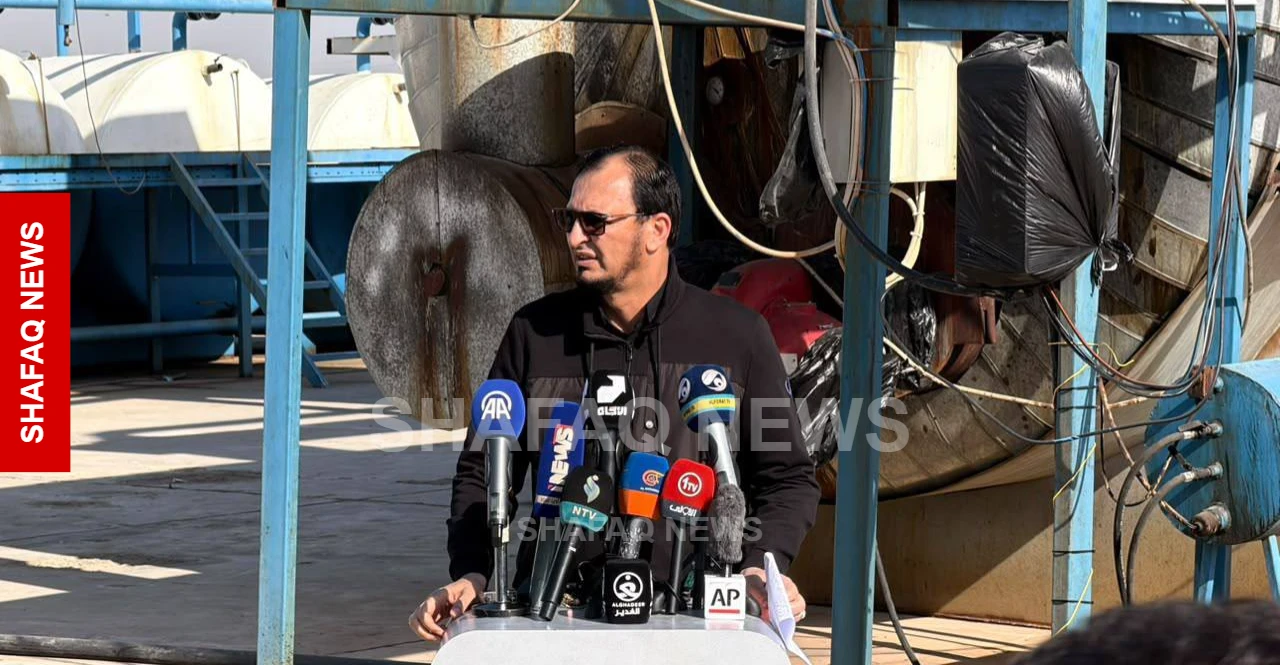
Abu Talib al-Saidi, a leader in the Kataib Hezbollah militia, confirmed on Tuesday that the militia does not intend to fight with the security services, describing the possibility of fighting with them as a “distant dream”.
Al-Saidi said during a press conference attended by a correspondent from Shafaq News Agency that the brigades did not participate in the political process in any position, noting that the government’s statements regarding the committee’s visit and the accompanying talk about oil refining sites represent a “provocation.”
He added that the committee of Iraqi Prime Minister Ali al-Zaidi falsified the facts, explaining that what it published regarding the oil refineries was nothing more than that they were “primitive” and abandoned refineries, used in times of crisis.
Al-Saidi explained that the facilities that the government spoke about are about five kilometers away from the three oil pipelines, stressing that all areas of Jurf al-Nasr were open to the committee, and that it did not face any restrictions on its movement.
He continued, saying that the work of these factories is to extract the substance “kerosene” from the crude oil that reaches them during times of crisis, noting that the brigades buy crude oil and convert it into kerosene for use in operating electric generators and heavy machinery.
Al-Saidi concluded by saying that “this issue has a political dimension.”
A security source reported last Friday that directives had been issued to place the military units under the command of the Commander-in-Chief on alert “C”, which is the highest level of military mobilization that requires raising the readiness of the forces to the highest degree of preparedness and canceling leaves.
The Iraqi government also announced last Sunday that it had decided to send official security forces into the Jurf al-Sakhr (al-Nasr) area in the coming period, confirming what Shafaq News Agency had published regarding the government’s intention to impose control over the area.
According to the agency’s sources, the moves came as part of government efforts to reassert full control over the region and hand over its security responsibility to official forces, after attempts to reach an understanding regarding the withdrawal of armed factions from it faltered.
An informed source revealed to Shafaq News Agency that Al-Zaydi informed the leaders of the framework that he insisted on complete control of the district and refused to extend the deadline that ends next Friday evening, stressing the readiness of the forces to carry out the military operation if the government demands are not met.
According to the source, the meeting witnessed verbal clashes between al-Zaydi and the leader of the Badr Organization, Hadi al-Amiri, against the backdrop of warnings that the use of force could lead to security disturbances in more than one Iraqi city, before the Prime Minister left the meeting without reaching any understandings.
The dispute between the government and Kataib Hezbollah escalated following official investigations into suspicions of smuggling oil and its derivatives from Jurf al-Sakhr, north of Babil Governorate, prompting al-Zaydi to issue directives to impose state authority on the area, while the brigades deny their involvement in smuggling operations.
shafaq.com
